





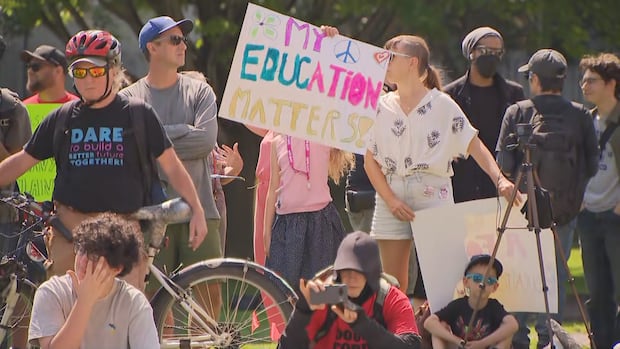
Multiple teachers’ unions are stuck in a deadlock with the Ontario government over contract negotiations, which may delay discussions and push possible strike actions deep into the school year.
According to Martha Hradowy, president of the Ontario Secondary School Teachers’ Federation (OSSTF), education workers’ contracts are due to expire Monday night.
This year’s negotiations have hit a snag because unions like the OSSTF and the Elementary Teachers’ Federation of Ontario (ETFO) have been unable to reach an agreement with the province on what issues should be negotiated at a central level versus a local one.
David Mastin, president of the ETFO, mentioned that the province is weakening local bargaining efforts by attempting to centralize all topics that teachers’ unions want to negotiate.
“For the last four rounds [of talks], we’ve had a pretty stable pattern of what is local and what is central. This particular round the government decided to really object to what has traditionally been local,” said Mastin.
The province follows a two-tiered bargaining system that outlines how school boards and education unions negotiate contracts. Typically, during contract talks, teachers’ unions, school boards, and the province agree on which issues will be handled at either central or local levels.
Central bargaining usually covers significant topics such as benefits and salaries, while local bargaining deals with matters specific to each school board, according to information from the Toronto District School Board’s website.
The current standstill means that Ontario’s labour relations board will now step in. It will need to set up a hearing date to determine which items will be negotiated at each tier-central versus local-which could take “weeks, if not months,” Hradowy noted.
In an emailed statement Monday, Emma Testani, spokesperson for the education minister’s office, stated that the ministry is “at all times” ready to continue discussions on local versus central issues “before proceeding to the next stage of negotiations.”
WATCH | Rallies held Saturday in support of Ontario education workers: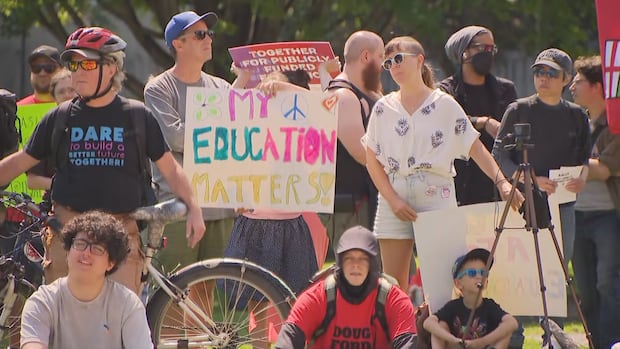 Rallies in support of education workers take place around Ontario
Rallies supporting Ontario’s education workers were organized throughout the province on Saturday. The demonstrations come just as students prepare for their return to school while workers’ collective agreements are about to run out. CBC’s Mercedes Gaztambide spoke with participants about where they believe assistance is most needed.
Rallies in support of education workers take place around Ontario
Rallies supporting Ontario’s education workers were organized throughout the province on Saturday. The demonstrations come just as students prepare for their return to school while workers’ collective agreements are about to run out. CBC’s Mercedes Gaztambide spoke with participants about where they believe assistance is most needed.
Source link
Rallies in support of education workers take place around Ontario
Rallies supporting Ontario’s education workers were organized throughout the province on Saturday. The demonstrations come just as students prepare for their return to school while workers’ collective agreements are about to run out. CBC’s Mercedes Gaztambide spoke with participants about where they believe assistance is most needed.
What does this mean for back to school?
Since negotiations are currently stalled, back-to-school season will continue as “business as usual,” according to Chantal Mancini, an adjunct assistant professor in labour studies at Mc Master University. “There can’t be job action until there’s actual bargaining,” she said. Mancini explained that changes made in bargaining started in the late 90s when then-premier Mike Harris centralized education funding at the provincial level. Before this shift, funding came from local taxes for school boards. This change meant that while “school boards and unions could have conversations,” any funds required for their discussions had also needed approval from the government,” she noted. In 2014, Ontario’s Liberal government formalized this change through legislation detailing how employee contracts would be negotiated among school boards, education unions, and provincial authorities according to Mancini. The law clarified how both tiers of negotiation worked but also “slowed down the process,” she added. “The concern is that clearly if it’s taking this long maybe they need re-examine this legislation,” said Mancini. “In one way, the legislation works for them because it allows cost control for government; however it’s clear it’s not fulfilling its purpose regarding timely labor negotiations.”Source link