




It’s widely expected that Prime Minister Mark Carney will finally reveal on Monday whether Germany or South Korea will be responsible for building Canada’s new fleet of submarines.
The Liberal government has been remarkably quiet and secretive about the upcoming announcement in Halifax.
Carney indicated at the end of May that a decision regarding the replacement of the Royal Canadian Navy’s aging Victoria-Class submarines would be made by early summer.
The prime minister is set to travel to Ankara, Turkey, for the NATO summit, where Secretary General Mark Rutte has emphasized that allies need not only a plan to meet defense spending goals but also military capabilities.
Insiders from both the defense and diplomatic circles, as well as from within the defense industry, say Carney intends to stop in Halifax en route to the summit to announce whether Thyssen Krupp Marine Systems (TKMS) from Germany or Hanwha Ocean from South Korea will be chosen as the preferred bidder.
It’s been nearly a year since Carney mentioned that there were two contenders left in the submarine bidding process: the German-designed Type 212CD and South Korea’s KSS-III.
Bidders and their governments were given until spring to provide detailed proposals along with commitments for economic offsets – plans that could lead to billions in investments in Canada’s economy.
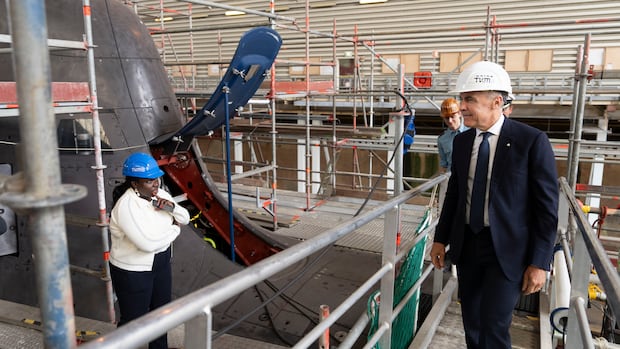
![]() From left, National Defence Minister David Mc Guinty, South Korean President Lee Jae Myung, Prime Minister Mark Carney and Hanwha Group vice-chair Kim Dong Kwan speak after touring a submarine at the Hanwha Ocean shipyard in Geoje Island, South Korea, on Oct. 30, 2025. (Adrian Wyld/The Canadian Press)
From left, National Defence Minister David Mc Guinty, South Korean President Lee Jae Myung, Prime Minister Mark Carney and Hanwha Group vice-chair Kim Dong Kwan speak after touring a submarine at the Hanwha Ocean shipyard in Geoje Island, South Korea, on Oct. 30, 2025. (Adrian Wyld/The Canadian Press)
![]() HMCS Windsor , oneof Canada ’ s Victoria-classlong-range patrolsubmarines , returns toporton June20 ,2018.(Andrew Vaughan/The Canadian Press)
Stephen Saideman , whoholds The Paterson Chairin International Affairsat Carleton Universityin Ottawa , notedthere’sconsiderablepressure”togetsubsfast”due totheconditionofthecurrentfleet.
Onlyoneinfour Victoria-classsubmarinessuitableforoperationscurrentlyexists.
“I thinkwe alreadyhavearealcrisisinoursubforceofnotbeingabletoactuallyhaveasubmarineoutinthewaterforanylengthoftime,” Saideman remarked.”Weonlyhaveone, yetwehavethreeoceans.”
Saidemanexpresseduncertaintyaboutwhether Canadawould ultimately proceedwithbuying12vessels, butgivenpotential U. S. removalsfrom NATO crisisplanning, thedecision carriesweight.
HMCS Windsor , oneof Canada ’ s Victoria-classlong-range patrolsubmarines , returns toporton June20 ,2018.(Andrew Vaughan/The Canadian Press)
Stephen Saideman , whoholds The Paterson Chairin International Affairsat Carleton Universityin Ottawa , notedthere’sconsiderablepressure”togetsubsfast”due totheconditionofthecurrentfleet.
Onlyoneinfour Victoria-classsubmarinessuitableforoperationscurrentlyexists.
“I thinkwe alreadyhavearealcrisisinoursubforceofnotbeingabletoactuallyhaveasubmarineoutinthewaterforanylengthoftime,” Saideman remarked.”Weonlyhaveone, yetwehavethreeoceans.”
Saidemanexpresseduncertaintyaboutwhether Canadawould ultimately proceedwithbuying12vessels, butgivenpotential U. S. removalsfrom NATO crisisplanning, thedecision carriesweight.
Source link
Germany, South Korea competing
The navy aims to acquire 12 submarines. The purchase cost might reach $24 billion, but when maintenance and support over their lifespan are considered, estimates suggest it could exceed $100 billion over thirty years. The joint German-Norwegian proposal emphasizes infrastructure development, energy projects, and advanced defense manufacturing. These projects include revamping the Port of Churchill Manitoba; partnering on building a dedicated space launch facility in Canada; and developing advanced weapons manufacturing capabilities such as a heavy torpedo factory and hypersonic missile testing facilities. This bid forecasts an impact of $86 billion on Canada’s gross domestic product. The South Korean proposal includes investments in green infrastructure and plans for manufacturing hydrogen-powered trucks alongside establishing hydrogen refueling stations across Canada. They also aim to produce armored vehicles using Canadian steel – a move supported by the Automotive Parts Manufacturers’ Association. There are commitments included for boosting domestic weapons production too. The total impact of this South Korean bid is anticipated to be around $94 billion. Speaking at an arms expo in Ottawa at the end of May, Carney stated that both submarine options fulfill naval requirements and that his choice would depend on both economic benefits offered and long-term geostrategic partnerships resulting from whichever deal is struck.Pressure ‘to get subs fast’
The Germans and Norwegians have emphasized their status as NATO allies alongside Canada heavily during discussions. In an interview with a few weeks back, German Defence Minister Boris Pistorius remarked that when combined with Norway’s fleet and potentially Canada’s submarines they create strategic importance for NATO forces overall. “If we come to that decision of the Canadian government, we talk about at the end about a fleet of up to 24 submarines of the same type,” Pistorius said. “This is really an advantage, really a benefit, for NATO and for all ofthe allies to be ableto operate with 24ofthesame typeofsubmarines.” He also mentioned it’s likely Germanand Norwegian vessels could assistin Arctic operations if necessary during crises. The South Koreans view sealinga dealwith Canadaasa benchmarkfor gauging how seriousthe federalgovernmentisaboutenhancingengagementandinvestmentintheregionofthe Indo-Pacific. They’ve takena slightly different approachby emphasizing historical alliances; Canada was partofthe United Nationsforcesduringthe Korean Warinthe1950s. Inan interviewwith atthestartoflastyear’sbidding, theformerministerofdefenceacquisitionfor South Korea Seok Jong-guncharacterizeditasa meansforhiscountrytorepayadebt. “By sharing our capabilities that we own, I’m surethatwewillworkcloselywith Canadaatcontributingtostabilityandpeaceinternationally,” theminister said.”Andbydoingso, Ithink Koreawillbeabletopay someofthedebthatwehaveandalsoexpressourgratitudeandappreciationtothe Canadianpeople.” The South Koreansarecommittingto deliveringfourboatsby2035. The Germansclaimtheycanprovide four submarinesby2036.Source link