




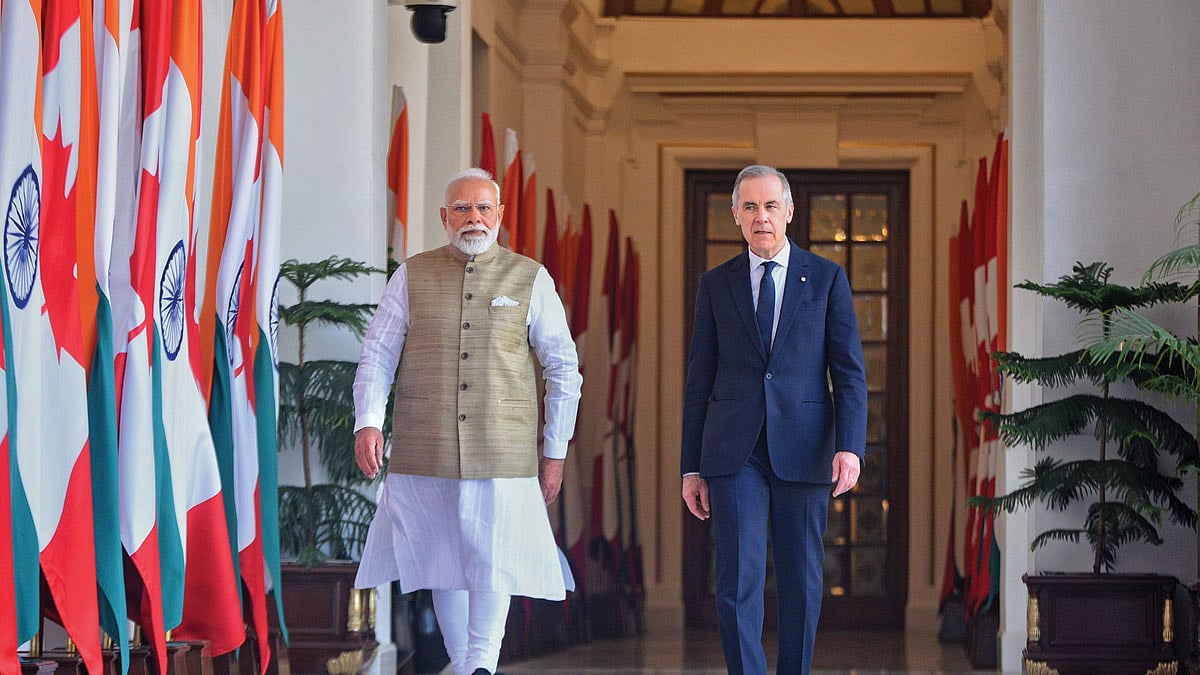
If you’ve been watching Canada’s internal politics and its ties with India, there’s a noticeable shift happening in Ottawa. This shift is becoming clearer in the relationship between India and Canada. In the past year, Prime Minister Narendra Modi and Mark Carney have met four times, and these discussions haven’t just been about making nice statements for India. There’s real engagement happening around trade, diplomacy, and mending political relations that had taken a downturn under former Prime Minister Justin Trudeau. Canada is also taking steps that could help resolve issues more fundamentally. For instance, there’s a crackdown on asylum seekers from India to Canada, mainly from Punjab. This was not only a source of irritation for India but also fuel for Khalistani propaganda claiming that Sikhs were being “victimized” in Punjab.
Canada’s understanding of India’s concerns started to change towards the end of the Trudeau administration. The first clear sign came during the initial meeting between Modi and Carney at Kananaskis in June last year alongside the G7 summit. At that time, Carney stated that the two leaders “reaffirmed the importance of Canada-India ties, based upon mutual respect, the rule of law, and a commitment to the principle of sovereignty and territorial integrity.” They agreed to appoint new high commissioners to restore regular services for citizens and businesses in both nations. This statement reflected both a desire for progress and an acknowledgment of past issues, especially regarding respect for sovereignty which aligns with Indian concerns. The mention of “rule of law” harkened back to Trudeau’s era when he often criticized India over claims regarding violations linked to Hardeep Singh Nijjar-a Khalistani terrorist killed in Surrey, British Columbia.
Trudeau’s approach involved making routine statements on National Day that were often vague enough to almost absolve those responsible for terrorism: Khalistani activists originating from Punjab. In 2024, during his last statement on this occasion, he mentioned that Iran’s Islamic Revolutionary Guard Corps (IRGC) was designated as a terrorist organization in Canada. The last time any suspected terrorist plot tied to an Islamic group happened in Canada was back in 2013; meanwhile, no Sikh extremist organizations were banned under Trudeau despite him portraying Sikh extremism as merely an expression of freedom cherished within Canadian values.
The situation deteriorated further when Indian diplomats faced open threats from Khalistani terrorists while Trudeau’s government showed little concern. Allegations concerning Indian involvement in terrorism on Canadian soil were made without substantiation even after multiple requests from India for evidence. In fact, there was no reliable proof linking Nijjar’s murder to Indian agents presented in court or shown by Canadian intelligence agencies to Indian officials in New Delhi. Nevertheless, Trudeau continued making unfounded accusations against India resulting in both countries recalling their high commissioners.
All this is now behind us. The previous one-sided narrative surrounding “the rule-of-law” has quietly shifted toward a more balanced “joint” commitment-though it’s mostly mentioned briefly now; current priorities focus on finalizing the Comprehensive Economic Partnership Agreement (CEPA) by November this year which aims to enhance bilateral trade amidst growing tensions with the U. S.
In light of these changes it’s interesting to observe applications coming from India-many stemming from Punjab-for refuge status here in Canada. Data from Canada’s Immigration and Refugee Board covering 2022 through March 2026 reveals some telling trends. A direct comparison between total applications filed in 2022 (3,237) versus those expected by 2026 (3,299) might seem misleading since complete figures won’t be available until next year; however some patterns are very clear. The number of claims abandoned has surged dramatically-from 261 claims left unprocessed back in 2022 up to an astonishing 3,914 by 2025-indicating applicants are beginning to recognize their chances entering Canada through these channels may likely lead nowhere productive. Notably , during peak campaigning against India by Trudeau , there were recorded figures showing as many as 32 ,563 refugee applications referred specifically from India-this marked highest activity across this five-year span.
This spike makes little logical sense considering Punjab isn’t facing ongoing insurgency anymore where individuals could make dubious claims about victimization driving them toward seeking refuge abroad. Terrorism effectively ceased functioning within Punjab since mid-1990s-the surge reported refers primarily during periods when certain political climates allowed narratives painting unfavorable portraits leading individuals presenting themselves needing asylum based solely upon questionable grounds rather than factual realities existing today throughout regions including most states across entire nation ; thus indicating underlying motives at play here. Thankfully though recent evidence suggests positive downward trajectory appearing within such exploitative practices employing refuges used more strategically against Indians has begun leveling off visibly over course past twelve months.
Source link
Source link