




The Ontario government is putting over $2.5 million into significant upgrades at Thunder Bay Pulp and Paper, along with two other initiatives in the area.
This funding comes from the province’s Forest Biomass Program, which aims “to protect Ontario forestry workers in the face of recent U. S. tariff attacks by building a more resilient, innovative and diversified forest sector, ready to compete in global markets.”
The other two projects will boost the use of mill by-products and underutilized wood, referred to as forest biomass.
This announcement arrives during uncertain times for the region’s forestry sector:
asked Kevin Holland, Ontario’s associate minister of forestry and forest products, about how the province is aiding workers impacted by these shut-down operations.
“We’re disappointed in the companies’ decisions to idle those mills at this time, and the conversations we had with the operators were strictly market-driven,” said Holland, who also serves as MPP for Thunder Bay-Atikokan. “We also know that those mills, sawmills are easy to start back up once conditions and markets change.”
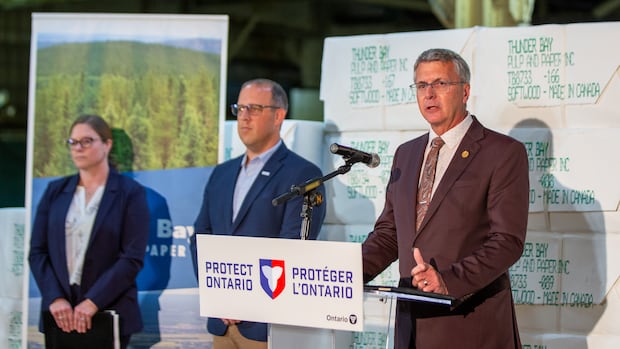
The Ontario government says the Forest Biomass Program is part its plan “to protect Ontario forestry workers in the face of recent U. S. tariff attacks by building a more resilient, innovative and diversified forest sector, ready to compete in global markets.” From left: Ashley Markle, Kevin Holland, Norm Bush and Travis Rob. (Marc Doucette/CBC)
The new investment from the province would allow the sector to take advantage when market conditions improve, according to Holland.
The provincial funding announced at Thunder Bay Pulp and Paper Thursday afternoon will be allocated as follows:
Thunder Bay Pulp and Paper is getting $2.4 million for planning boiler and chemical plant upgrades. AUX Energy is receiving $92,500 for developing plans for a biomass-powered generator project aimed at increasing energy security in Fort Frances. Weyerhaeuser will get $32,650 for studying production line improvements that aim to lower costs while enhancing efficiency and product quality in Kenora.Norm Bush, chief executive officer of Thunder Bay Pulp and Paper, mentions that their mill is well-positioned compared to industry peers across Canada and North America due to its close customer relationships. (Sarah Law/CBC)
The upgrades at Thunder Bay Pulp and Paper are expected to enhance competitiveness while raising daily kraft production by 11 percent, according to provincial statements. The kraft process refers to how wood gets transformed into pulp.
“This productivity will create a market for over 130,000 tonnes of forest biomass each year which will strengthen forestry supply chains by increasing demand for harvesting, hauling and trucking throughout the region,” states a release from the Ontario government.
“The upgrades will contribute toward boosting production capacity within the forest sector while protecting over 700 direct jobs along with more than 3,350 indirect jobs.”
Norm Bush expressed that this funding would support evaluations needed for three major projects at their mill requiring significant capital input.
“Those funding decisions are very difficult during these times so having assistance from Ontario helps us reach that critical decision point,” Bush noted.
Facing tariffs amid shifting market needs
U. S. tariffs on most softwood lumber imported from Canada hit 45 percent in October 2025. At that time frame, the U. S also imposed an additional 25 percent duties on imports like upholstered furniture along with kitchen cabinets and vanities.
A new set of U. S tariffs affecting various categories including paper products took effect on Tuesday impacting Canadian goods.
Piles of western red cedar lumber can be seen at a sawmill located in Vancouver B. C., captured in this August 2024 file photo. (Ben Nelms/CBC)
Regarding Thunder Bay Pulp and Paper specifically, Bush commented they’re well-equipped compared to other industry players across Canadaand North America during these challenging times.
<p“There's plenty of fibre available; we have ample power; plus we're fortunate enough being closeby most customers,” he said.“We're not reliant on exporting our materials overseas.”
In other parts ofthe region, Fort Frances has spent years exploring ways tomake upfor diversifying after its mill closure backin2014.
“We’ve been seriously considering biomass since our mill closed years ago – looking intohow we can harness itto attractnew industries, new jobs, and development opportunities withinour community,” stated Travis Rob, the town’s managerof infrastructureand growth.
“There’s still active forestry work goingon here. It didn’t vanishalongwiththe mill,” he added.
“Whether it’s wastefrom themills or wastefrom bush operations, the resourcesare outthere – these mills just needtomean something worthwhile.” p>
Source link