





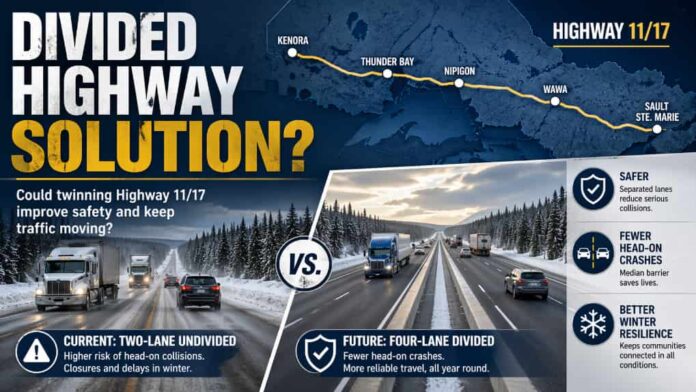
Thunder Bay – NEWS – This past winter, it often felt like regional highways were shutting down more than usual. Each closure effectively splits Canada in two. While Ontario has made attempts to tackle some issues, the underlying problem is that Canada needs a divided highway running from coast to coast.
A divided highway would directly address the biggest safety flaw on Highway 11 and Highway 17: oncoming traffic separated only by paint.
On a two-lane road, drifting across the center line can lead to a head-on crash. One jackknifed truck can block the entire roadway. One serious accident can shut down the only east-west route for hours. A divided highway significantly reduces those risks.
The safety statistics are compelling. The U. S. Federal Highway Administration reports that median barriers greatly lower cross-median accidents, showing a 97 percent reduction in such incidents where they are installed on rural four-lane highways.
A crash-modification study found that changing a two-lane road into a four-lane divided road resulted in about a 31 percent decrease in overall crashes.
Another U. S. transportation study indicated that converting typical two-lane roads into four-lane divided roads achieved crash reductions of between 40 to 60 percent per kilometer.
But having a divided highway adds resilience. It gives emergency responders more options and reduces the likelihood that one mistake turns into a fatal head-on collision or complete corridor blockage.
Source link
Benefits of a Divided Highway
A four-lane divided Highway 11/17 would provide five key advantages. First, it would lower head-on collisions by physically separating traffic going east and west. Second, it would lessen dangerous overtaking since drivers wouldn’t have to enter oncoming lanes to pass trucks, snowplows, or slower vehicles. Third, it would enhance incident management. If one side of the highway is blocked, police and MTO could use the other lane or planned detours to keep some flow going. Fourth, it would improve snow-removal operations as plows could work in separate lanes with less chance of conflicts with oncoming traffic and better staging areas. Fifth, it would strengthen Canada’s supply chain. Highway 11/17 isn’t just another northern road; it’s the main all-Canadian east-west link between Eastern and Western Canada.What It Won’t Solve Alone
A divided highway won’t completely eliminate winter closures. <p Whiteouts, freezing rain, snow squalls, multi-vehicle accidents involving transports, vehicle fires, hazardous-material spills, and police investigations can still close off these roads. <p Manitoba, Saskatchewan and Alberta also shut down their divided highways during severe weather.But having a divided highway adds resilience. It gives emergency responders more options and reduces the likelihood that one mistake turns into a fatal head-on collision or complete corridor blockage.
The Reasons for Delays in Implementation
<p The main obstacles are cost, terrain challenges and distance involved. <p Northern Ontario isn't flat like prairies. The Highway 11/17 stretch has rock cuts, lakes rivers wetlands rail crossings steep grades bridges protected areas and long segments with limited access for construction nearby. Twinning sections between Thunder Bay and Kenora or Thunder Bay and Sault Ste. Marie will be a multi-decade project costing billions of dollars. <p That’s why Ontario is also exploring the 2+1 highway concept north of North Bay. A 2+1 road features three lanes with a center passing lane alternating directions every few kilometers along with median barriers frequently included. The province's pilot program on Highway 11 in Nipissing District is currently under design and environmental review. <p The Northern Policy Institute argues that these types of roads can deliver good safety benefits at lower costs compared to full twinning especially on less-trafficked northern routes. Its analysis suggests incorporating median barriers into any proposed 2+1 roads throughout Northern Ontario as well.The Optimal Approach: Both Models Together
For Highway 11/17 , an effective solution should be implemented gradually. Utilize full four – lane divided highways where traffic counts , history of crashes , along with national corridor significance warrant first priority. This includes areas stretching from Thunder Bay towards Shabaqua , Kenora through Manitoba border , plus particularly hazardous segments prone to closures near Nipigon , Schreiber , Marathon , Wawa , Batchawana Bay along major slopes. Ontario already has plans underway regarding constructing new sections aimed at expanding existing stretches westward beyond Thunder Bay heading toward Shabaqua while advancing Trans – Canada twinning efforts connecting Manitoba border alongside Kenora bypass region too. Implementing temporary measures like using sectioned-off portions featuring barriers over lengthy rural distances where total twinning won’t happen soon enough allows us still curb unsafe overtakes reducing potential dangers while allowing regular passing spots available regularly too! In essence : establishing these interim standards via adopting model standards based upon careful consideration combining both approaches makes sense moving forward strategically ! Full twin projects ought remain ultimate objective within context surrounding national corridors moving ahead!The Policy Recommendations
Both levels – provincial government working hand-in-hand federal counterparts should treat this critical stretch Route including Hwy ‘s Eleven Seventeen linked nationally not merely regarded local infrastructure supporting northern regions solely ! A feasible action plan entails :- A collaborative funding initiative focusing entirely aimed solely around developing twinned infrastructure along Hwy ’s Eleven Seventeen!
- Pursue immediate expansion focused prioritizing highest-risk zones needing attention promptly!
- Create mixed barrier-enhanced designs featuring safe passing opportunities accounted lesser-trafficked routes awaiting future investments!
- Additional facilities dedicated primarily toward truck rest locations along route inspections stations staging facilities addressing severe weather conditions !
- Cultivate improvements related maintenance practices ensuring reliable real-time updates communicated widely shared signboards tracking current situations experienced motorists faced daily journeys navigating safely through vast expanses travelling here regardless seasons’ fury faced routinely !
- Accelerate response times managing incidents swiftly employing heavy-duty towing services stationed strategically throughout corridor aiding stranded travelers successfully getting back enroute quickly again post-crisis moments encountered unexpectedly each time faced challenging circumstances arise suddenly impacting overall flow capabilities occurring daily cycles governing user experiences shaped naturally ensued thereafter consistently afterward whenever possible always prioritized first ideally seeking balance achievable results eventually met finally afterwards adequately maintained thereafter consistently improved iteratively over time until success realized thoroughly enjoyed feeling relieved knowing something tangible done together jointly assisting greatly throughout ordeal endured actively pursued diligently addressed concerns raised continuously forever forward henceforth now onward steadily improving progress achieved sustainably throughout journey traveled together collaboratively forging ahead strength gained collectively leveraging partnerships fostered diligently shared widely cherished among citizens served faithfully serving all communities everywhere seen benefiting massively seeing outcomes desired reached realized soon enough coming true ultimately satisfying experience enjoyed collectively once again !!
Source link