





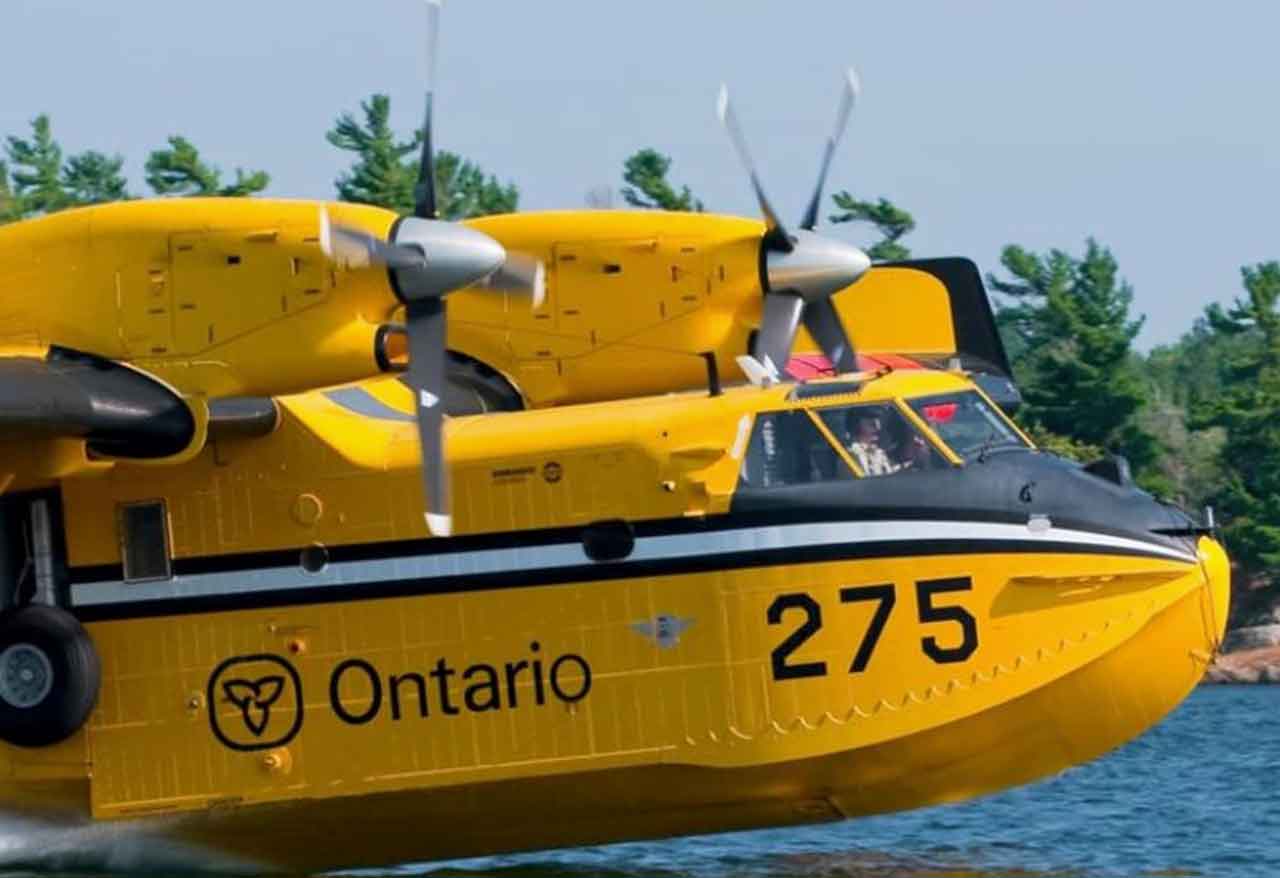
THUNDER BAY – As of Saturday, Aug. 8, there were no new wildland fires reported in Northwestern Ontario. However, the area is still dealing with a heavy wildfire situation, with 109 active fires burning throughout the Northwest Region.
According to Aviation, Forest Fire and Emergency Services, by 6 p. m. CDT, 13 of those fires were considered out of control. Six were being held back, six were under control, and 84 were under observation.
The primary focus for firefighting efforts remains on the Rinker Lake Complex, which includes Thunder Bay 36 and two significant fires near Dryden. Evacuation orders and alerts are still in effect for several fires in the region.
Rinker Lake Complex is a Key Focus for Firefighters
The Rinker Lake Complex consists of Thunder Bay 36 (THU036), Dryden 34 (DRY034), and Dryden 35 (DRY035).
A total of twenty-five wildland firefighting crews from Ontario, Alberta, and Nova Scotia are working on this complex along with two teams from Mexico consisting of 20 people each.
The operation also includes heavy equipment operators, pilots, overhead staff from Ontario and Quebec, an incident management team, and 17 helicopters.
Fire crews are patrolling fire lines to put out hot spots while reinforcing hose lines and setting up equipment to protect valuable resources as well as building helipads for better access to affected areas.
Heavy machinery continues to create fire guards around parts of the THU036 and DRY035 perimeters. Helicopters are conducting water drops where necessary.
On early Saturday morning, part of THU036 was scanned using infrared technology which helped identify more hot spots that need suppression efforts.
Monitoring and maintenance of values-protection systems is ongoing.
The three fires remain out of control:
THU036 is estimated at 301,240 hectares. DRY034 is estimated at 45,800 hectares. DRY035 is estimated at 31,510 hectares.
The sheer size of THU036 poses a serious threat to local communities along with transportation routes and resource activities across Thunder Bay and nearby areas in Northwestern Ontario.
Atikokan-area Fires Exhibit Low Fire Activity
Firefighting teams are also actively working on the Atikokan Cluster which includes Fort Frances 13 (FOR013), Fort Frances 14 (FOR014), and Fort Frances 15 (FOR015).
Eight helicopters have been assigned to assist with this cluster.
Officials reported low fire activity across all three fires on Saturday.
On the northern side of FOR014 where water sources are scarce, Fire Ranger crews patrol the perimeter using helicopter buckets to extinguish hot spots about 100 feet inward from the edge of the fire.
Crews are also searching for hot spots along the north and northeast sides of FOR015 with helicopter support in what has been described as difficult terrain by officials.
A wildland firefighting engine equipped with a 4,000-litre water tank is currently operating in the Cushing Lake area.
The three fires remain not under control:
FOR013 is estimated at 25,279 hectares. FOR014 is estimated at 51,768 hectares. FOR015 is estimated at 42,273 hectares.
Evacuation Orders And Alerts Still In Effect
Several evacuation orders and alerts continue related to various fires within the Northwest Region.
Ontario has listed evacuation measures linked to Dryden 36; Thunder Bay numbers 36;54;56; Dryden numbers34;35; and Fort Frances14.
An expanded evacuation alert, has also been associated with Fort Frances14 , while alerts remain connected to Fort Frances15and38.
Residents living in affected areas should keep following guidance from their First Nation or local authorities including emergency management officials.
Conditions regarding evacuations can shift rapidly based on factors like fire activity or weather changes such as wind or smoke conditions.
Airspace Restrictions Enforced Around Major Fires
A Notice To Airmen , Or Notam , Is Still In Effect Around Thunder Bay36.
A Separate Notam Also Applies To Fort Frances14 , Northeast Of Byers Lake.
These Restrictions Are Additional To The Standard Limits Established Under Section60115 Of The Canadian Aviation Regulations.
According To Those Rules , Airspace Surrounding An Active Forest Fire Is Restricted To Firefighting Aircraft Within Five Nautical Miles Of The Fire And Up To3000Feet Above Ground Level.
These Measures Aim To Protect Fighting Aircraft And Crews Operating In Areas Where Helicopters And Other Suppression Aircraft May Be Flying At Lower Altitudes.
Pilots Should Check NAV CANADA Flight Planning Information For Current NOTAMs Before Entering Near Wildfire Areas.
Restricted Fire Zone Remains In Effect
A Restricted Fire Zone Continues Across The Northwest Region Along With A Small Portion Of Northeast Region.<P CLASS= ”IS SELECTED END” > This Restriction Was Implemented By Ministry Of Natural Resources On July15 Due To High-To-Extreme Risk Associated With Fires , Increased Activity , And Overall Number Which Already Requires Resources For Suppression. This Measure Also Aims At Minimizing Risks From Additional Human-Caused Fires While Resources Are Heavily Engaged. For Residents Living In Northwestern Ontario , Campers , Anglers , Hunters , Forestry Workers,And Backcountry Travelers,This Means That Preventive Measures Regarding Fires Remain Crucial.
<h3. class= “ISSSELECTED END”>Why The Wildfire Situation Matters Across Northwestern Ontario
Having Over100Active Fires Impacts Much More Than Just Each Individual Area. Large Fires Can Disrupt Access Via Highways Or Forest Roads Along With Remote Aviation Activities Such As Forestry Operations 、 Mining Exploration、Tourism,And Supply Routes Serving First Nations Or Other Remote Communities. Smoke May Even Travel Hundreds Of Kilometres Away From Active Fires So Places Far Removed From Flames Could Also Experience Changes In Air Quality. Deployment Crews From Multiple Provinces Including Mexico Highlights Scale Of Current Response. Mutual Aid Agreements Plus International Support Have Become Essential During Severe Canadian Wildfire Seasons When Many Areas Experience Intense Activity Simultaneously. For Thunder Bay Continued Growth As Well As Suppression Efforts Around THU036Hold Particular Significance Given It’s Currently Largest Among Highlighted Fires In Saturday’s Provincial Update.
Fire Danger Can Change Throughout Day< P CLASS=”IS SELECTED END”>Ontario's Fire Danger Rating Derives From Data Collected Through Over130Weather Stations Across Province's Various Regions.
This Rating Can Shift During Day Depending On Temperature、Humidity、Wind Conditions等. Residents Travelers Should Consult Interactive Map Plus Local Emergency Information Before Heading Into Remote Or Affected Areas.
Anyone Noticing AWildfire North Of French Mattawa Rivers Must Call310-FIRE(3473). Reports Regarding Fires Located South French Mattawa Rivers Should Be Directed To911.
Provincial Wildfire Situation Remains Fluid With Changing Sizes、Control Statuses、Evacuation Measures Access Restrictions While Conditions Develop
” Source link “.