



The Ontario government has announced it will stop funding for at least three drug consumption sites that receive provincial support, including two located in Toronto. This decision has raised concerns among advocates.
According to letters obtained by CBC Toronto on Friday, the Ontario Ministry of Health informed the Fred Victor Centre and South Riverdale Community Health Centre in Toronto that their provincial funding for consumption and treatment services will be terminated in 90 days, effective June 13, 2026.
The Carepoint Consumption and Treatment Service based in London, Ont., also received similar notice on Friday.
During a news conference late Friday, harm reduction advocates reported that sites in Peterborough, Kingston, St. Catharines, and two additional locations in Ottawa were also notified by the province about their impending shutdowns.
Elizabeth Walker, executive lead for the office of the chief medical officer of health, indicated in the letters that site operators were given 90 days’ notice to facilitate an “orderly transition” for clients so they can access other community health resources such as local HART Hubs.
“This decision reflects Ontario’s commitment to prioritizing treatment, recovery and supports that help individuals move toward long-term stability while protecting Ontario communities,” Walker stated.
CBC Toronto has reached out to the ministry for further details regarding how many sites received letters on Friday but has not yet received a response.
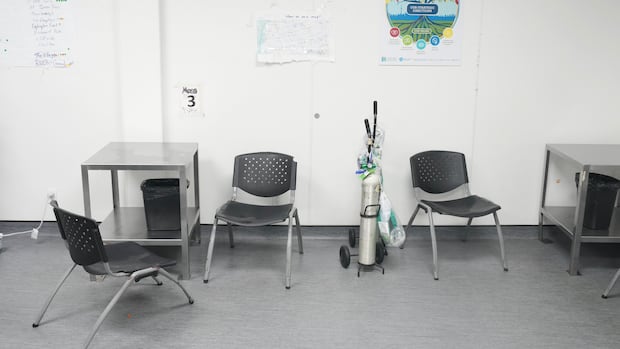
![]() A mural displayed inside Parkdale Queen West Community Health Centre’s consumption room is shown here on March 21st ,2025.(Chris Young/The Canadian Press)The CCLA urged province officials to reverse their decision ending funds designated towards drug consumption centers while promoting safety , health dignity among all citizens inclusive those struggling with addiction.
A mural displayed inside Parkdale Queen West Community Health Centre’s consumption room is shown here on March 21st ,2025.(Chris Young/The Canadian Press)The CCLA urged province officials to reverse their decision ending funds designated towards drug consumption centers while promoting safety , health dignity among all citizens inclusive those struggling with addiction.
Source link
‘This decision is deadly,’ advocate says
Zoe Dodd, an organizer with the Toronto Overdose Prevention Society, described the news as “absolutely appalling,” emphasizing that these sites are lifesaving. “What the government is choosing to do today will cause deaths,” Dodd said. “It’s something that we said would happen when the sites closed and people did die.” “This decision is deadly. We are angry about this decision and we will be fighting back.” Janet Butler-Mc Phee, co-executive director of the HIV Legal Network, mentioned that advocacy groups learned about this development late in the day and still lack complete details regarding it. Butler-Mc Phee labeled the province’s choice to defund remaining sites as a “cowardly” action. “We do know people will die without access to the life-saving care they receive at these sites. The sites exist within our communities and make them better and safer for everyone,” she remarked during a virtual news conference on Friday. Zoe Dodd, an organizer with the Toronto Overdose Prevention Society, says: ‘What the government is choosing to do today will cause deaths.’ (Martin Trainor/CBC)3 non-provincially funded sites remain open in Toronto
Diana Chan Mc Nally, a community worker, pointed out that three drug consumption sites in Toronto-run by Street Health, Kensington Market Overdose Prevention Site and Casey House-are unaffected by these funding cuts since they aren’t funded by the province. Meanwhile, Regional HIV Aids Connection which operates Carepoint Consumption and Treatment Service in London stated it is reviewing details regarding this situation and assessing potential impacts on its service users and communities served. “Our immediate focus remains ensuring continuity of care and support for those who rely on our services.” In a statement released Friday, Canadian Civil Liberties Association (CCLA) condemned this move by the province to defund drug consumption facilities across Ontario as “misguided.” “Communities across Ontario and throughout Canada are facing an unprecedented opioid crisis alongside escalating homelessness and mental health challenges. This moment calls for expanded evidence-based supports – not reduced access to critical lifesaving healthcare services,” it added.</pp “The loss of these services will disproportionately harm already marginalized communities including Indigenous peoples as well as racialized individuals experiencing poverty or homelessness who face systemic barriers accessing healthcare.”</ppOntario prohibited sites near schools , daycares back in 2024
</pp The letter sent out instructed centres need provide plan due April tenth detailing assets purchased using ministry funds along expected winding down costs associated operations Walker explained plans should include strategies aimed transitioning clients over various community health options & staff transitions among others. Further correspondence outlines officials getting touch developing connections towards HART Hub Services plus other recovery & treatment support systems available across different regions Back In twenty-fourteen Ford’s administration imposed restrictions preventing establishment new-consumption-systems situated close proximity hundred meters surrounding educational facilities daycare centers targeting ten specific locations slated closure before end March twenty-five. Most have since shut down opting convert into abstinence-based models focused primarily homelessness recovery treatments referred colloquially sometimes short-hand “HART hubs.” The government aims shift away from harm reduction approaches adopting new frameworks with emphasis only upon rehabilitation efforts planning launch nineteen separate HART locations alongside three-hundred seventy-five supportive housing units projected cost reaching upwards around three hundred seventy-eight million dollars overall.Source link