




Water levels in Lake Simcoe are getting close to a record high, putting at risk what’s known as Ontario’s salad bowl area, a rich farmland region north of Toronto that produces a lot of the province’s vegetables.
This month, the Lake Simcoe Conservation Authority issued a “high risk” warning for flooding in low-lying regions.
In an update on Friday, they said this alert will stay active until May 8.
The affected “low-lying” areas include Innisfil, Georgina, Ramara, Barrie and Orillia, which are already seeing some flooding based on the alert.
<p“A warning like this usually means flooding is likely or already happening,” said Kenneth Cheney, director of flood management with the conservation authority.
Cheney mentioned that the current water level of the lake is nearly at its historical peak from 1960.
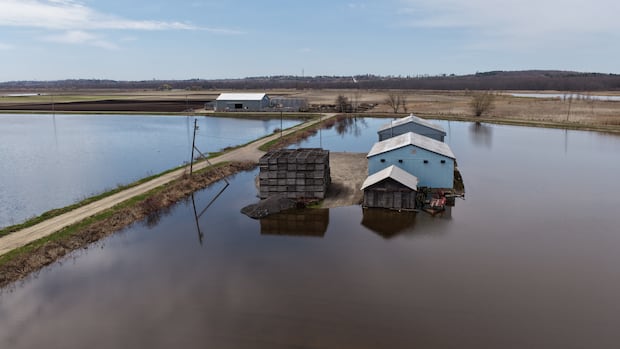
![]() Higher than average water levels in Lake Simcoe are causing worry amongst farmers in Ontario’s ‘salad bowl’ region, which is a major vegetable producer in the province. (Patrick Morrell/ )
The conservation authority reported Friday that water levels reached 219.4 metres, which is 31 centimetres above normal for this time of year.
This level could increase even more with rain since an additional 10 to 30 millimetres is expected over the weekend in the Simcoe area.
<p“It might take weeks or even months” for lake levels to get back to more seasonal averages, Cheney stated.
Higher than average water levels in Lake Simcoe are causing worry amongst farmers in Ontario’s ‘salad bowl’ region, which is a major vegetable producer in the province. (Patrick Morrell/ )
The conservation authority reported Friday that water levels reached 219.4 metres, which is 31 centimetres above normal for this time of year.
This level could increase even more with rain since an additional 10 to 30 millimetres is expected over the weekend in the Simcoe area.
<p“It might take weeks or even months” for lake levels to get back to more seasonal averages, Cheney stated.
![]() Joe Chapman, manager at Don Chapman Farms Limited, said he is worried about the potential impact of flooding due to elevated water levels on this year’s growing season. (Sue Goodspeed/ )
Chapman mentioned he had already started growing celery in his greenhouse ahead of the season.
This crop thrives near water and does well when grown in fertile “black muck” soil that risks being flooded if there’s a serious dike breach.
<p“We’ve got quite a bit invested into this season already,” Chapman noted.
<p“What would be worse … is if we manage to plant all [the celery] and then it floods.”
<
If a dike on his farm fails, it wouldn’t just affect his land but also nearby properties as well.
<pp“It’s really serious business. This is how we make our living.”
Joe Chapman, manager at Don Chapman Farms Limited, said he is worried about the potential impact of flooding due to elevated water levels on this year’s growing season. (Sue Goodspeed/ )
Chapman mentioned he had already started growing celery in his greenhouse ahead of the season.
This crop thrives near water and does well when grown in fertile “black muck” soil that risks being flooded if there’s a serious dike breach.
<p“We’ve got quite a bit invested into this season already,” Chapman noted.
<p“What would be worse … is if we manage to plant all [the celery] and then it floods.”
<
If a dike on his farm fails, it wouldn’t just affect his land but also nearby properties as well.
<pp“It’s really serious business. This is how we make our living.”
![]() Lake Simcoe is part of a greater watershed system that spans 3,400 kilometers. (Lake Simcoe Region Conservation Authority)
Certain elements like strong winds creating larger waves and higher-than-average rainfall could also contribute factors here.
Lake Simcoe is part of a greater watershed system that spans 3,400 kilometers. (Lake Simcoe Region Conservation Authority)
Certain elements like strong winds creating larger waves and higher-than-average rainfall could also contribute factors here.
<p“As long as weather permits,” Arhonditsis commented,“I’m hopeful we can lessen flood risks thanks tothe existing engineering infrastructure designed for flood prevention.”
<p“This serves as broader encouragement for proactive measures ensuring all protective structuresare maintained properly-and possibly increasing investments aimedat safeguarding farmers withinthat productive area around Lake Simcoe."
Source link
Farmers Concerned About Water Levels
Joe Chapman, manager at Don Chapman Farms, has been busy trying to prevent rising waters from flooding his fields. He’s constructed dikes – raised dirt barriers – to keep water out and used bladder bags that expand when wet as an alternative to sandbags. <p“Things are pretty tense right now. We’re still at risk of a potential dike breach,” he shared.Lake Simcoe Within Larger Watershed System
Lake Simcoe forms part of a larger watershed system covering 3,400 kilometers according to information from its conservation authority’s website. Parks Canada oversees managing the lake’s water levels because it’s included within the Trent Severn Waterway system-a national historic site linking Lake Ontario with Georgian Bay. George Arhonditsis, an environmental modeling professor at the University of Toronto who has researched Lake Simcoe watersheds stated that increased water levels aren’t “unusual.”<p“Since it belongs to Trent Severn system," he explained," its water levels have some predictability; you can expect them to go up during spring months due to melting snow.” “This year’s unusual pattern comes from an extended cold winter along with heavy snowfall which may relate backto La Niña conditions,” added Arhonditsis.<p“As long as weather permits,” Arhonditsis commented,“I’m hopeful we can lessen flood risks thanks tothe existing engineering infrastructure designed for flood prevention.”
<p“This serves as broader encouragement for proactive measures ensuring all protective structuresare maintained properly-and possibly increasing investments aimedat safeguarding farmers withinthat productive area around Lake Simcoe."
Source link