





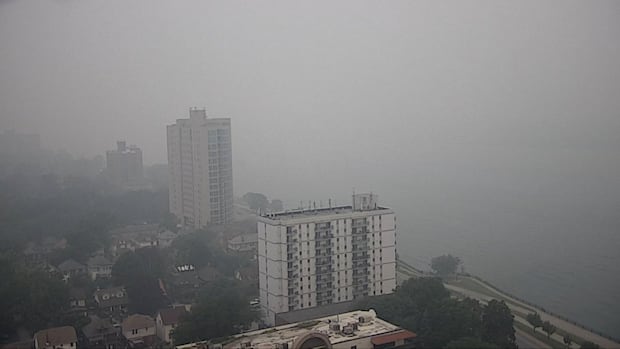
You can smell it. You can taste it. You can even see its haziness under street lights or how it blocks or awkwardly reflects the sunlight.
Wildfire smoke from northern Ontario has made its way down to the southwest – including Windsor-Essex, Chatham-Kent and Sarnia-Lambton.
As a result, the region is under an orange level air quality warning.
As of 7:30 a. m. Thursday, Ontario’s Air Quality Health Index lists our region at a level of 10, indicating high or very high risk. This information is communicated as hourly concentrations of each pollutant.
Biker and walker move along Windsor, Ont.’s riverfront amidst a poor air quality warning because of wildfire smoke in the region, July 16, 2026. (Jennifer La Grassa/CBC)
Across the river from Windsor, Detroit, Mich., had the worst air quality in the world as of 8 a. m., according to the Air Quality Index website. The index is an international system for translating pollutant concentration measurements.
You can share what you’re experiencing by sending us an email to windsor@cbc. ca. Include a picture of how things look from where you are.
The Detroit, Mich., riverfront can be seen through a fog-like haze created by wildfire smoke that’s made its way into southwestern Ontario prompting air quality warnings July 16, 2026. (Bob Becken/CBC)
Environment Canada says that regardless of someone’s age or health status, everyone’s at risk during heavy smoke conditions like this.
The federal weather agency is advising people to limit their time outdoors and reschedule or cancel outdoor sports, activities and events.
“You may experience mild and common symptoms such as eye, nose and throat irritation, headaches or a mild cough,” the air quality warning statement included.
“More serious but less common symptoms include wheezing, chest pains or severe cough. If you think you are having a medical emergency, seek immediate medical assistance.”
People over 65 years old, pregnant individuals, children and those with existing illnesses or chronic health conditions are also more likely to be affected by smoke in the air.
WATCH | Air quality warnings blanket southwestern Ontario:
Southwestern Ontario under air quality warnings as smoke from wildfires blankets region
Smoke from wildfires in northwestern Ontario is covering much of southwestern Ontario as the region emerges from a heatwave. Here’s what you need to know.
According to Environment Canada, when indoors it’s crucial to keep all windows and doors closed as much as possible.
“Protect your indoor air from wildfire smoke. Actions can include using the highest quality air filter that your ventilation system can handle and/or a certified portable air cleaner that can filter fine particles.”
If you absolutely must go outside, officials recommend wearing properly fitted respirator-type masks that reduce exposure to fine particles in the smoke.
Dr. Mehdi Aloosh is the medical officer of health for the health unit. He echoes Environment Canada’s advice and adds that those with underlying health conditions should take extra precautions.
“On a day like today, I would recommend to people who have underlying diseases like respiratory diseases, cardiac diseases, or any other diseases to talk to their healthcare provider to make sure that they take all of the precautionary measures to prevent any hospitalization,” Aloosh told . p >
Aloosh said that people can still factor in their regular routines.
“I recommend our community do exercise , but modified exercise indoors,”
he said. “With doors and windows closed , the risk is really low.” p >
Windsor health provider closes because of air quality
The Windsor Family Health Team is closed Thursday.
The primary health-care provider says it is shut down because of poor air quality inside office.
“As a result , we are unable operate safely , and all appointments scheduled for today have been cancelled ,”the office said in online statement.
Patients with appointments will be contacted at later time reschedule.
“We apologize for inconvenience appreciate your patience while we work resolve this issue.” P >A fog-like haze surrounds Ambassador Bridge from riverfront Windsor , Ont., just hours after wildfire smoke began blanket area , July 15 ,2026.( Ken Amlin/CBC )
Some local municipalities like Windsor, La Salle and Chatham-Kent have cancelled services and outdoor activities, including pools, while reminding residents municipal centres remain open for relief.
Blame Canada
Detroit’s mayor and chief public health officer are urging citizens to take precautions because of poor air quality that’s swept in from ongoing wildfires in Canada.
“Detroit is experiencing most significant effects from wildfires and we strongly encourage all residents to take this issue seriously,” said Mayor Mary Sheffield.
“Smoke from Canadian wildfires is causing unhealthy air quality that can affect everyone, particularly people with underlying health conditions,” said Detroit’s chief public health officer and director Ali Abazeed.
“We are closely monitoring conditions and working directly with departments across city to provide timely updates guidance help keep Detroit residents safe.”
Source link