




Ontario is looking into upgrading an important nuclear facility, which could extend its operational life by another 30 years, in response to electricity demands that have “surprised” the government, according to the energy minister on Thursday.
The Pickering Nuclear Generating Station – which made up 14 percent of last year’s electricity generation – was scheduled for closure in 2025. However, the province is now requesting approval from the Canadian Nuclear Safety Commission to push that back to September 2026, as announced by Energy Minister Todd Smith.
Furthermore, Smith mentioned that the plant could still contribute power for many more years ahead, and Ontario has asked Ontario Power Generation to assess whether a refurbishment is feasible.
The Independent Electricity System Operator recently expressed confidence that it could address the electricity supply gap expected when Pickering goes offline – along with other units undergoing refurbishment – through new procurements that will significantly depend on natural gas in the near term.
However, Smith indicated that “unprecedented growth” in Ontario means there might be a need for Pickering’s substantial capacity for some time longer.
“I think that growth has surprised even Premier (Doug) Ford and our team,” he stated during a news conference on Thursday.
Smith highlighted recent developments like new electric vehicle and EV battery manufacturing entering the province, along with steel producers adopting electric arc furnaces.
“One of the things as we were exploring opportunities on how we fill that (supply) gap is we’ve got an existing asset here that has a proven track record of providing safe and reliable electricity and affordable electricity every day.. We have to be able to ensure that as we continue to see investment in our province, that the power is going to be there.”
Delaying Pickering’s shutdown for a year allows more time for new procurement generation sources to come online, Smith noted.
Interim NDP Leader Peter Tabuns argued that the government should have anticipated and planned for this supply gap much earlier.
“Premier Doug Ford failed to plan for Ontario’s energy needs and that’s put the province in a bind,” he said in a statement.
“The Conservatives cancelled and dismantled low-price renewable energy generation, then had to sign contracts last month to ramp up very expensive gas-fired power.”
The Progressive Conservatives removed a requirement established by the previous Liberal government mandating an update of Ontario’s long-term energy plan by February 2021. The most recent plan was released in 2017.
IESO forecasts indicate an increasing supply gap as electrification expands rapidly, especially within transportation.
Demand from growth in electric vehicles and public transportation electrification is predicted to surge significantly starting around 2035. By then, it’s expected there will be a projected gap of about 5,000 megawatts – enough power for five million homes – during summer months if all current power providers renew their contracts.
Long-term plans are focusing on incorporating more non-emitting resources into electricity generation portfolios including small modular nuclear reactors.
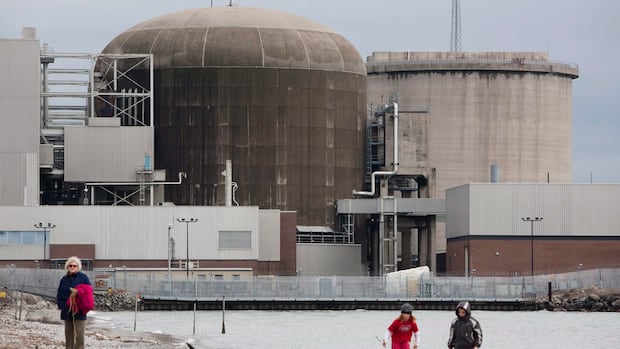
The Pickering Nuclear Plant is seen in an aerial image. (Kevin Frayer/The Canadian Press)
Smith also requested IESO provide insights on possibly halting new natural gas generation projects along with developing strategies aimed at achieving zero emissions within the electricity sector. The current dependence on natural gas implies rising greenhouse gas emissions from this sector
During Thursday’s announcement , Smith emphasized nuclear power’s emission-free characteristics. Keeping Pickering running until 2026 would cut emissions by approximately 2.1 million tonnes this year alone-equivalent to removing around 640 ,000 cars off roads , he explained.
He added keeping operations at Pickering would help preserve thousands of jobs temporarily.
Ken Hartwick , OPG’s president and CEO , confirmed that it’s safe for Pickering operate until 2026. In response inquiries regarding costs associated with extending its lifespan by one year , he stated it will ultimately benefit rate payers financially.
The Canadian Manufacturers and Exporters applauded potential refurbishments noting they would guarantee reliable energy access crucial industries like electric vehicle production , green steel manufacturing , essential minerals extraction while creating over one thousand jobs throughout construction phase renovations.
Source link