


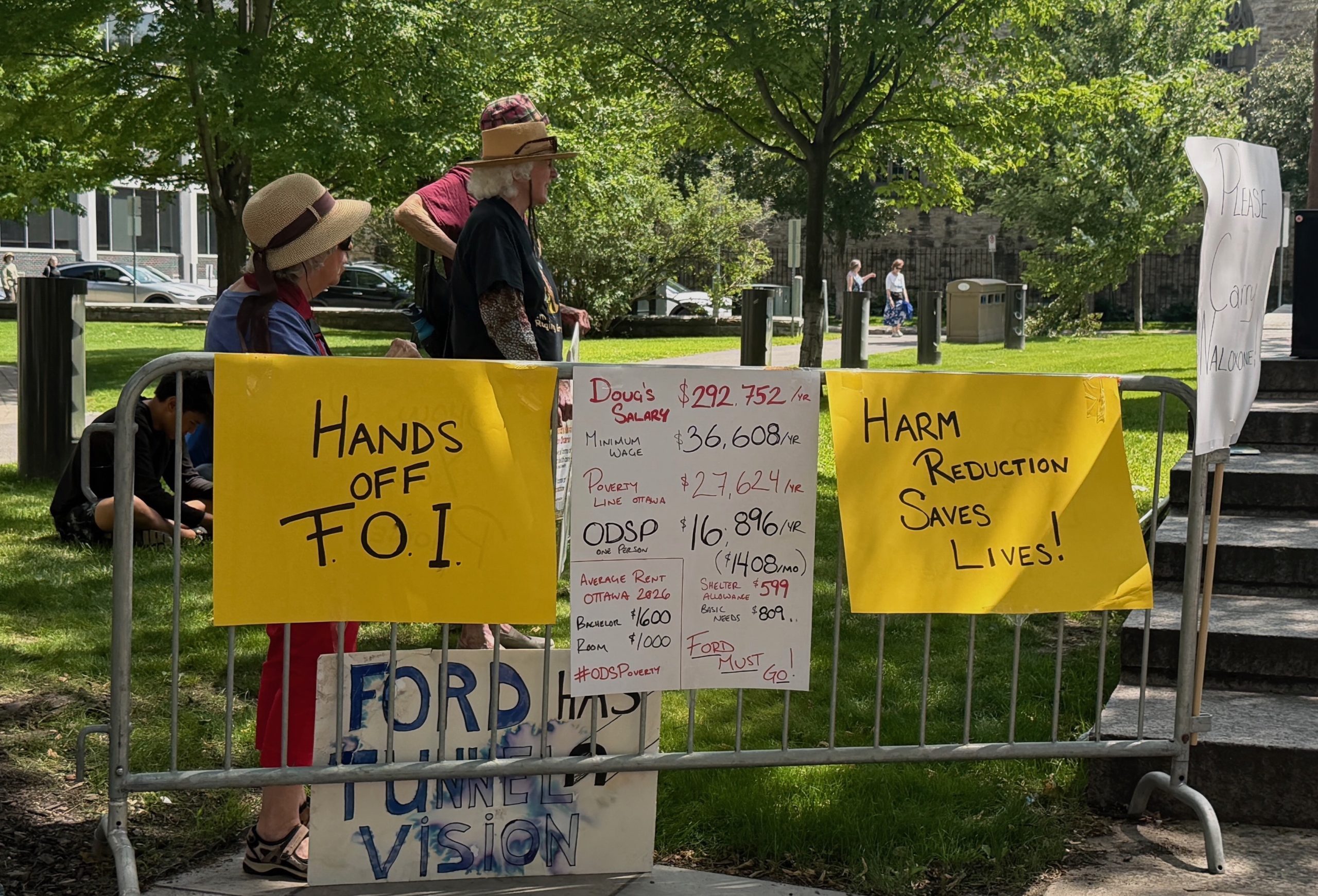
On July 25, demonstrators gathered at the Canadian Tribute to Human Rights in downtown Ottawa to voice their opposition to the Progressive Conservative government led by Premier Doug Ford.
The rally in Ottawa was part of a larger series of protests across Ontario under the grassroots Fight Ford initiative. Speakers expressed strong disapproval of the Ford government’s choice to shut down supervised consumption sites and highlighted issues regarding the province’s response to northern First Nations affected by wildfires.
These protests followed a Liaison Strategies poll that showed Ford’s approval rating had dropped to 24 percent amid criticism over government spending, with support for the Progressive Conservatives lagging five percentage points behind the Ontario Liberals.
Lois Pond, one of the organizers from the Ottawa Harm Reduction Collective, shared that the goal of the rally was to unite those who are concerned about various provincial matters, particularly focusing on closing supervised consumption sites.
“This is not about political affirmation, not right, not left, not religion,” Pond said in her closing remarks. “This is about human life.”
She pointed out that shutting down supervised consumption sites will place additional strain on emergency services, hospitals and public health systems while jeopardizing more lives.
A protester takes aim at Ontario’s Progressive Conservative government during the “Fight Ford” rally along Elgin Street in Ottawa on July 25. [Photo © Marjan Massoom]
Dr. Yipeng Ge, a family and public health physician based in Ottawa who focuses on health equity as well as Indigenous and refugee health issues, noted that the impacts of these closures affect more than just those who use drugs.
“When we talk about public health, emergency services and safety, we are talking about systems that belong to all of us,” Ge told the crowd. “The consequences don’t stay in policy. They show up in real life.”
Ge explained that supervised consumption sites play a crucial role in preventing overdoses and providing connections to healthcare and support services; their closure will increase pressure on emergency departments, paramedics and hospitals.
Activist and singer-songwriter Christophe Elie speaks during Ottawa’s “Fight Ford” demonstration on July 25 at the Canadian Tribute to Human Rights before performing an original protest song. [Photo © Marjan Massoom]
Activist and singer-songwriter Christophe Elie criticized how the government managed evacuations due to northern wildfires while calling for more transparency from officials. He then performed an original protest song aimed at the premier.
“It’s very important for us to gather like this,” Elie said. “But we also have to send letters, make phone calls, and that is what’s going to make a difference.”
The rally wrapped up with an open microphone session where participants expressed personal concerns regarding affordability, student financial aid, harm reduction policies and climate change. Although only a few dozen people attended in Ottawa, organizers stated this event was part of a larger effort across Ontario aimed at keeping pressure on the Ford government.
Source link