




The candidates for mayor displayed on the screen include current Mayor Josh Morgan, along with contenders Susan Stevenson, Kirsten Krose, and John Feher.
However, these names aren’t meant for voters to mark on a ballot. Instead, they represent options for those looking to bet on who will become London’s next mayor, with over $6,000 already wagered.
The betting options are available on Polymarket. com, a U. S.-based prediction-market platform. Such sites allow bets on a wide range of outcomes, including whether Bitcoin’s value will go up or down and which celebrity couples might marry or break up.
Prediction markets let users place bets on binary outcomes-essentially yes or no questions.
Alongside London’s mayoral race, Polymarket provides odds for other Ontario cities’ mayors as well, including Windsor, Toronto, and Stratford.
WATCH | People are betting on municipal elections: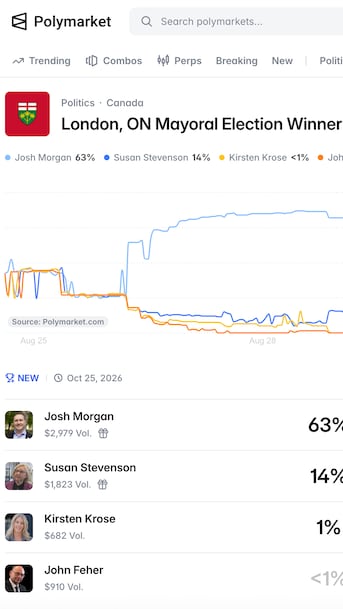
Website posts odds on London’s mayoral race
Experts warn that betting during elections could influence how people vote.
At first glance, bets at Polymarket may resemble the offerings of a sports betting site but operate quite differently. The key difference is that users aren’t placing bets against the house or a bookmaker; instead, they’re wagering against other users who support opposing outcomes.
The odds are represented as shares of each contract that pays out based on specific results. These contracts are priced between one cent and one dollar, with around a dollar being the approximate payout after deducting handling fees.
<p. For instance, a contract predicting Josh Morgan will win costs 64 cents based on Wednesday's odds-meaning if he wins, a bettor risks 64 cents to collect just under a dollar.
A contract guaranteeing a dollar if Susan Stevenson wins would cost 15 cents.
Bets can be scaled higher too; for example, winning $1,000 if Morgan is re-elected would set the bettor back $640.
Additonally , prediction market contracts can be sold before results come in at prices determined by market demand for that event.
Is it illegal?
Canadian regulators permit limited prediction-market trading only in three areas: economic indicators, financial markets , and climate trends. Wagering on sports events , elections , or pop culture isn’t allowed. p >An image from Polymarket. com shows the list of available contracts for bettors keen to wager on London’s mayoral race. (Polymarket. com)
Also , only two prediction market websites have received approval for Canadian users: Wealthsimple and Interactive Brokers Canada. Technically speaking , Canadians can’t open accounts with Polymarket ; however , many bypass these rules using VPNs to hide their location. p >
So how does Polymarket manage to provide odds for London’s mayoral race along with races in Windsor , Stratford , Waterloo , and Toronto? It has users from regions where such wagers aren’t regulated. p >
Concerns about mixing democracy with wagering h2 >
Brock University finance professor Ernest Biktimirov believes Canada’s ban on election-related prediction-market betting is justified. p >
He highlights several issues related to election gambling-including insider trading risks when campaign staff or candidates use confidential information about their races for profit. p >
“It’s a thin market,” said Biktimirov regarding the relatively few prediction-market bets placed during local elections in smaller towns. “In big races like Toronto , it’s much harder to shift prices. For local contests , the smaller number of traders means one person holding significant funds can easily influence contract values.” p >
Insider trading has been problematic in political races within U. S.-based prediction markets too. The site Kalshi prohibited three political candidates from participating because they allegedly betted on their own campaigns-one case involved an open Senate seat. p >
Could affect voter behaviour h2 >
Another concern is that voters might interpret posted odds similarly to polling data-thinking they accurately reflect candidate support levels. p >
Noah Vanderhoeven from The Body Politics Lab at Western University notes that prediction markets could sway voter decisions. p >
“The risk would be someone places a lot of money behind one position.. and that’s not necessarily representative of what the polling is and that could affect people’s decision making,” he said. p >
Voters in Ontario’s municipal elections-including London-will cast their ballots on October 26th. P >
Source link
Source link