



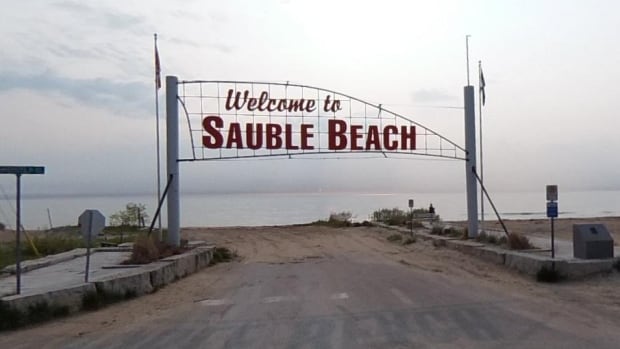
The province’s prime courtroom has upheld a decrease courtroom’s ruling {that a} strip of Sauble Seashore, a preferred Ontario vacationer spot, has all the time belonged to an area First Nation.
In a 121-page determination on Monday, the Ontario Courtroom of Attraction dismissed appeals introduced by the Municipality of South Bruce Peninsula, the Ontario authorities, and a number of other native households to the April 2023 ruling by Superior Courtroom Justice Susan Vella.
In her 2023 determination, Vella dominated that “Chi-Cmiinh,” a roughly two-kilometre strip of seaside on the northern finish of Saugeen Reserve No. 29, had all the time belonged to Chippewas of Saugeen First Nation, and that the federal authorities breached its treaty rights.
“No third events have any curiosity in Chi-Gmiinh, often known as the reserve portion of Sauble Seashore,” Vella wrote.
The Crown, Vella wrote, failed to guard and protect the treaty it signed in 1854, Treaty 72, by which the First Nation and neighbouring Chippewas of Nawash surrendered Saugeen Peninsula, excluding 5 reserve territories. One would turn out to be Reserve No. 29.
In 1856, the Crown surveyed the land improperly, Vella dominated. In consequence, roughly 2.2 kilometres of land promised underneath the treaty was faraway from the reserve. Right this moment, the land covers an space west of Lakeshore Boulevard from Important Avenue and seventh Avenue North.
She additionally decided that, upon Confederation in 1867, the federal authorities assumed the Imperial Crown’s liabilities when it got here to the safety and preservation of reserve lands.
The city, province, and landowners appealed, asking the judgment be put aside and the First Nation’s motion in opposition to them be dismissed.
Officers with South Bruce Peninsula mentioned they had been disenchanted by the choice, however “respect the judicial course of and stay dedicated to appearing in the most effective pursuits of our group.”
“A radical evaluation of the choice might be carried out, and Council will convene to debate its implications and decide the suitable subsequent steps within the coming days,” a press release from the city reads.
contacted Saugeen and the province for remark, however didn’t obtain a response by publication.
The province’s enchantment centred across the interpretation of Treaty 72, together with that Vella made “factual errors” assessing the historic and cultural context related to its interpretation, the Courtroom of Attraction ruling says.
The enchantment introduced by South Bruce Peninsula and the households argued Vella erred by granting judgment on an “unpleaded concept” that might transfer the japanese boundary additional east, impacting landowners who weren’t concerned within the litigation.
Each appeals had been dismissed.
The households additionally argued Vella erred in ruling they could not use the “bona fide purchaser” defence as a result of they inherited their properties relatively than bought them. The enchantment courtroom agreed, however noticed no foundation for difficult her discretion to not apply the defence.
The enchantment courtroom additionally dismissed Bruce Peninsula’s depart to enchantment on authorized prices. Bruce Peninsula argued the prices must be borne by Canada, “because it alone was accountable” for figuring out the reserve’s boundary, the survey, and Crown patents.
The federal authorities conceded at trial that it breached its fiduciary responsibility to Saugeen, and bore some responsibly for the breach of fiduciary responsibility dedicated by the pre-Confederation Crown. Nonetheless, it rejected that it engaged in dishonourable conduct.
Vella dominated 100 per cent of the legal responsibility fell on Canada, with none falling to Ontario. The Courtroom of Attraction mentioned it might enable a cross-appeal by the federal authorities, who argued such a dedication ought to have been made at a later section of the trial meant to handle any excellent points.
In Could, Vella ordered Bruce Peninsula to fork over $1.67 million in authorized charges to the First Nation, and ordered the province to pay $1.28 million, and the federal authorities $322,000. The city was additionally ordered to pay 50 per cent of the federal authorities’s $486,784 authorized prices.
The city appealed the award, and price submissions had been paused as was handled.
The enchantment courtroom says if a value settlement can’t be reached, every might make submissions. The First Nation and federal authorities would have 15 days, and the province, city and households 30 days.


