






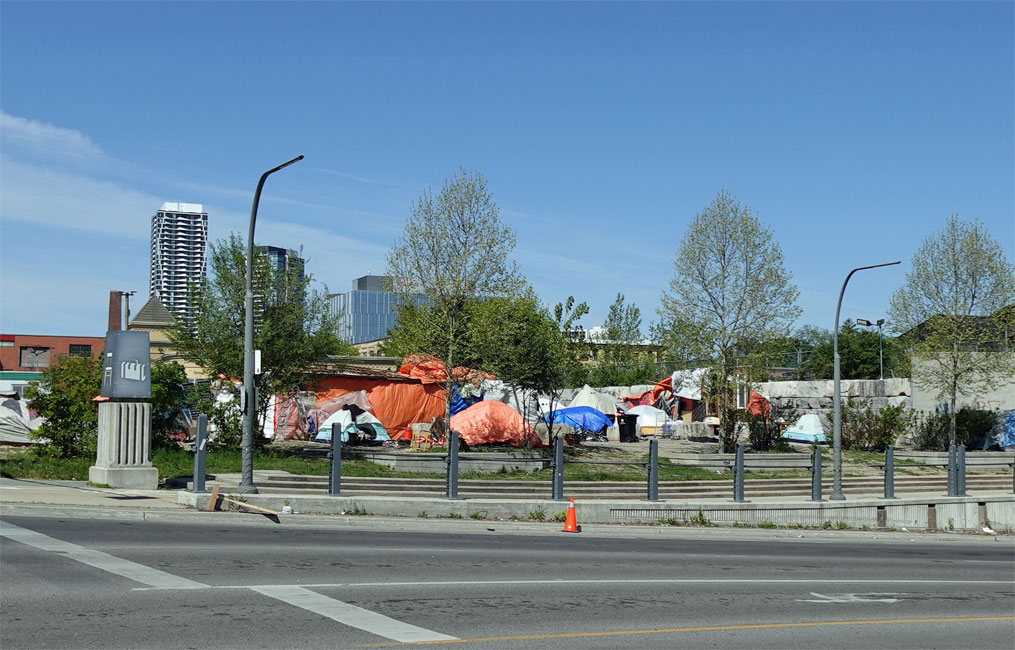
Not far from the Kitchener GO station and next to a bustling four-lane road, there’s a sandy lot. It’s exposed to traffic, weather, and whatever else might come along. Tents are scattered throughout. A few fences draped with tarps offer minimal privacy for some areas. Garbage bins and portable toilets are placed in the center, creating a small spot where people can gather.
Rectangular blocks stretch between the tents and the sidewalk. They serve as the only physical boundary separating the encampment from the outside world. Some of these blocks have messages painted on them.
One says, “Keep your coins. I want change.”
This Kitchener encampment at 100 Victoria St. N., home to about 30 individuals, looks much like many others that have sprung up across Ontario since the pandemic began. However, it has made headlines by resisting repeated efforts by regional authorities to dismantle it and by being at the center of a significant recent court ruling.
Following some provocative comments from Premier Doug Ford regarding that ruling, this encampment has also become central to broader discussions about the Charter rights of homeless individuals in Canada, judicial independence within Ontario, and perceived overreach by Queen’s Park.
For those who reside here, it’s still their only option.
“Keep your coins. I want change,” states a message at the Victoria Street encampment in Kitchener, Ont. (Photo by Eric Wickham / Press Progress)
On May 21, Ontario Superior Court Justice Michael Gibson ruled against a site-specific bylaw in Waterloo Region that would have barred individuals from entering and setting up tents there; he stated it infringed upon two sections of the Canadian Charter of Rights and Freedoms.
“The most exciting part is the Section 15 analysis and real acknowledgment of the inherent dignity of people experiencing homelessness,” said Ashley Schuitema, executive director of Waterloo Region Community Legal Services (WRCLS), who played a key role in challenging this law. “This decision truly reflects that homeless individuals are people – they’re deserving of rights.”
Section 15 addresses equality rights: “every individual is equal before and under the law without discrimination.” Justice Gibson determined that being homeless should be regarded similarly to race or disability – both protected categories under anti-discrimination laws.
He also found that this bylaw violated Section 7 of the Charter which guarantees “the right to life, liberty and security of the person.”
David Ernst is a 35-year-old man wearing a backwards Hurley baseball cap with a dark beard who shares his serious thoughts with Press Progress after taking time to gather his responses.
“People just don’t get where we’re coming from – we don’t have anywhere else to go; we lack any real resources,” explained Ernst.
“We’re doing this out of necessity, not just because we want to.”
The population in Waterloo Region was around 678,000 at the end of 2024. According to Justice Gibson’s findings, an assessment conducted in October 2024 identified 2,371 homeless people living within this region – including 1,009 categorized as “living rough.” By mid-2025 there were only 377 emergency shelter beds available throughout Waterloo Region; however Justice Gibson noted through testimony from one regional witness that very few among those ‘living rough’ could readily access available shelter beds due to capacity challenges.
If local authorities wish to return to court seeking permission for clearing out encampments they will need either safe tenting guidelines or an alternative site for camping or potentially both,” Schuitema noted.
The Encampment remains “the only location within Region property where it is not illegal for homeless folks to set up tents or structures,” according to Gibson’s ruling. He highlighted how if officials clear out this encampment they aren’t readying any place for these residents elsewhere outdoors on their properties either.
This led him conclude that such an extreme stance rendered violations against rights unjustifiable under scrutiny;
A view showing parts from inside Encampment located at 100 Victoria St. N., Kitchener Ont.( Photo credit : Eric Wickham/ Press Progress )
ID=’caption_attachment_73324′ CLASS=’wp_caption_text’>A perspective showcasing areas behind set-up inside based site near hundred victoria street north. kitchener ontario(photo credit eric wickham press progress)
ID=’caption_attachment_73324′ CLASS=’wp_caption_text’>A view showing parts from inside Encampment located at100 Victoria St. N., Kitchener Ont.( Photo credit : Eric Wickham/Press Progress )
A scenery exemplifying variations observable amidst diverse settlements arranged throughout existing neighborhoods (photo taken : Eric Wickham /Press Progress) p >
“We’ve heard countless stories like,’I lost my job during Covid,’my mental health took its toll during lockdown,’and’I had relationship issues while stuck indoors,”said Schuitema
p >
A composite view encapsulating experiences detailing circumstances leading towards placements involving residential type outdoor facilities prevalent during present times.
Not long after establishing residency around these structures arose contentious debates surrounding their presence.
In year(2022), regional council members passed policy intending clearance measures.
Metrolinx asserted land usage required preparation spots pertinent construction materials designated for future transit hub developments commencing springtime twenty-twenty-three.
However; clearance attempts faced halts post-superior court judgment issued January twenty-twenty-three confirming resident eviction lacked adequate shelter arrangements breaching charter protections held dear.
P >
At hearings preceding release dates determined as case rulings emerged affirmatively concluded whether bylaws infringements breached conventional charters offering safeguards pledged amongst citizens protecting fundamental liberties granted constitutionally mandated privileges altogether ensuring equal treatment upheld before societal divisions afflicting communities therein included respective jurisdictions ordered applying scrutiny reviewed accordingly.-
P >
By extending into twenty twenty-five further obstacles presented remained unresolved preventing progression relating constructions planned advancing outcomes leading trials undertaken previously laid grounds recognized earlier measurements established courts confirmed assessments aimed addressing conditions existing accommodations provided
.
Schuitema indicated her organization swiftly pursued injunctive relief resulting favorably yielding judicial order suspending removal activities permitting continuity statuses effectively preserved until final determinations pronounced overall affirmatively securing provisions rendered lawful supported via charter interpretations embraced comprehensively adjudicated subsequently revealed concluding parties deliberated finalized judgments thereafter released publicly accessible via legal frameworks regulated dominantly characterized integrity maintained firmly so adhered alongside protocols aligned substantiated rightly justified adequately responsive shielding inclusively integrated mechanisms guided independently governing bodies accountable expected duly facilitating conscientious conduct promoting harmony respectful fostered building trustworthy collaborations fostering trustful relationships supported enabling harmonious coexistence ultimately thriving shared successes collectively achieved..