





For Canadians reminiscing about the Toronto Blue Jays’ thrilling 2025 World Series journey, Donald Trump’s recent attacks have brought moments of intense drama and genuine national pride.
And just like baseball is mostly a mental game (the other half being physical, as famously put by Yogi Berra), trade wars aren’t just about economics. In the last two weeks alone, the U. S. president has derailed a trade agreement, threatened Canada’s economic and cultural independence, labeled Canada’s leaders dishonest (and worse), and demanded a change to the name of a lake that predates America itself.
Read more: Trump’s Lake Ontario bluster: Why treating his sovereignty threats as a joke is dangerous
These abrupt events create an impression that the world is unsafe and full of surprises. Yet while the Trump administration continues to undermine science by cutting research budgets and endorsing Robert F. Kennedy Jr.’s false vaccine claims, it’s actually science that helps us understand the subconscious motivations behind Trump’s unpredictable actions – and how we can react effectively.
Why have other countries given in?
It’s vital to explore why only Canada and China have stood their ground against Trump’s bullying tactics so far.
Two key ideas can clarify this seemingly irrational compliance.
The first concept is known as loss aversion. Research indicates that people are more distressed about losing a dollar than they feel pleased about gaining one. Psychologically speaking, losing something inflicts twice as much pain as gaining an equal amount brings joy.
The fear of job losses becomes intolerable, leading countries to accept less harsh tariffs: even though the current American administration isn’t reliable regarding trade agreements, a 25 percent tariff feels bad while a 50 percent one feels worse.
If all this appears chaotic, it’s intentional. While I’m not claiming that the Trump administration is deliberately random in its assaults on allies like Canada and the European Union, unpredictability itself acts as a weapon – which is another reason many nations have bowed to Trump’s demands.
Animals subjected to random shocks experience higher stress levels than those who learn how to manage their responses. They ultimately give up searching for ways to escape discomfort.
In a similar vein, bullies wield power not through constant aggression but through the looming threat of it. The ongoing possibility of being economically shoved into a corner with punishing new tariffs keeps trading partners anxious and uncertain, further strengthening the bully’s position.
A participant holds an ‘Elbows Up Canada’ sign during a rally in response to U. S. President Donald Trump’s threats to Canadian sovereignty on Parliament Hill in March 2025. THE CANADIAN PRESS/Justin Tang
How should Canada respond?
So what should Canada do? Should it allow American products on its shelves? Or should it threaten to cut off energy supplies and critical minerals? Game theory suggests neither option is ideal.
Read more: What game theory teaches Canada about negotiating with an untrustworthy Donald Trump
Computer simulations show that simple tit-for-tat strategies outperform more complex ones. To put it simply, you start with cooperation and react accordingly based on what the other party does.
A peaceful approach leads to peace; aggressive moves are met swiftly at equivalent levels. There exists forgiveness along with reciprocity; tariffs evoke matching responses.
In reality, Trump has threatened an escalation in January 2027 with further tariffs. In reply, it’s essential for Canada to convey clearly: we desire peace and are willing to overlook past offenses but will not tolerate future provocations.
The fallout
No matter how we respond, there will be repercussions – even if they’re milder or shorter-lived than if an unfavorable deal had been accepted.
While maintaining our stance and encouraging Canadians to buy local products, Prime Minister Mark Carney’s government also needs to inspire confidence in our economy – which can tap into feelings of community solidarity.
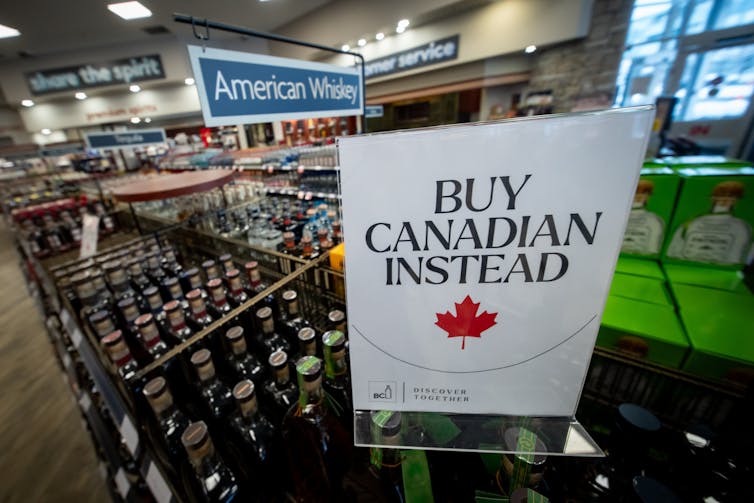
A sign is placed in front of the American whiskey section at a B. C. liquor store after top-selling American-made products have been removed from shelves in Vancouver on Feb. 2, 2025. THE CANADIAN PRESS/Ethan Cairns
We naturally form groups with those who share our looks or thoughts. Despite Canada’s cultural diversity, many Canadians identify themselves primarily as “not Americans” united by indignation towards Trump’s administration’s actions.
Trump himself isn’t popular here at all; there’s even a petition calling for his combative ambassador Pete Hoekstra’s removal! Rallying cries like Elbows Up and Never 51 resonate strongly.
Carney has rightly stood firm on protecting Canada’s sovereignty; he enjoys high approval ratings along with support for pausing trade discussions with Trump’s team.
Even politicians across various parties are coming together for national support.
p >
While questions linger about Canadian identity , right now they’re united by what they aren’t ; such unity boosts Carney ’ s leverage when negotiating.
More attacks to come
Given Trump’s established pattern , both Canada and traditional allies can expect continued erratic attacks filled with spite.
As uncertain as this new global landscape may be , science clarifies how these aggressions impact us-and how we might respond.
And if anyone needs an escape from political turmoil , remember-the Blue Jays are making another push for playoffs.
Source link