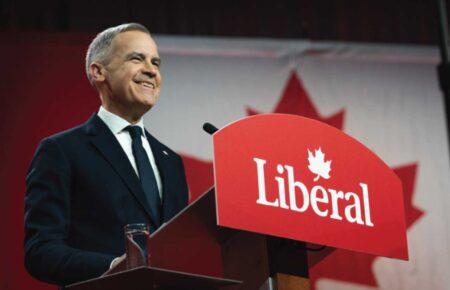




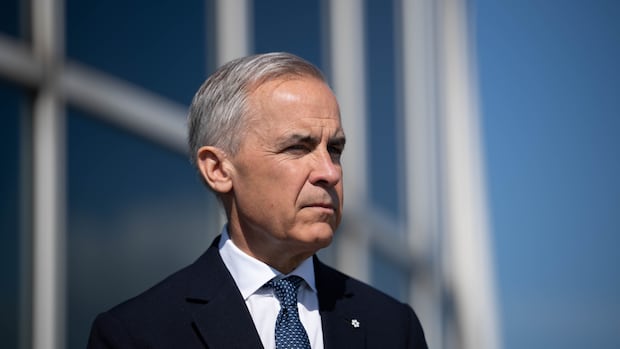
While in B. C. meeting with the province’s premier, who is doubtful about another oil pipeline, Prime Minister Mark Carney stated that the world is facing an “energy crisis” and Canada needs to contribute by providing necessary natural resources.
Addressing a primarily business crowd at the Greater Vancouver Board of Trade before his discussion with Premier David Eby on Wednesday, Carney pointed out that recent global events have jeopardized the availability of certain energy types, putting many nations in a difficult spot.
He mentioned that Ottawa aims to act swiftly to deliver those resources, and if B. C. resists further development, his government will “be spending more time elsewhere in the country.”
Carney outlined his approach – expediting project approvals, revising clean energy policies, and supporting a new oil pipeline to the Pacific – as a way for Canada to help alleviate the global energy shortage while also boosting its own economy during a period when trade issues with the U. S. have hurt some sectors.
“Unlike many countries, Canada can be part of the solution, for the world, for ourselves,” he said. “Canada is a stable, reliable partner in a world that is anything but.”
Being aware of what he referred to as the “existential challenge of climate change,” Carney noted that both abundance and affordability are also major concerns for him and other governments as rising tensions in Iran sharply increase fuel prices and disrupt supplies, including significant amounts of Qatar’s gas.
He described these challenges as a “three-dimensional energy crisis.”
WATCH | Carney says Canada can help the world out of its ‘energy crisis’: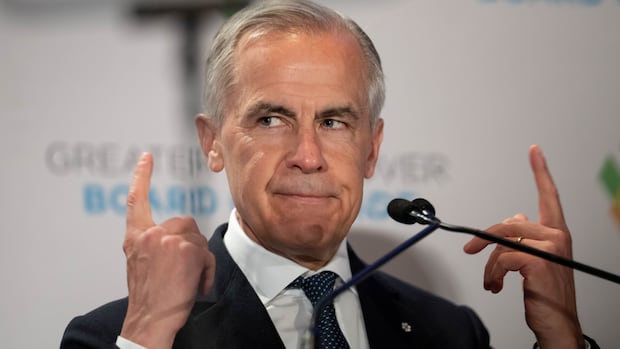
Carney says Canada can help the world out of its ‘energy crisis’
Prime Minister Mark Carney emphasized that Canada, ‘unlike many countries,’ has what it takes to be part of addressing this global ‘energy crisis.’
“In a rapidly changing world, Canada must become the source of our own affordable, clean, reliable power because when we master energy, we master our destiny,” Carney said.
Eby has been critical regarding the memorandum of understanding between Carney and Alberta Premier Danielle Smith.
Before their meeting on Tuesday, Eby remarked that Carney was rewarding Smith – whom he labeled a “separatist premier” – along with her “bad behaviour” by adjusting industrial carbon tax regulations and supporting her push for a pipeline to the West Coast. Eby strongly opposes oil infrastructure through northern B. C.
Aware of this opposition as well as pushback from certain First Nations and environmental activists, Carney informed his Vancouver audience that any pipeline project would only proceed if there’s development on Pathways carbon capture and storage systems aimed at reducing emissions.
Though he had previously stated “the government of British Columbia has to agree” for any pipeline plans to move forward, on Wednesday he added that another condition would be for B. C. to “share substantial economic and financial benefits” from such projects without naming specifics about their agreement. He emphasized that Indigenous peoples should also be consulted so they could benefit economically if this new oil route goes ahead.
Diving deeper into discussions after his speech, Carney explained how this pipeline along with other natural resource initiatives currently under consideration aim at making Canada more self-sufficient amidst ongoing U. S. trade tensions.
Eby criticized federal efforts focused heavily on Alberta’s pipeline proposal; however, Carney responded by pointing out that nearly one-third of major projects fast-tracked by his government originate from B. C.
If opposition continues against additional developments within B. C., Carney cautioned that Ottawa might need to shift its focus towards projects situated in other provinces instead.
“If things get stalled here, we’re going to be spending more time elsewhere in the country,” Carney stated.
“We need to move forward. We need to invest at scale in the country. For all those reasons I mentioned: affordability, sustainability independence and prosperity,” he reiterated-echoing sentiments he’s shared often now.
Eby remains against any northwest coast oil pipelines but supports natural gas initiatives like LNG Canada’s Phase 2 expansion which Ottawa endorses too; it’s included on their major projects list along with some mining activities across B. C.
Latterly during their meeting while cameras were rolling, Eby expressed desires directly stating he wants fair federal investment allocations directed toward B. C.’s priorities addressed appropriately.
WATCH | Oil tanker ban ‘crucially important’ as Ottawa advances pipeline , B. C. premier tells Carney: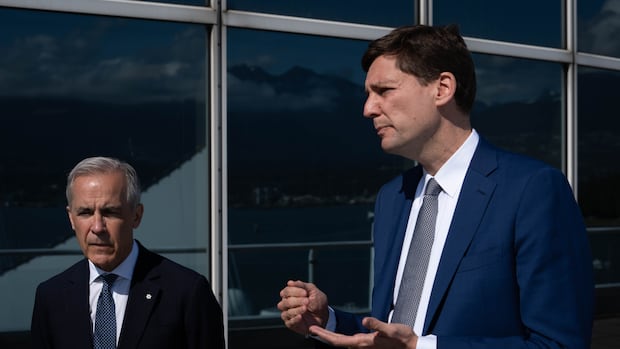
Oil tanker ban ‘crucially important’ as Ottawa advances pipeline, B. C. premier tells Carney p >
B. C. Premier David Eby told Prime Minister Mark Carne yon Wednesdaythatprojectdevelopmentinhisprovince’hastogo hand-in-hand’withenvironmentalprotectionincludingamoratoriumonoiltankers. Thetwo metdaysafter Ottawaand Alberta signedanenergyagreementthatcouldseeconstructionofanoilpipelineto West Coaststartasearlyas September2027.
Hestatedthat Canada’srenewedfocusonenergydevelopment’hastogohand-in-handwithenvironmentalprotection’, addinganymove tolifttheoiltankerbanisanon-starter.
Despite tensionsoverapipelinehe trulydoesn’twant, Ebyendedonthefriendlynote.’There’s nodoubtinmymindthattheprime ministerisafriendto B. C.’, hesaid.
Source link