




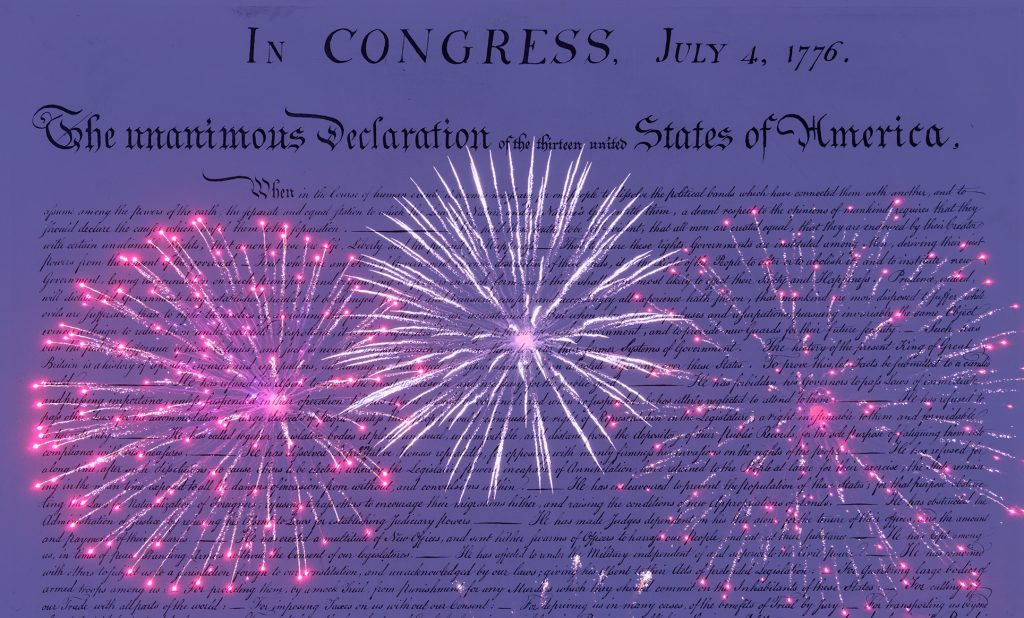
As our country gears up to celebrate its 250th anniversary, Virginia Tech’s experts in history and political science are ready to share their insights on how much the United States has evolved since its inception and what challenges lie ahead.
Thoughts on Equality
The nation’s birthday usually prompts Americans to think about what it means to be part of this country, and opinions vary widely. Discussions about the intentions of the Founding Fathers when they created the Declaration of Independence and the Constitution have been ongoing for generations, said Paul Quigley, a history professor. Since 1776, every generation has debated what these principles truly mean, including prominent figures like Thomas Jefferson and John Adams.
“Understanding how past generations have grappled with America’s meaning can guide us today, especially when it feels like our nation is fracturing,” Quigley stated. “History can both unite us and divide us; however, it primarily shows us how interconnected we are with those who came before and those who will come after.”
Many people might mistakenly view the drafting of the Declaration of Independence and the U. S. Constitution as a straightforward journey, but that wasn’t the case at all, noted political scientist Karen Hult.
“In restless British colonies, writing and spreading the declaration was considered seditious; soon enough it had to be re-evaluated. The first governing framework post-independence was the Articles of Confederation, which proved inadequate,” she explained. “It’s also worth considering those involved in lively debates in cramped Philadelphia rooms where crafting the Constitution took place.”
Over these 250 years, “the country has made gradual progress toward several aspirations outlined in the declaration – though not always evenly across individuals or demographic groups,” Hult remarked.
The Declaration of Independence is a vital document because it set forth ideals that continue to influence our nation today, said Dan Thorp, associate professor of history. Many of its principles weren’t realized at that time; for example, claiming all men are created equal with unalienable rights.
Even so, various groups within America and around the globe have drawn upon these principles during their quests for equality and justice.
“We’ve faced setbacks along the way; we may never fully achieve everything promised by the declaration. However, one of this nation’s greatest strengths lies in its commitment to strive towards Jefferson’s words,” Thorp added.
Innovation Through Time
Cayce Myers, an expert in political communications, pointed out that marking the anniversary of the Declaration of Independence isn’t just about celebrating a political achievement but also recognizing a significant moment in media history.
“The announcement spread through printed broadsides-the mass media format back then-to rally public support,” he explained. “This was an early instance of content being widely reproduced via printers and newspapers-essentially 18th-century viral content. Coupled with information exchanges happening in colonial taverns and coffeehouses allowed news to circulate rapidly. This highlights how crucial free speech and press are for effective self-governance and democracy.”
This impactful document laid out ideas regarding government responsibilities toward citizens while detailing individual rights as well, Myers stated. “In our fast-changing world filled with technology and diverse media narratives it’s crucial to recognize our shared philosophical roots stemming from the Declaration of Independence.”
The drive for technological innovation has always been central to achieving what many consider part of the American Dream. “Since its founding days we’ve dealt with hopes alongside fears related to technology,” historian Matt Wisnioski said. “There was optimism that new inventions could solve persistent social issues while creating opportunities-improving lives across society-and even generating wealth alongthe way. We’re witnessing fractures now.”
Concerns over where innovations originate from or whether they happen too swiftly have consequences regarding how they shape national identity. “At 250 years old today , the United States still struggles with harnessing technology effectively for a democratic society,” he commented.
About Hult
Karen Hult is a professor specializing in political science at Virginia Tech whose expertise covers topics such as U. S presidency matters , federal/state politics , governance policies , and court systems. She frequently discusses U. S presidential issues as well as Virginia politics/government matters with journalists.
About Myers
Cayce Myers serves as both a public relations professor & director overseeing Graduate Studies within School Communication. His research focuses mainly on laws / regulations affecting PR practices alongside historical developments relating PR sector overall.
About Quigley
Paul Quigley currently directs Virginia Center Civil War Studies while holding position James I. Robertson Jr Professor title pertaining specifically Civil War Studies field. Additionally leads Center Humanities located at Virginia Tech ; recent publication includes titled work “The Man Behind Cane : Preston Brooks Political Violence Road Civil War.”
About Thorp
Dan Thorp works as an associate history professor affiliated Virginia Tech where his research centers around African American experiences particularly Southwest region Virginia British colonies European exploration processes concerning North America overall.
About Wisnioski
Matt Wisnioski holds position professor/director graduate studies focusing on intersection between science technology society fields simultaneously serving interdisciplinary historian role authoring latest release named “Every American Innovator : How Innovation Became Way Life.”
Schedule an interview
If you’d like to set up an interview please reach out via email contacting office@mediarelations. vt. edu p>
Source link