





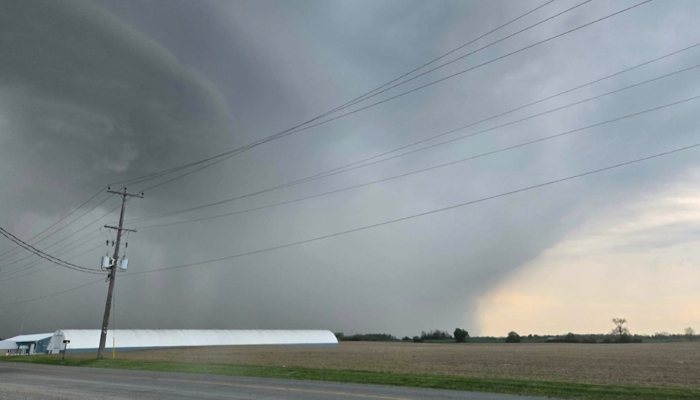
A big cleanup is now in progress after severe weather swept through the area, knocking down trees and power lines. While Hamilton mostly dealt with heavy rain and strong winds, officials have confirmed that a tornado touched down just west of the city in London.
Environment and Climate Change Canada reported wind gusts reaching around 90 km per hour in London, while the highest gust recorded in Hamilton was an 80 km per hour blast at the airport.
In Hamilton, city services received nearly 70 calls about fallen trees and power outages. Officials reported responding to 34 service calls overnight and another 33 during the day, with more expected as residents start to check their properties.
Chantal Bourque was one of many people in Hamilton checking for damage after the heavy rain and strong winds hit. A large branch from her neighbor’s old tree fell into her backyard in the north end, causing some minor damage to her garage but leaving her house intact. Thankfully, there were no injuries.
“The wind was pretty bad, we felt the whole house shake,” Bourque said. “Now that I’m thinking about it, maybe that was the tree falling. But yeah, we could feel the upstairs shaking, so it was pretty intense wind.”
Bourque shared that she and her sister were watching TV when they got a call from their neighbors.
“All I heard was ‘yup okay, I’ll be out back.’ And I said ‘what happened’ and she said ‘the tree fell down.’ I was like ‘oh, you mean the fence?’ And I came out like nope, the tree,” Bourque said.
Bourque is currently waiting for her landlord to handle the branch, which she described as large enough to be considered a whole tree itself.
: Local cleanup begins after severe thunderstorm rips through southern Ontario
The destruction wasn’t limited to just the north end; tree limbs also fell in Victoria Park and Dundas.
However, Hamilton didn’t face the worst part of the storm. Tornado sirens sounded on Western University’s campus in London-home to the Northern Tornadoes Project-a team dedicated to studying weather patterns and assessing tornado damage.
David Sills, director of the Northern Tornadoes Project, explained how different storm types affect areas differently.
“A tornado is usually a long, narrow path of damage. And with a downburst, it’s usually over a wider area,” Sills said.
Officials confirm at least one tornado touched down southeast of London; unverified images showed a funnel cloud nearby. The team continues analyzing data to assess how powerful this storm was.
“We rate the damage on the Enhanced Fujita scale that goes from zero to five,” Sills noted. “I doubt anything will get past zero from yesterday; even though it affected many people, it wasn’t very damaging overall. We’ve seen much worse.”
The Northern Tornadoes Project indicates this is only Ontario’s second recorded tornado this year after an event on May 7 just north of London.
Monica Vaswani, a meteorologist focused on warnings at Environment and Climate Change Canada mentioned that Hamilton airport recorded its strongest wind gust at around 80 km per hour.
“There was a gust of about 80 km per hour which is still very strong,” Vaswani stated.”
While officials say predicting more tornadoes this year isn’t easy; severe thunderstorms are quite common. Environment Canada suggests residents prepare an emergency kit for such situations.
: Environment Canada tracking severe thunderstorm across southern Ontario
Source link
Source link