




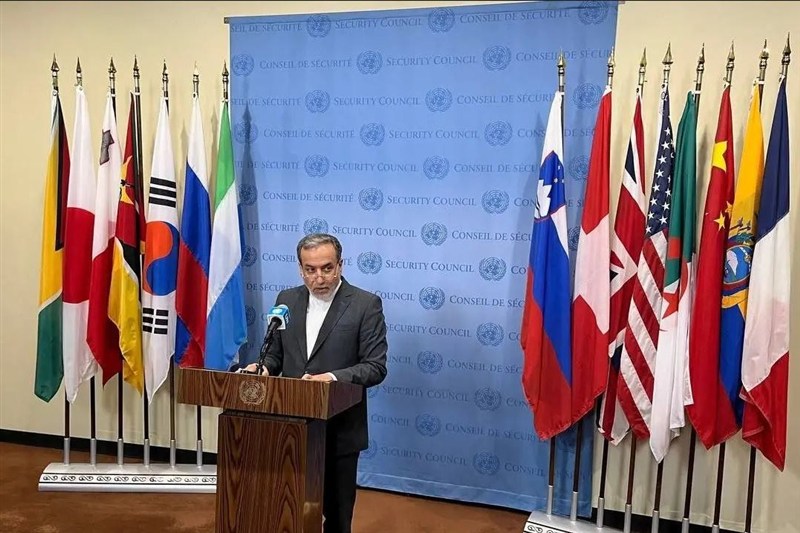
While speaking to reporters at a stakeout outside the United Nations Security Council, Araqchi emphasized that Iran is strongly dedicated to international law, the UN Charter, and diplomacy. He highlighted the negotiations that resulted in the 2015 nuclear deal, its implementation, and Iran’s ongoing diplomatic efforts over the last two years.
He pointed out that even though Iran is dealing with aggressive moves from the US and Israel, Washington has opted for “aggression, threats, assassination, economic warfare and blatant disregard for international law and the UN Charter.”
Araqchi noted that over 5,000 individuals have been martyred during US-Israeli aggression against Iran, which includes hundreds of women and children. He labeled the assassination of Iran’s Leader along with several high-ranking political and military officials as “a flagrant crime and an obvious violation of international law.”
He mentioned that residential areas, schools, hospitals, energy facilities, cultural sites, transportation infrastructure and other civilian locations have been targeted. Araqchi referred to documented incidents such as the killing of more than 168 students and teachers in Minab, a cluster-bomb attack on a stadium in Lamerd, bombing residential homes on Qeshm with 2,000-pound bombs and a missile strike on a wedding ceremony in Sirik as examples.
The Iranian foreign minister stated that despite these occurrences, both the US president and the prime minister of Israel attempted from the podium of the UN General Assembly to misrepresent facts and flip roles between victim and aggressor. “The United States and the Israeli regime cannot whitewash their actions against the Iranian people,” he said.
Araqchi also criticized Washington for using economic deprivation as a means of collective punishment and political leverage. He argued that the US is intentionally causing severe harm to Iranians while directly violating their fundamental rights-like rights to life, health care access-medicine-and food.
“This is not diplomacy; it is coercion and economic terrorism,” he stated while adding that such actions represent a “clear and direct violation” of binding provisional measures set by the International Court of Justice on October 3, 2018.
Iran’s Peaceful Nuclear Program
Shifting focus onto Iran’s nuclear program, Araqchi claimed new allegations regarding this peaceful initiative were politically motivated rather than based on technical or legal evaluations.
He dismissed assertions that Iran is close to obtaining nuclear weapons as “a big lie,” stating this accusation originated from Israel back in 2003 before being echoed by both US officials as well as European nations.
Araqchi reinforced that since 1970 Iran has acted responsibly under the Nuclear Non-Proliferation Treaty (NPT) framework while undergoing extensive monitoring by International Atomic Energy Agency (IAEA) for many years.
He remarked that it’s contradictory for Washington to advocate for non-proliferation yet target peaceful nuclear facilities safeguarded by IAEA-a clear breach of America’s international commitments.
Hormuz Security
Regarding Hormuz Strait security issues specifically Araqchi reiterated Iran’s dedication towards ensuring safe shipping; however insisted maritime safety can’t be achieved through military actions or economic sanctions.
He indicated Hormuz Strait will remain open until February 28th 2026 while arguing current instability stems directly from American-Israeli hostilities affecting maritime traffic there.
“A country cannot be bombed threatened with destruction subjected naval blockade or coercive measures then still expected restore security shipping immediately,” Araqchi asserted.
He also highlighted responsibility lies within regional nations who’ve enabled this aggression via their territories providing bases logistical infrastructure intelligence despite obligations outlined under UN charter principles good neighborliness.
Araqchi mentioned following cooperation efforts between Pakistan Qatar , signed Islamabad memorandum understanding June seventeenth. Under article five memorandum , committed arrangements facilitating ships’ safe passage.
Asserted after signing began technical negotiations sultanate Oman implement commitment restore pre-war level maritime traffic within two weeks implementation returned around sixty percent pre-war levels.
Nevertheless stressed unilateral us actions military aggression violated halted progress implementing memorandum resorting instead aggression dispute resolution mechanisms available memoranda.
“Iran kept door diplomacy open” Araqchi stated stressing Tehran continuously participated good faith negotiations past two years.
Said bad faith response came each time met military action distrust rebuilt resuming talks without credible guarantees future repetitions.
Clearly positioned conveyed through Qatar specific seven-day plan said “If necessary conditions provided strait Hormuz reopened normal maritime traffic resumed seven days.”
“Choice now belongs United States” Araqchi emphasized wouldn’t accept coercion threats intimidation relinquish sovereign rights pressure.
Concluded stressing United Nations established preventing “law jungle” replacing rule international law adding “UN Charter optional sovereignty conditional Diplomacy mean surrender peace can’t built threats destruction.”
Source link
Source link