




Ontario Construction News staff writer
A newly updated heritage plan for the old Campanile Campus on Heron Road has gained approval from an Ottawa committee. This plan will allow for the construction of 1,100 new homes while still keeping important heritage elements intact.
The City of Ottawa’s Built Heritage Committee gave its backing to the plan on Sept. 15 for the properties located at 1485 and 1495 Heron Road. The City Council is set to review the committee’s recommendations on Sept. 23.
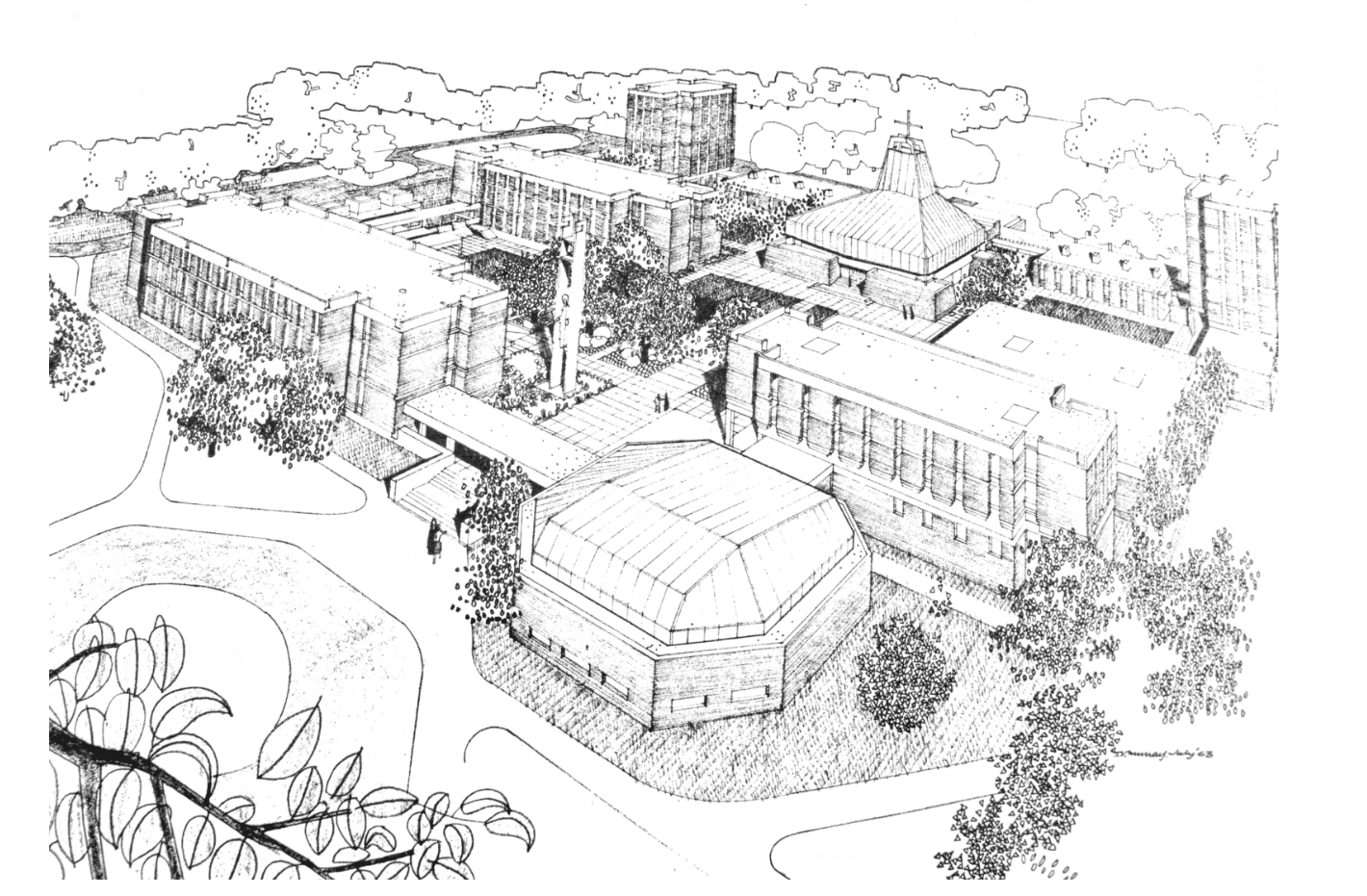
The proposal aims to maintain and repurpose the central parts of the former educational campus while paving the way for new housing developments in the area.
Five existing heritage buildings will be preserved, and three other buildings will keep their façades intact. However, two six-storey red-brick dormitories are planned for demolition.
Dormitory buildings are often hard to convert into different uses due to structural issues, such as small floor spaces and low ceiling heights.
This site is recognized as a designated heritage property that represents a rare and well-preserved example of a Modernist educational campus. It also has ties to Catholic education and the growth of federal public service jobs in postwar Ottawa.
Build Canada Homes, a federal agency launched in 2025 with the goal of boosting mixed-income housing across Canada, has adjusted its concept plan to find a balance between conserving heritage and allowing redevelopment with more housing options.
The committee also instructed city staff to approve future project changes so that redevelopment can continue without needing every modification to go back through committee review.
The Heron Road initiative was one of several heritage issues addressed by the committee on Sept. 15. The committee additionally designated two properties in West Carleton-March as heritage sites: 1837 Maple Grove Road and 756 Kinstead Private.
These properties were originally part of the historic Hartin farmstead and fulfill three out of nine criteria required for heritage designation under Ontario’s guidelines.
The property at 1837 Maple Grove Road, known as Patrick Hartin House, is an Ontario farmhouse from the 19th century featuring Gothic Revival architecture. The farmhouse was built around 1886 and remained in the Hartin family for over 170 years.
The original house at 756 Kinstead Private dates back to around 1840 and serves as an example of an early Eastern Ontario stone cottage. After constructing the farmhouse at 1837 Maple Grove Road, this original house became a secondary structure and later functioned as a blacksmith shop.
Both properties have connections to Patrick Hartin and his descendants, who were among Irish Protestant settlers arriving in Huntley and Goulbourn townships during the early part of the 19th century.
Source link
Source link