





Recent heavy rains in Ontario’s Niagara region, which led to the flooding of thousands of homes and strained sewage systems, have also posed a serious threat to the local peach industry.
Peach trees, along with other delicate fruit trees like nectarines and cherries, struggle with too much water and can perish if their roots stay waterlogged for extended periods.
This means that the several storms that hit the area between July 21 and August 2 are likely to have a negative effect on these trees.
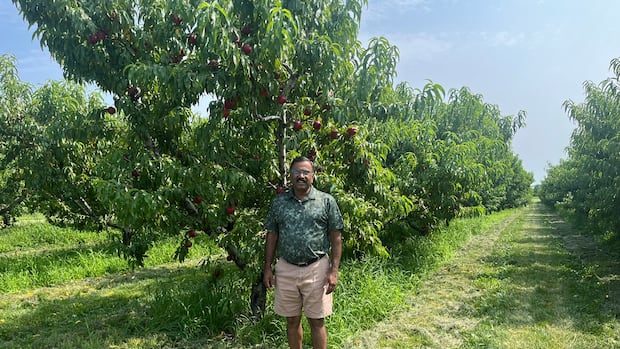
“That’s a given,” said Jay Subramanian, a professor of tree fruit breeding and biotechnology at the University of Guelph.
He mentioned that it might take weeks or even months for the impacted trees to die, so it will be some time before we fully understand the extent of the losses.
“It could be anywhere between, you know, 20 per cent … even upwards of 40 per cent.”
“Comparatively we are really facing tough challenges.” We need varieties suited for our conditions – Jay Subramanian , University Of Guelph professor While growers from warmer regions – such as southern Europe , Australia or America – can test various new types from numerous warm-climate countries , Canada must rely more heavily on home-grown varieties. “Comparatively we are really in a tough spot. We have to breed varieties for our needs ,” he noted , adding that there has been a decrease over recent years regarding such efforts. According To Subramanian , he is among only about five individuals across Canada focusing on breeding fruits resistant to climate change. He mentioned government support has declined recently , although industry contributions have increased funding gaps. Still , more support is needed for meaningful research moving forward. Without proper funding , Subramanian stated finding high-quality homegrown fruits will become increasingly difficult. In an email statement sent To CBC , representatives from agriculture ministry indicated they invested over $343 million In research & innovation within Ontario’s agri-food sector For addressing real challenges faced By tender fruit producers In 2023. The government has allocated $41 million toward enhancing infrastructure meant For agricultural breakthroughs And providing practical solutions available To farmers,” wrote Miriam Leardi senior communications advisor. The ministry representatives visited flood-affected regions And expressed ongoing collaboration With farmers across The area through supports provided By Agri Corp,” referring To Ontario agency offering crop insurance.
Source link
The Cost of Peaches and Wine May Rise
An organizer for the Winona Peach Festival, scheduled from this Friday to Sunday in Winona, east Hamilton community, shared with CBC Hamilton that their peaches haven’t been affected. Most vendors come from nearby areas like Winona and Beamsville in Niagara. The festival is expected to feature its usual assortment of pies and peach sundaes, according to Terry Gudgeon. Subramanian noted that several peach trees on his Vineland research farm are already showing signs of distress and are dying off. If there’s significant damage, he warned consumers might feel the impact next summer. “That will obviously drive prices up.” The same could happen with wine prices as well. A large portion of Ontario’s grapes is cultivated in this region. Like peaches and nectarines, grapevines do not handle excessive moisture well. Jamie Slingerland, director of viticulture at Pillitteri Estates Winery, stated that two hectares of grapevines were flooded. WATCH | The toll of Niagara floods on region’s vineyards: How grape growers from Niagara-on-the-Lake are dealing with back-to-back rainstorms Grape growers in Niagara are racing against time to save their crops after two severe rainstorms flooded many homes and businesses in just a few days. “All this humid weather brings about every disease you can think of. You start seeing downy mildew, powdery mildew, black rot, botrytis … and it just keeps going.” Slingerland mentioned that these flooded vines could result in a loss of $250,000 for the winery.The Broader Effects of Climate Change
Flooding isn’t the only issue related to climate change affecting Niagara’s fruits. Subramanian pointed out that warming temperatures bring various challenges. For instance, he highlighted the Harrow Diamond – a classic cold-weather peach developed in Harrow located in Essex County. “This variety used to ripen around July 28 or 29 in Vineland,” he explained. “Now I’m harvesting this same variety between July 12 to 15. So that’s an advancement by two weeks to 2.5 weeks within just 25 years.” This earlier ripening means less time for peaches to develop fully which often results in smaller peaches lacking flavor. Warmer weather also leads to new pest pressures. Subramanian is engaged in breeding varieties of peaches resistant to such changes. He believes Canada needs urgent attention on this issue. The country stands out because few regions produce as much fruit while dealing with cold conditions.“Comparatively we are really facing tough challenges.” We need varieties suited for our conditions – Jay Subramanian , University Of Guelph professor While growers from warmer regions – such as southern Europe , Australia or America – can test various new types from numerous warm-climate countries , Canada must rely more heavily on home-grown varieties. “Comparatively we are really in a tough spot. We have to breed varieties for our needs ,” he noted , adding that there has been a decrease over recent years regarding such efforts. According To Subramanian , he is among only about five individuals across Canada focusing on breeding fruits resistant to climate change. He mentioned government support has declined recently , although industry contributions have increased funding gaps. Still , more support is needed for meaningful research moving forward. Without proper funding , Subramanian stated finding high-quality homegrown fruits will become increasingly difficult. In an email statement sent To CBC , representatives from agriculture ministry indicated they invested over $343 million In research & innovation within Ontario’s agri-food sector For addressing real challenges faced By tender fruit producers In 2023. The government has allocated $41 million toward enhancing infrastructure meant For agricultural breakthroughs And providing practical solutions available To farmers,” wrote Miriam Leardi senior communications advisor. The ministry representatives visited flood-affected regions And expressed ongoing collaboration With farmers across The area through supports provided By Agri Corp,” referring To Ontario agency offering crop insurance.
Source link