




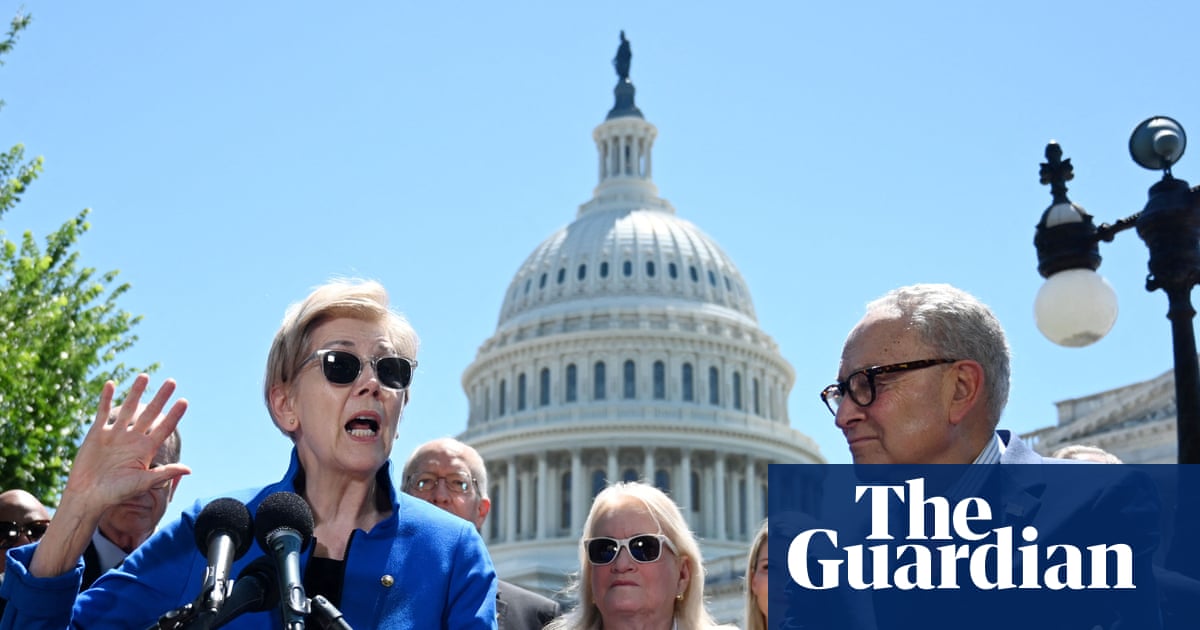
Democratic senator Elizabeth Warren has expressed concerns that corporate mergers approved during the Trump administration – including a pending agreement that would place two of America’s largest news organizations under the influence of a family aligned with the president – might be reversed by a future government.
“After 2028, we’ll have new players in Washington, and everyone who’s engaged in this merger frenzy right now is aware of that,” Warren said in an interview.
“The deals being struck today are taking place amid an impending political backlash against these massive corporations that believe they can dominate one industry after another, inflate prices, extract profits, and escape accountability.”
“By 2028” – the year of the next presidential election – “they may find out they have badly miscalculated,” Warren stated.
The Massachusetts senator’s remarks follow a decision by the justice department earlier this month to approve the $111bn merger between Warner Bros Discovery, which owns CNN and HBO, and Paramount Skydance, which controls CBS News through the Ellison family.
This deal has raised worries that Larry Ellison, a long-time associate of Donald Trump, along with his son David, could shift CNN’s reporting to favor the president. Following last year’s merger that resulted in Paramount Skydance gaining control over CBS News, David Ellison appointed Bari Weiss as editor-in-chief; she is a conservative commentator with no prior television experience.
Since then, the news network has faced accusations of political bias, including issues at 60 Minutes, which is one of television’s most-watched news programs. At CNN, the potential for Ellisons to take control and possibly position Weiss in leadership has caused concern within the organization.
Warren warned that if these networks come under unified ownership by the Ellisons, it would mean “there’s one ultimate decision-maker who decides what’s important and what’s not” at two major news outlets in America.
“A bigger problem is that Ellison himself wants to inject a tilt into the news. That means where Americans turn for information will become less reliable for independent reports and more about a pre-packaged version of reality comfortable for their new management,” she explained.
State attorneys general reportedly plan to file a lawsuit regarding this deal but haven’t announced it yet. Warren mentioned she “wouldn’t draw a lot of inferences” from their delay since pursuing such cases requires considerable resources and collaboration among states as they figure out “how they’re going to pool their efforts to go up against a giant like Ellison.”
Aside from media mergers, Trump’s administration has also authorized Nippon Steel’s $14.9bn purchase of US Steel; Omnicom’s $13.5bn acquisition of Interpublic forming the world’s largest advertising firm; plus a $35bn transaction between Capital One and Discover Financial.
In her address at an event hosted by Open Market Institute in Washington, Warren accused Trump’s administration of ignoring how this wave of mergers harms consumers all for political contributions.
“As soon as Trump took office, corporations came knocking at the White House door to get their pro-monopoly deals approved,” Warren remarked. “Have you wondered why companies keep donating millions of dollars to Trump’s gold-encrusted ballroom or his arch or his library? It looks like nothing short of a pay-to-play scheme.”
Warren isn’t alone among Senate Democrats threatening action against mergers sanctioned during Republican rule. In February, Senator Chris Murphy warned via social media that Paramount-then vying prominently for Warner Bros Discovery after Netflix withdrew-“should enjoy its growing news monopoly while they have it because when Democrats win back power we are going to break up these anti-democratic information conglomerates. All of them.”
In November voters will participate in midterm elections which could enable Democrats to regain control over both chambers-the Senate and House. Representing Massachusetts and currently leading as top Democrat on Senate banking committee, Warren noted reclaiming majority status might give her party some limited chance to counteract Trump’s merger policies.
“What we’ll be able to change legally will be difficult with Donald Trump still residing at The White House capable vetoing anything he opposes,” Warren said. However, she pointed out antitrust laws allow retroactive dissolutions if mergers are found later violating those regulations.”
Source link