





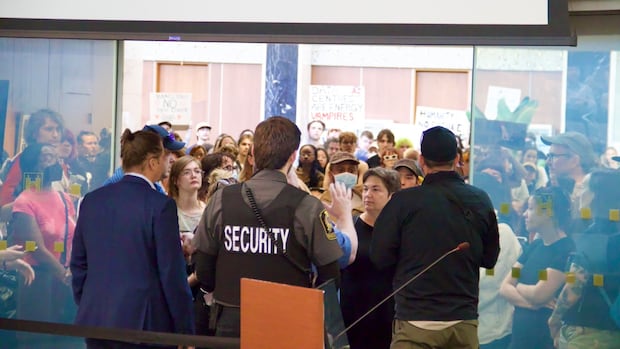
After listening to hundreds of residents who opposed a proposed data centre, a planning tribunal in Hamilton turned down a developer’s request to divide a piece of land where the company is looking to build such a facility.
“In many years, I’ve never seen that kind of response from the public,” tribunal member Robert Reid said Thursday night following the lengthy meeting at city hall.
It’s uncertain whether the developer will challenge the decision or proceed with its plans without changing the land designation.
Before the lively planning session on Thursday morning, chants of “f–k AI” echoed through Hamilton’s city council chambers as dozens filled the public gallery and more than a hundred waited outside.
For over eight hours in the council chambers, numerous community members spoke before a local planning tribunal deciding if development company Slate Asset Management could split approximately 324 hectares of land it owns into two sections.
In Slate’s application, they mentioned that one potential use for the smaller parcel would be “hyperscale and enterprise data centres.”
The possible establishment of a data centre sparked strong opposition among locals. City staff noted that 1,688 individuals submitted comments on the land severance application, which might be a record.
Concerns about noise, pollution and water consumption
Before the meeting, Nick Tsergas, one of the local organizers against the data centre project, told CBC Hamilton he aimed to ensure public voices were heard.
He expressed concerns regarding noise levels, pollution issues and impacts on drinking water quality.
“People in Hamilton seem aware of these realities,” he stated.
Hundreds gathered outside Hamilton city hall on Thursday ahead of and during an important meeting where committee members were set to decide whether to allow a developer to split its property into two segments. (Justin Chandler/CBC)
The rise of AI across North America has led to increased demand for physical locations designed to store and manage data and software efficiently. Canada currently hosts five hyperscale data centres with another 96 under development.
Some protesters in Hamilton carried signs opposing not just artificial intelligence but also any plans for establishing a data centre in their city.
Residents voiced their worries about AI’s effects on employment opportunities, creativity, and environmental health while expressing fears that pollution from a data centre could adversely impact their wellbeing.
Citizens swayed committee’s decision, says member
The site “meets all regulations” for severance Reid noted when it was time to vote; however, “because of residents’ turnout today and how they shared their thoughts, I would like to propose denying the severance.”
The audience applauded as other committee members raised their hands in support of passing this motion.
CBC Hamilton reached out to Slate regarding its intentions concerning an appeal against this committee ruling but received no response before publication.
Dressed as representatives for MHBC Planning Urban Design & Landscape Architecture at the meeting was Gerry Tchisler representing Slate. He emphasized that dividing off 76 hectares on one side wouldn’t speed up developing at 386 Wilcox St., but still pointed out it wouldn’t affect launching any potential data centre plans either.
This proposal aligns with federal initiatives
Slate informed CBC Hamilton Wednesday that it’s involved in an initiative by Canada’s Digital Research Alliance aiming at securing funding through federal government’s AI Sovereign Compute Infrastructure Program.
This program includes an “open call for applications to construct large-scale sovereign public AI supercomputing systems accessible for Canadian researchers and innovators.”
slate clarified that this proposal doesn’t focus on training AI but ensuring Canada maintains adequate storage capacity along with high-performance computing access. slate further mentions there’s no determination made yet regarding constructing any specific data center or determining who might use it; however indicated confidence it could run such facilities addressing public concerns effectively.
A Steelport facility would utilize existing resources from prior steel manufacturing sites helping prevent strain on local electricity networks while also potentially employing bay water cooling techniques conserving more water compared other methods.
Tsergas remarked those assurances didn’t ease his apprehensions.
“It’s convenient for them to make those claims,” he stated firmly.”Honestly though? I don’t trust them.”
A significant number within attendance urged stricter evaluations surrounding future developments relating specifically around proposed centers.
A resident named Chase Alford requested conditions tied closely monitoring aspects like energy usage disclosures should approval occur now stating ,“I’m not asking you put halt altogether. Just look out better interests behalf citizens residing here,” which additional note registered interest running candidacy ward fifteen upcoming elections.
Additionally Lisa Kearns serving Burlington’s Ward Two likewise present emphasized awareness gained growing amidst industrial surroundings witnessing firsthand adverse impacts stemming pollutants urging committee delay consent exploring options enabling legal frameworks establish oversight new tech implementations’ implications.
 Canada’s new AI strategy aims to serve all Canadians , Carney states
On Thursday Prime Minister Mark Carney announced launch government-led initiative targeting artificial intelligence directed aiding entire population asserting ‘Prosperity sovereignty digital age belong nations capable cultivating technologies alongside governing appropriately.’
Shion Guha professor affiliated University Toronto studying Information Technology Faculty formerly advised CBC Hamilton highlighting necessity regulatory guidance developing protocols concerning these types establishments rising trend necessitates reevaluation traditional oversight functions should adapt accordingly too!
This Tuesday CBC contacted Innovation Science Economic Development department querying inclusion newer strategies initiated recently offering considerations directives surrounding emerging industries related towards contemporary innovations witnessed lately unfortunately failing garner responses timely manner prompted publish deadline arrival thus far..
Canada’s new AI strategy aims to serve all Canadians , Carney states
On Thursday Prime Minister Mark Carney announced launch government-led initiative targeting artificial intelligence directed aiding entire population asserting ‘Prosperity sovereignty digital age belong nations capable cultivating technologies alongside governing appropriately.’
Shion Guha professor affiliated University Toronto studying Information Technology Faculty formerly advised CBC Hamilton highlighting necessity regulatory guidance developing protocols concerning these types establishments rising trend necessitates reevaluation traditional oversight functions should adapt accordingly too!
This Tuesday CBC contacted Innovation Science Economic Development department querying inclusion newer strategies initiated recently offering considerations directives surrounding emerging industries related towards contemporary innovations witnessed lately unfortunately failing garner responses timely manner prompted publish deadline arrival thus far..