




Doctors at Hamilton Health Sciences (HHS) report that a Western University student hurt in a London fraternity house fire has become the first burn patient globally to receive an experimental treatment that may change the way severe burn victims are cared for.
Kaitlin Jeffrey, 18, sustained significant burns to her face and neck during a fire at a frat house near Western in December 2025. The incident left five individuals needing hospital care.
After being transferred to Hamilton General Hospital’s regional burn center, Jeffrey was treated with an innovative approach using exosomes, which are small particles released by cells that help manage healing, tissue repair, and reduce inflammation.
“My goal for Kaitlin was to prevent skin graft surgery on her face and neck at all costs,” said Dr. Marc Jeschke, vice-president of research and innovation at HHS, burn surgeon and medical director of the hospital’s regional burn program.
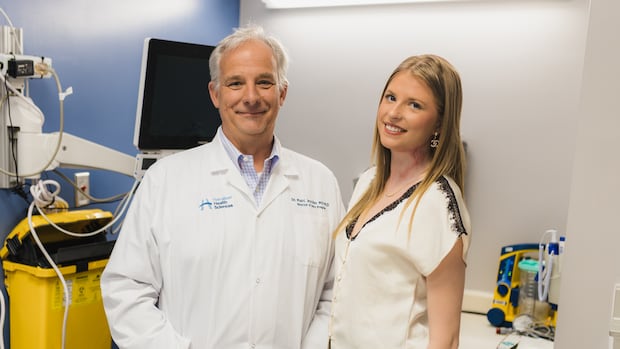
Doctors examine Kaitlin Jeffery as she recovers from severe burns suffered during a fire at a fraternity house party in December 2025. (Hamilton Health Sciences)
Exosomes have been researched for years in burn treatments but had never been used on a human burn patient before this case, according to HHS. While these particles have shown promise in other wound-healing scenarios, Jeffrey became the first person ever to receive this treatment for burns.
LISTEN | Breakthrough burn treatment shows remarkable results:
London Morning8:37Breakthrough burn treatment shows remarkable results
At a party gone wrong, 18-year-old Kaitlin Jeffrey experienced severe burns on her face and neck. Instead of opting for skin grafts, doctors utilized a new state-of-the-art procedure. Dr. Marc Jeschke discussed the exosome treatment on London Morning.
With support from Jeffrey and her family, Jeschke reached out to Health Canada to request permission for compassionate use of the therapy. After receiving no objections, doctors administered two exosome treatments several days apart using one trillion exosomes sourced from the United States.
Jeschke noted that traditional skin grafts can save lives and restore damaged tissue but often result in noticeable scarring and can’t return skin to its original look.
Western University student Kaitlin Jeffrey, 18, received an innovative treatment to help her heal from severe burns. (Hamilton Health Sciences)
“You can do the best graft on the planet, but you won’t return the skin to normal,” he said.
Jeffrey mentioned that the results have changed her life.
“It’s honestly a miracle,” she said. “Being injured in the fire has also had a deep impact on my mental health, and it’s something I’m continuing to deal with. But having such good results, particularly to my face, is helping me move forward.”
Researchers at HHS hope that further studies and clinical trials will eventually make exosome therapy standard practice for burn patients across Canada and worldwide.
Source link