



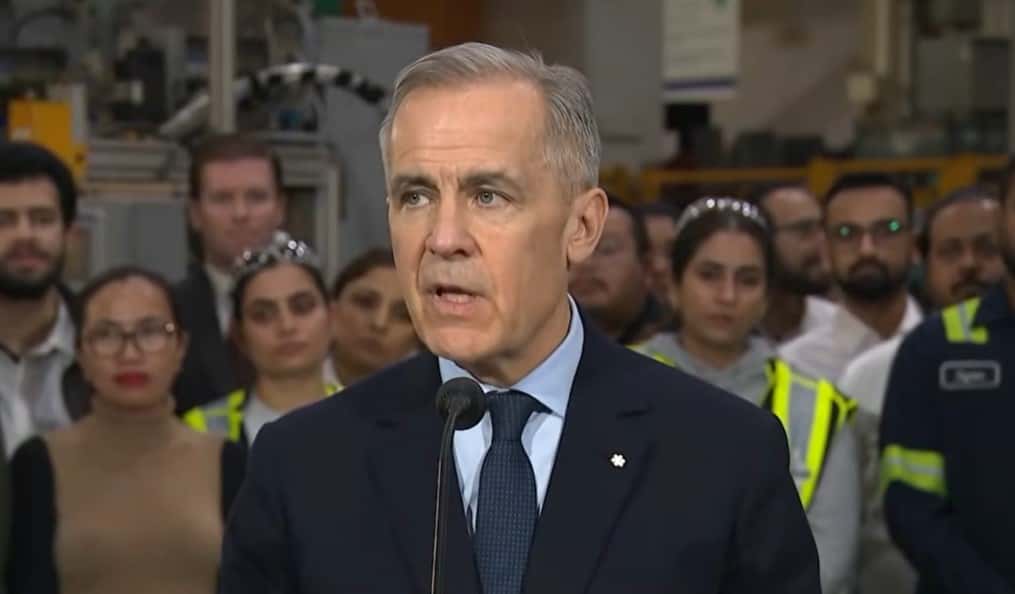
Before Prime Minister Mark Carney announced the plan at a manufacturing facility in Vaughn, there were rumors that it would remove the electric vehicle mandate for automakers and reintroduce rebates for those purchasing electric vehicles.
This was confirmed during the announcement on Thursday morning. However, Carney also shared new initiatives aimed at helping auto workers, increased investments in charging stations, and the formation of an automotive task force with Ontario.
Regarding those rebates, Ottawa is rolling out a five-year $2.3-billion EV affordability program that will reimburse car buyers up to $5,000 for electric vehicles and as much as $2,500 for plug-in hybrid cars priced under $50,000. The program kicks off on February 16.
The rebates won’t be available for new Chinese-made EVs entering Canada. They will only apply to vehicles manufactured domestically or imported from countries that have a free trade agreement with Canada.
The trade deal with China allowing the import of 49,000 Chinese-made EVs caused tension between the Prime Minister and Premier Doug Ford. Carney stated that Ottawa and Queen’s Park will be collaborating more closely moving forward.
“We’re launching the automotive task force to drive coordinated action between our government and the province of Ontario to build the cars of the future,” said Carney. “We’re breaking down barriers and working together across government, industry, and labor with a shared focus on delivery.”
Revoking the electric vehicle mandate was something requested by the auto industry. This mandate required that 100 percent of all vehicle sales be emission-free by 2035.
The EV availability standard has been paused since last fall but will now be repealed. In its place, new greenhouse gas emissions standards for vehicles manufactured from 2027 to 2032 will be established. The federal government aims for 75 percent of vehicle sales to be electric by then, increasing to 90 percent by 2040.
<p"For auto workers, we're providing additional income supports to workers and employers through a new work-sharing grant, giving themthe flexibility that employers need to retain workers and prevent layoffs," said Carney.
He mentioned that grants have already saved around 3,700 workers from facing unemployment.
Workers will also receive employment assistance along with funding for reskilling opportunities.
A lot of Carney’s announcement focused on expanding Canada’s automotive sector while reducing reliance on U. S. imports. He noted that Ottawa is working closely with Detroit’s Big Three automakers to upgrade their plants.
To encourage domestic investment, the federal government plans to allocate $3 billion from the Strategic Response Fund alongside $100 million from the Regional Tariff Response Initiative as incentives for car companies to speed up their investments.
Carney also highlighted his recent trips to Asia where negotiations are currently underway with car manufacturers from countries like Korea.
As more electric vehicles hit Canadian roads-and addressing concerns about charging infrastructure-the federal government is promising $1.5 billion toward enhancing EV charging networks across Canada.
The rise in electric vehicles is expected to put pressure on electricity grids; therefore, Carney mentioned that a new electricity strategy would be revealed in upcoming weeks.
Source link
Source link


