





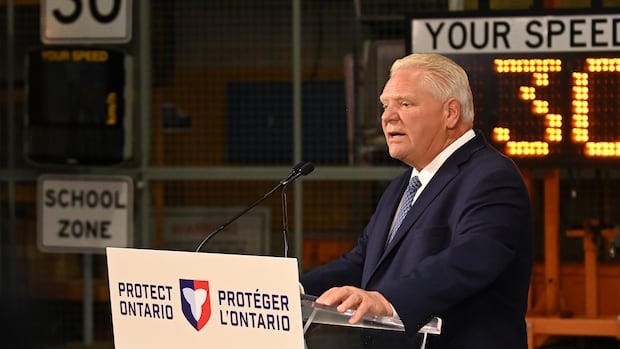
Ontario Premier Doug Ford announced Thursday morning that his government will introduce legislation aimed at banning speed cameras – a method of traffic enforcement that Ford has labeled an ineffective “tax grab.”
“Over the last few years, we’ve seen municipalities across the province use municipal speed cameras as nothing more than a cash grab,” he stated during a news conference in Vaughan. “People are fed up.”
In contrast to study findings and the views of police associations and municipalities, Ford argued that speed cameras do not reduce speeding, and the province plans to create a new fund to assist municipalities in implementing other “proactive traffic-calming initiatives that stop people from speeding in the first place.” This includes measures like speed bumps, roundabouts, raised crosswalks, and curb extensions.
He mentioned that municipalities currently using speed cameras in school zones will be required to install large signs with flashing lights aimed at encouraging drivers to slow down.
Ford did not specify where funding for this initiative would originate or what its cost might be. Following the announcement, some provincial and municipal politicians expressed their disapproval.
Premier Ford called speed cameras an ineffective ‘cash grab,’ while announcing his plan to ban the road safety tools in Ontario Thursday. (Jon Blacker/Canadian Press)
Supporters Cite Effectiveness of Speed Cameras
The Ontario Association of Chiefs of Police, along with the Association of Municipalities of Ontario and Toronto’s mayor, have all voiced their support for speed cameras this month.
The police chiefs’ association had previously stated that utilizing automated speed enforcement (ASE) cameras “has been proven to reduce speeding, change driver behaviour, and make our roads safer for everyone – drivers, cyclists, pedestrians, and especially children and other vulnerable road users.”
This statement followed a Sick Kids study conducted earlier this summer which found that ASE cameras had decreased instances of speeding around schools in Toronto by nearly half.
WATCH | Sick Kids head explains how speed cams around schools improve safety: 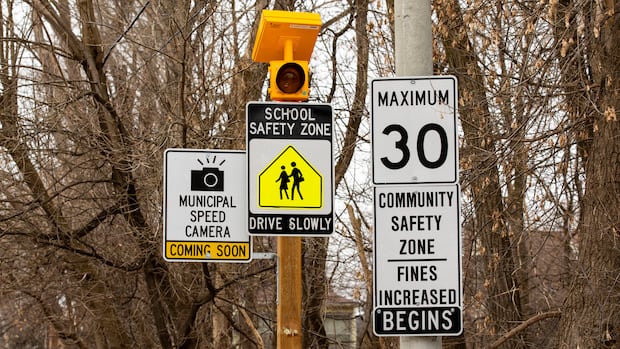
How speed cameras make streets safer for kids
A new study by Sick Kids hospital shows speed cameras make the streets safer for kids. The hospital’s head of orthopedic surgery, Andrew Howard, spoke to CBC’s Metro Morning about the study findings and how they can improve kids’ safety.
On Thursday, Ford acknowledged his respect for both Sick Kids and law enforcement but insisted that speed cameras aren’t effective, characterizing it as “black-and-white.”
In Ottawa, compliance with speeding regulations increased from 16 percent to 81 percent three years after installing speed cameras in certain areas according to information on the city’s website.
A report from Brampton indicated earlier this month that there was an average reduction in speeds exceeding nine kilometres per hour where camera enforcement was present. Mississauga reported similar outcomes. Five locations in Brampton experienced reductions exceeding 20 kilometres per hour as noted in their report.
Announcement Faces Backlash
Following the announcement, statements opposing Ford’s decision were released by both the Ontario Liberal Caucus and Ontario NDP members.
Andrea Hazell, transportation critic for the Liberals stated that while improvements are needed within the camera program it plays a role in saving lives. She described eliminating them as “reckless.”
“We shouldn’t throw the baby out with the bathwater just because the Premier thinks it will boost him in the polls,” she commented.
“Speed cameras are first and foremost about safe schools,” John Fraser said, education critic for Liberal party indicated his belief Ford’s decision is moving “in reverse.”
. In her own statement on behalf of her party Jennie Stevens said Ford’s change is stripping safety tools away from school zones and high-risk community areas against expert advice. p>
. Toronto Mayor Olivia Chow refuted Ford’s claim regarding these devices being merely “cash grabs,” explaining instead how fines contribute towards traffic lights , crosswalks , police officer wages , and victim services p >
. “We’re not putting these systems into place because we have any ulterior motives other than public safety,” Chow remarked during her Thursday news conference. p >Studiesandreportsfromsome Ontario municipalities indicate speeds being reducedbythecameras.(Arthur White-Crummey/CBC)“I thinkthisisawrongdecision ,” Chow declared. “It signals topublicthatprovincialgovernment acceptspeeding. It’ll leadto lesssafe roads.” p >Shesaid plansareinmotionto proposeamotionthatwill enhance thespeed-camera programwithlarger signageanda grace period sothatfirst-time offenders receive ticketsbymail before subsequent onesareissued.
The motionwill alsoasktheprovincefor “road safetyrationale, datafor removing ASEcameras,”accordingtoanewsreleasefromher office.
As per astatement issued Thursday, the Cityof Torontohas collectedover$30millionfromspeedingticketfinessofarthisyear.
Support From Some Mayors h2 >On Thursday, Fordstatedonly37outoftheprovince’s444municipalitiessupportthespeedcameras.
Vaughan Mayor Steven Del Duca sharedhis cityrecently endeditsuseofspeedcamsdespitefindingsindicating56%reductioninspeedingvehiclesdueenforcementareas daily.” em > strong > P >ACAAstudythissummernoted73%of Ontariansfavorcamerain targetedzones.
Both Fordand Del Ducasaidthey’veheardstoriesofdriversbeingfinedmultiple timesforjustslightlyexceedinglimitsinspecifiedareas.
However, Fordandhisadministrationhaven’talwaysbeenagainsttheseprograms.
Whileitwas Torontoaskingfirstforcamerasin2016, revisionsmadebythenpremier Kathleen Wynnepermittedtheirusageinafterchangesmadesomeyearsafterallowingmunicipalrun programsinitiallyapprovedby Ford’sgovernmentin December2019.
Source link