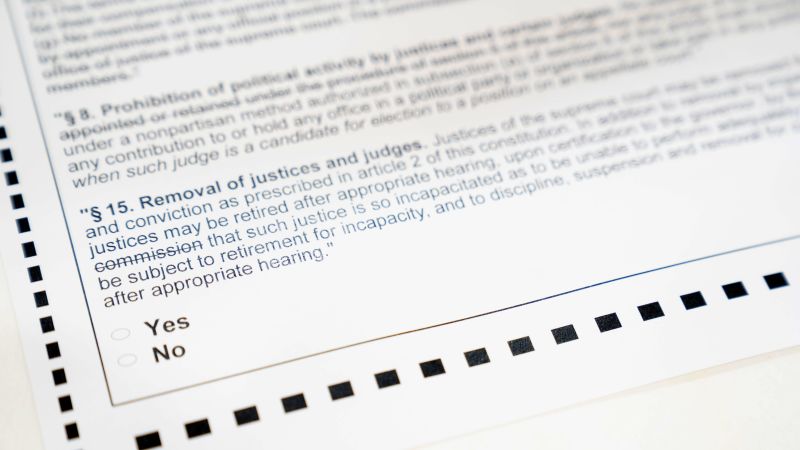
[ad_1] A version of this story appeared in CNN’s What Matters newsletter. To get it in your inbox, sign up for free here. The big headline out of Tuesday’s primaries was the slim victory of former public health official Abdul El-Sayed in Michigan’s Democratic Senate primary — proof that progressives are ascendant in the party, even in a key swing state. But two other results that barely registered in the national news chart another trend in US politics: the increasingly complicated relationship between Republican state legislatures and direct democracy. In Kansas, voters rejected a proposal placed on the ballot by the state’s GOP-dominated legislature that would have taken the power to appoint state Supreme Court justices away from a merit board and the state’s governor, a Democrat. Instead, the amendment would have given voters power to elect state Supreme Court justices, who have been a thorn in the side of the GOP-dominated legislature. That might sound like voter empowerment, but the longer-term intent was to elect judges opposed to abortion rights so the court might eventually overturn the right to abortion in the state’s constitution, which was affirmed by voters in a 2022 ballot initiative. Bottom line: Anti-abortion rights activists hoped to use this amendment to overrule voters’ decision to uphold abortion rights. But voters understood this and rejected the move. In Missouri, voters rejected a measure placed on the ballot by the state’s Republican-dominated legislature that would’ve made it much harder to pass amendments placed on the ballot by citizens gathering signatures. Legislators’ goal was to create a two-tiered system: Constitutional amendments proposed by voters would have had to win in every congressional district in the state to pass, while amendments proposed by the state legislature would still need just a statewide majority. The important additional context is that Missouri’s GOP-dominated government has already drastically gerrymandered the state’s congressional districts to benefit Republicans, including by erasing a Democratic seat earlier this year. Functionally, the change would’ve given conservatives veto power over constitutional amendments proposed by Democrats or progressives, even if they were broadly popular. It’s not just abortion rights that Missouri voters have endorsed in recent years, frustrating Republican legislators. They also expanded Medicaid and increased the state’s minimum wage. On taxes, Missouri voters on Tuesday rejected the legislature’s request to phase out the state’s income tax and, in theory, replace it with a sales tax, a priority of Republican legislatures elsewhere in the country. Missouri voters will not get the opportunity to weigh in on gerrymandering. The state’s top election official denied a citizen petition signed by hundreds of thousands of voters requesting a statewide vote on congressional districts enacted by the state’s GOP-dominated government. Supporters have promised to fight the decision in court. But voters will be asked to take another look at abortion rights. Missouri’s legislature is asking voters to repeal the citizen-initiated amendment they passed in 2024, but with a tweak, adding in the politically potent issue of banning transgender therapy for people under 18. Gerrymandering, the drawing of legislative maps for partisan gain, is frequently described as politicians picking voters instead of the other way around. In fact, Republicans were able to get the upper hand in the unprecedented mid-decade gerrymandering war this year in part because they did not have to consult voters about their plans to erase Democratic districts. In California and Virginia, Democrats redrew maps, but only after consulting voters in statewide referendums, as their laws required. Voters in both states approved the concept of new maps, but only California’s will go into effect. In Virginia, state Supreme Court justices are appointed by the state legislature and a majority made up mostly of justices appointed in years when Republicans controlled the legislature threw the voter-blessed maps out, ruling they did not adhere to a strict process. In Florida, there’s already a supermajority requirement (60%) for citizen-initiated amendments to pass. That’s why, in 2024, solid majorities of voters supported restoring some abortion rights (57.2%) and legalizing cannabis (55.9%), but neither became law. Rather than face such questions again, the state’s GOP-dominated legislature and Gov. Ron DeSantis made it much more difficult and expensive for citizens to add initiatives to the ballot. The new rules, enacted earlier this year, make it a felony to gather more than 25 signatures in support of an initiative without first registering with the state as a petition circulator. In the 17 states where voters have been asked to weigh in on abortion rights at the state level since Roe v. Wade was overturned, according to KFF, voters have supported abortion rights in all but three instances, in Nebraska and South Dakota, where majorities opposed abortion rights, and in Florida, where the supermajority requirement was not met. Five more abortion-related initiatives are currently expected to appear on statewide ballots in November. In many of these instances, the divide is between ballot initiatives proposed by citizens and those proposed by the state’s legislature. Citizens have the ability to place initiatives on the ballot in about half of states, according to the National Conference of State Legislatures. CNN’s Fredreka Schouten wrote last year about the surge of efforts to put new hurdles in front of these efforts, which are frequently backed by liberal groups who feel locked out of power in red states. South Dakota voters will vote in November on whether to impose a 60% threshold on citizen-initiated ballot initiatives. South Dakota voters will also take another crack at Medicaid. In 2022, South Dakotans voted to expand the program offering health insurance to low-income people, bringing it in line with most of the rest of the country under Obamacare. This year, the legislature is asking the voters to drop that expansion if federal funding drops. If the trend is for left-leaning groups to use the initiative process to counter conservative legislatures, there are exceptions. California voters in 2024 narrowly rejected a state law that would have created an $18 per hour minimum wage. An initiative that would have raised the minimum wage in Oklahoma was rejected by voters earlier this year. Supporters of the initiative were frustrated that the state’s leaders moved the question to the June primary rather than the November general election. Voters in most states, given the chance, have supported minimum wage hikes, including in Arkansas and Missouri. Oklahoma’s vote means it will retain the federal minimum wage of $7.25 an hour, the product of a 2007 law. Look for Democrats to try to raise that floor the next time they hold majorities in Congress. Voters, ultimately, hold the power. They could throw out the legislators they disagree with. But that power is muted by gerrymandered legislative maps that feed hyper-partisanship in US politics. It could all get worse if, as expected, the redistricting war restarts next year and politicians do even more to pick their voters instead of the other way around. CNN’s Ethan Cohen contributed to this report. [ad_2] Source link