




The Ontario Student Assistance Program (OSAP) calculator has been updated for the 2026-27 school year, giving students insight into how the recent cuts from the Ford government might affect their financial aid for college.
The changes to the program were revealed by the Ford government in February, alongside an end to a long-standing tuition freeze and billions in new funding for colleges and universities.
OSAP usually provides a combination of loans and grants for current or incoming post-secondary students to help cover their education costs. Although it’s managed at the provincial level, OSAP funding comes from both provincial and federal sources.
The adjustments impact the provincial part of OSAP and decrease the maximum grant amount that students can receive from 85 percent down to 25 percent, leading to concerns and protests from students across the province.
Example calculation shows a reduction in grant funds
utilized the online calculator for sample estimates comparing both the 2025-26 academic year-before these changes-and for the upcoming 2026-27 academic year affected by them.
A number of factors determine how much OSAP will offer, including what percentage will be allocated as loans or grants. These include household income and marital status.
CBC applied these criteria for its sample estimates:
The student is entering first-year university right after high school. The student plans to study at Toronto Metropolitan University pursuing a bachelor’s degree in biomedical science. The student lives at home during their studies and is considered dependent. The student does not have disability status nor identifies as Indigenous. The student has no declared assets or scholarships/bursaries. The household consists of married parents with two dependent children; only one child is enrolling in post-secondary studies. The total household income stands at $100,000.
For the 2025-26 year, based on this profile, that student would qualify for $9,100 from OSAP – with $3,100 available as grants and $6,000 offered as a loan.
For the following academic year of 2026-27, according to estimates from the updated calculator, that same student would be eligible for $9,500 – which seems like an increase compared to before. However, only $2,300 would come from grants while $7,200 would be issued as a loan-a drop of nearly $1,000 in grant money.
The OSAP online calculator includes a note stating you could qualify for more or less depending on your formal application process. It also doesn’t clarify how much of your estimated loan or grant amounts will come from either provincial or federal governments.
WATCH | Questions persist about Ford’s cuts to OSAP: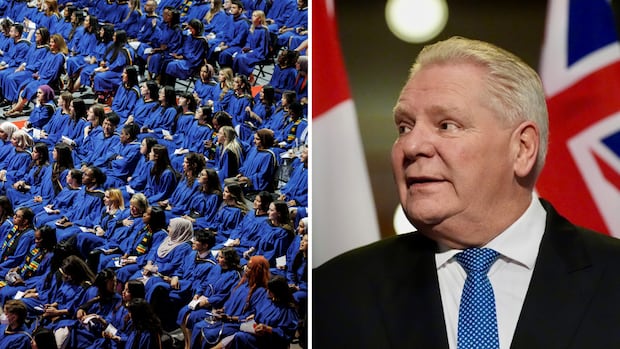
How will Ford’s OSAP cuts affect students? The answer isn’t so simple
Following Premier Doug Ford’s cuts to OSAP, there are ongoing questions about how exactly this program functions. CBC’s Julia Knope explains what we currently understand.
Bianca Giacoboni, press secretary for Ontario’s Colleges and Universities Minister Nolan Quinn, previously informed that these reductions align with funding models used by other provinces.
“To restore sustainability to the OSAP system that was facing a $2.3-billion pressure and ensure its availability for future generations, our government is aligning our student financial support framework with other jurisdictions across Canada,” she said in an emailed statement.
Source link