




The co-founder of a group called Truckers for Safer Highways says the province’s plan to widen a large section of Highway 11/17 in northwestern Ontario is long overdue.
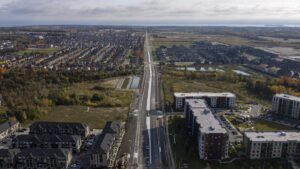
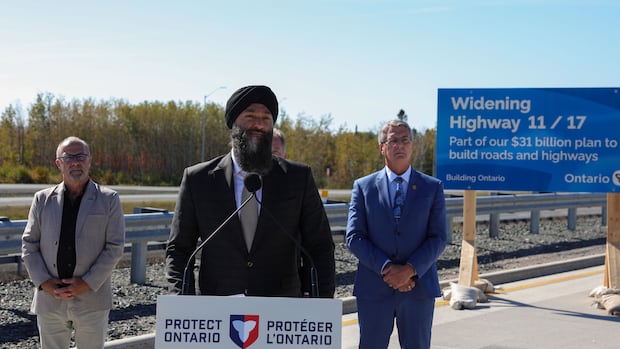
The Ontario government has announced the start of construction to widen 11/17 from Mc Guire Road to Coughlin Road, northwest of the existing two-lane corridor. The section will feature two lanes in each direction – separated by a grass median – and two new bridges across the Black Sturgeon River.
The work is part of the province’s plans to twin more than 107 kilometres of the Trans-Canada Highway between Thunder Bay and Nipigon.
“When you have more traffic and some drivers that are not as skilled in this poor weather, with less room for all these drivers, then it’s just a recipe for tragedy, disasters, issues,” said Travis Mc Dougall, a transport truck driver and highway safety advocate who drives across the country.
A map showing the planned improvements along Highway 11/17 between Thunder Bay and Nipigon. (Ontario government)
“The fact that they’ve been widening it, widening it and that they’re widening it more, it is a great thing.”
The announcement was made on Monday by Ontario transportation minister Prabmeet Sarkaria, who describes the corridor as “a key link, supporting Ontario’s position as an economic powerhouse, strengthening interprovincial trade and helping to reduce barriers that cost us billions of dollars annually.”
Sarkaria also announced 24-7 staffing at the $30 million Shuniah truck inspection station on Highway 11/17, a long-time ask of local leaders and groups such as the Northwestern Ontario Municipal Association (NOMA) and Federation of Northern Ontario Municipalities (FONOM).
The Shuniah truck inspection station in northwestern Ontario opened in 2024. (Ontario government)
“We thank Minister Sarkaria and the MTO (Ministry of Transportation) recruitment and training teams for working hard to recruit, train and mobilize new transportation enforcement officers to make this possible as we head into the fall and winter driving seasons,” said Rick Dumas, president of NOMA and the mayor of Marathon, in a news release on Monday.
Mc Dougall agreed that 24-7 staffing at the inspection station “is necessary.”
“We need to make sure that everybody’s following the rules,” he said.
Twinning vs. 2+1 model
As for future highway improvements, many in the region have advocated for further twinning of Highway 11/17 while others are pushing for something called the 2+1 model. This consists of three-lane highways with a centre passing lane that changes direction every two to five kilometres.
In a new publication released on Thursday, the Northern Policy Institute made the case for using the 2+1 model stating “twinning most highways in northern Ontario would cost too much and require northerners to wait too long for better, safer roads.”
Backed-up traffic is seen on Highway 11-17 in Thunder Bay, Ont., near Hodder Avenue following a multi-vehicle collision in Shuniah in this 2024 file photo. A section of the highway was closed for 12 hours. (Sarah Law/CBC)
“If Ontario primarily used the 2+1 configuration to upgrade northern highways instead of twinning these upgrades could be delivered sooner – without compromising on safety – and government could save billions of dollars,” said report author William Dunstan in a news release.
Despite this view, there are sections where twinning “would be a reasonable investment” including:
Highway 17 between Greater Sudbury and North Bay. Highway 17 between Greater Sudbury and Sault Ste. Marie. Highway 11/17 between Thunder Bay and Nipigon. Highway 11/17 between Thunder Bay and Shabaqua Corners.
New training requirements welcomed
Mc Dougall has long spoken out about dangers along Trans-Canada highway in northwest due to large single-lane sections lacking medians.
Add harsh winter weather plus trees rocks water nearby makes landscape unforgiving he explained.
“If you’re licensed in Ontario you can drive anywhere in Ontario North America so all drivers should be taught trained prepared all those conditions,” Mc Dougall said.
This kind training commercial truck drivers been lacking he noted however province recently announced new standardized entry-level truck driver training curriculum.
A mandatory six-month waiting period effective Jan.1 ,2027 before Class G or higher license holders can attempt Class A road test also introduced.
“We look forward seeing how these improvements actually come take effect make difference.” Mc Dougall concluded.
Source link