





From the outside, the 3.2-hectare stretch of grass around the Elgin County Railway Museum in St. Thomas, Ont., might seem like a nice park. But for Wil Zufelt, it’s something else entirely.
To him, it feels like a huge open wound.
“You say green space,” he mentioned. “We’re actually sitting in the middle of a brownfield site that was left behind from the railroads.”
Constructed in 1913, this large red-brick building used to be the Michigan Central Railway Locomotive Shops, where locomotives were serviced and repaired by a workforce of 400 people. It’s one of only three remnants from what was once a vast railway complex featuring 112 buildings.
The old structure now serves as a museum but cannot accept visitors because it’s literally falling apart. The city engineer ordered it shut down after discovering its walls were bowing and its ceiling posed safety risks.
‘People need to notice what we’re losing’
“People need to wake up,” Zufelt said. “Pay attention to what we’re losing.”
The former Michigan Central Railway Locomotive Shops occupy 3.2 hectares of former railway land in St. Thomas, Ont. Built in 1913, this building is now home to the Elgin County Railway Museum but is closed due to structural issues. (Patrick Morrell/CBC News)
Zufelt leads Railworks, an organization focused on preserving three remaining railway landmarks in St. Thomas. He’s initiating a campaign aiming to raise $8 million for saving and restoring these locomotive shops.
The vision is to transform these old shops into more than just a museum; they aim to create an active community hub at the heart of a revitalized downtown.
“I want it to be more than alive. I want it to be the center of St. Thomas,” he stated. “That’s what success looks like – bringing life back into the core and letting everything flow out from there.”
By 1914, eight railroads met in St. Thomas, allowing over 100 trains daily through this southwestern Ontario city. Its strategic location made it a vital hub for American rail traffic between Detroit and Buffalo and between New York and Chicago; so significant was this connection that at one time St. Thomas even hosted a U. S consulate.
Now, however, this community known as the “Railway City” has no rail service whatsoever.
Tracks that lead nowhere
The railways may be gone now, but their traces remain scattered throughout the city – empty lots filled with debris from previous railway structures, abandoned switching yards, railroad spikes popping up like seashells on shorelines and tracks that wander aimlessly without purpose.
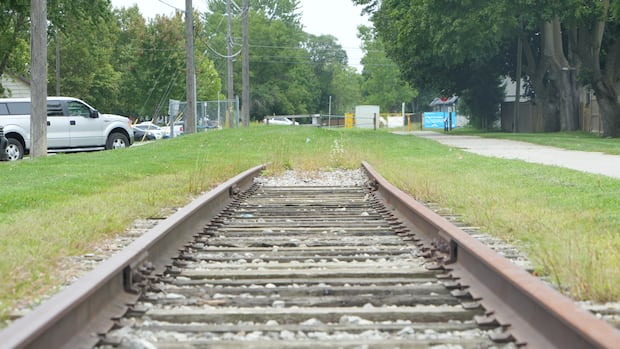
The former London to Port Stanley Railway passes by a renovated station in St. Thomas before suddenly ending – vanishing into residential grasslands.
A section of railway track ends abruptly in St. Thomas, Ont., where a missing connection has been under federal order for CN to restore since 1990. Across Canada, communities seeking passenger rail revival are facing what’s left after years of decline.(Colin Butler/CBC News)
This lost link was addressed by a federal transport order back in 1990 requiring CN to replace it at their own cost once reaching CN tracks; however, that physical connection never materialized.
Currently part of that route is blocked off by an enclosed parking lot.
The Canadian Transport Agency informed CBC News that the order remains active and would still apply if restoration occurred.
CN did not respond when asked for comments before publication time.
St. Thomas reflects Canada’s railway changes
St. Thomas serves as an especially clear example illustrating how communities across Canada experienced similar fates as rail services dwindled according to historian Thomas Blampied who studied Canada’s railway past at the University of Toronto.
The former Canada Southern Railway Station stands as one of few historical landmarks remaining from when St. Thomas was among Canada’s busiest railway hubs; built-in 1873 it’s one among just three historic railway structures left out of what used to be over 112.(Colin Butler/CBC News)
“Cars began taking away passenger income from railroads while trucks grabbed freight traffic,” he explained.
As travelers switched over cars and goods transitioned towards trucks instead of trains many routes became too unprofitable causing numerous lines’ abandonment along with much infrastructure being dismantled alongside them.
Canada strives toward reviving passenger trains
Transportation policy expert Anthony Perl from Simon Fraser University pointed out how loss led operators removing passing tracks amongst other necessary elements transforming infrastructures focusing solely freight needs following passenger train disappearances. p >Northern Ontario tourism advocates hope reinstating Northlander passenger service will boost regional visits.(Submitted by Ontario Northland )
“ We had extensive streamlining or right-sizing or value engineering depending on which term you prefer within national railroad frameworks paralleling passengers fleeing.” Perl noted “ It mattered since today’s efforts involve trying reintroducing passengers onto systems many places either vanished or revamped altogether.”
In Ontario specifically authorities prepare reestablishing Northlander connections linking Toronto northward again post-cancellation decade ago whilst federally new high-speed routes called Alto aimed stretching between both cities also benefit individual track usage mostly unchanged.
Communities across regions including Vancouver Island Alberta Calgary-Banff route Cape Breton drive renewed ambitions reclaiming their respective passenger lines too.
The advantage behind track ownership h2>
However unlike airlines trucking firms Canadian networks possess unique control maintaining essential infrastructures laid down therefore facilitating seamless operations throughout country’s vast terrain. p >![]() Abandoned freight cars lie dormant amidst wild vegetation inhabiting ex-shunting yard remnants within town proving testament sprawling history encompassing major urban links across continent today.(Colin Butler/CBC News )
Abandoned freight cars lie dormant amidst wild vegetation inhabiting ex-shunting yard remnants within town proving testament sprawling history encompassing major urban links across continent today.(Colin Butler/CBC News )
“No alternatives exist constructing additional sets rails nationwide,” Perl emphasized “ This power influences decisions whether lay remove specific areas’ existing tracks becomes reality.” p >
“ Even government orders carry weight yet take considerable time fulfilling requests due inherent ownership dynamics governing industry standards present ” added Perl reinforcing root influence stemming deep-seated traditions embedded company cultures emphasizing lack transparency accountability overall. p >
Source link