



May 04, 2026 • Last updated 4 days ago •
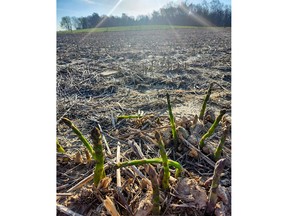
The asparagus crop at Dalton White Farms near Delhi, Ontario faced nearly complete destruction due to frost as night temperatures dropped to -4 C in Norfolk County on Saturday, May 2, 2026. Photo by Rebecca Compton /Dalton White Farms
Drastic overnight temperature drops over the weekend caused serious frost damage to crops in Norfolk County.
This has not loaded yet, but your article continues below.
“We lost about 98 per cent of our field. It was almost a 100 per cent loss,” said Rebecca Compton, manager at Dalton White Farms near Delhi. “We have guys that have been working with us in asparagus for 25-plus years, and none of them have seen the level of damage that we got on Saturday night.”
She mentioned that around five per cent of their asparagus crop was affected on both Thursday and Friday nights, while they’re assessing the overall damage today.
“It’s almost the whole field that’s gone,” Compton pointed out, estimating losses between $50,000 to $100,000.
The farm manager explained that asparagus is unique because after planting it isn’t harvested for three years. Afterward, it can be harvested multiple times throughout the season for about two decades.
While the frost damage is limited to the already sprouted asparagus, Compton noted that the field should recover in about a week or so.
“The plant is continually producing,” she observed. “It will all depend on the temperatures. The warmer it is, the faster it will regenerate so we have to depend on Mother Nature to give us some sun and some heat. Hopefully it will be growing again by the weekend.”
This has not loaded yet, but your article continues below.
On Monday, farm workers spent time removing dead asparagus plants; some had fallen over or became “soft and mushy”.
“We sell wholesale and work with a lot of local retail stores and farmers markets, and sell off our farm,” Compton stated.
In addition , she hasn’t had a chance yet to check their blueberry crop.
“I’m hopeful that the stage the plant was at should be able to withstand down to -3 C. I know that in this area we were at -4 C for several hours,” Compton mentioned. “I’m hopeful we didn’t have as extensive a loss in our blueberry crop as we did in our asparagus. Sometimes it takes a couple of days to show up , so you don’t really know the extent of it.”
In Brant County , Andrew Pate of Brantwood Farms said temperatures in Norfolk were “way colder” than what he experienced at his operation on German School Road , north of Brantford.
“For some reason we were in this little belt that stayed warmer,” he noticed. “I know north of us and south of us got really cold. We definitely had frost. It was a little too early for frost to have affected apples – we lost a little bit – but not anything significant.”
This has not loaded yet , but your article continues below.
Pate believes his 20 to 25 acres of strawberries should be fine after the frost.
“We put a row cover down. They look like giant white blankets and that keeps us good to about -2 C. That’s kind of where we got to this week. We will still have a crop.”
Pate explained they laid down blankets around late March which keep plants warm and help strawberries come earlier. A second layer was added once they saw there might be frost risk.
“Each blanket covers about an acre , measuring 60 feet wide by 1,000 feet long,” he described. “They’re like giant parachutes so you don’t put them out when it’s windy.”
bethompson
This has not loaded yet , but your article continues below.