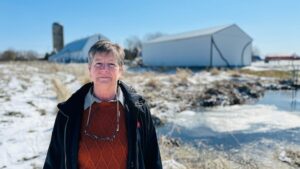



A farmer from eastern Ontario believes that a conservation area she built on her land could help Canada achieve its environmental goals.
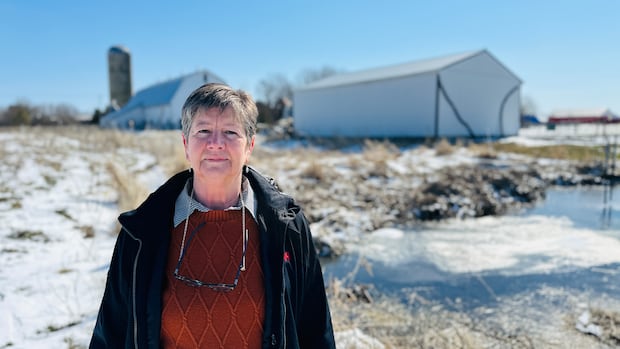
At her small beef farm close to Winchester, where her husband’s family used to run a large dairy operation, Jackie Kelly-Pemberton has developed a wetland.
With cattle outdoors all year round, “we wanted a way to manage the manure runoff,” she explained.
This wetland features sedges, bulrushes, cattails, and ponds that filter barnyard runoff before it reaches her property line and flows into the South Nation River and eventually into the Ottawa River.
“Water has no boundaries and fences don’t hold it in. Water quality has always been important to me,” said Kelly-Pemberton.
The project received expertise and funding from ALUS, which was previously known as Alternative Land Use Services. This Canadian organization supports farmers in creating conservation projects on their lands.
WATCH | Hopes that a built wetland can be a model for others:
Farmer-led conservation projects could help Canada meet national targets
Farmland stewardship could help Canada reach its conservation targets. The CBC’s Stu Mills explains how.
ALUS President Jordan Sinclair mentions that nature-based farmland initiatives like this one could contribute 65,000 hectares towards the federal government’s nature protection goals.
“We’re not looking at converting productive acres of the farm, but [rather] those edge-of-field projects where the farmer’s not making money anyway,” Sinclair said.
Last month, Prime Minister Mark Carney introduced a new nature strategy for Canada aiming for “30 by 30” – referring to the national plan to protect 30 percent of lands and oceans by 2030.
That’s roughly double what is currently protected.
The strategy, released March 31, includes encouraging businesses and investors to provide private funding for conservation efforts. It also involves acknowledging areas known as “other effective area-based conservation measures,” or OECMs, which are protected by local communities and private groups.
“Creating these spaces is ambitious and requires significant funding,” Carney stated during that news conference. “We can’t do it with public money alone.”
For an area like Kelly-Pemberton’s to be recognized as an OECM, it needs defined boundaries, allows authorities control over activities within those limits, and prohibits actions that would conflict with conservation aims according to Environment and Climate Change Canada.
Source link
Source link