

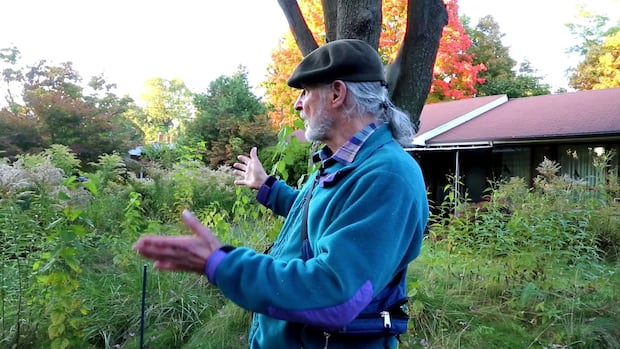
A Mississauga man has successfully challenged the city in court over a bylaw that restricts homeowners from having certain plants and grass taller than a specific height.
Wolf Ruck, the owner of the lawn involved in the case, shared with CBC Radio’s Metro Morning on Friday that his main focus is on protecting nature.
“I felt that this is something that I could do personally, in order to address the problem of biodiversity decline and global warming,” he said.
This past Tuesday, Ruck won a self-represented case against the City of Mississauga, contesting part of a weed control bylaw that forbids grass from exceeding 20 centimetres and prohibits specific plants. Ruck sought $2.46 million in damages and other relief but was not granted any money according to the ruling.
However, parts of the bylaw were found to infringe on Ruck’s right to freedom of expression, as noted by Justice M. T. Doi in her decision.
“In this case, I find that the impact of the By-law’s tall grass and nuisance weed provisions on the right to freedom of expression is relatively serious,” stated the decision.
The City of Mississauga is currently reviewing the ruling and considering its next actions, Irene Mc Cutcheon, a spokesperson for the city informed via email on Thursday.
![]() Wolf Ruck seen watching birds in his property in Mississauga. (Andréane Williams/Radio-Canada)
“To enforce the By-law, the City arranged to cut his grass that exceeded allowable height, removed nuisance weeds from his property, and added those costs onto his property tax bill,” stated the ruling.
Ruck explained that after leaving parts of his lawn uncut for some time, weeds started growing from seeds blown by wind-aligning with his aim to promote biodiversity and pollination.
“The lawn basically consists of islands that are surrounded by a pathway that is regularly mowed,” Ruck said. “So it’s not as if the entire property was just left to grow wild.”
The city referred to an internal report as part of its argument highlighting how their bylaw “contributes to a healthy and safe environment for occupants within the City.” It also mentioned conducting research into what other municipalities have done regarding regulating tall grass and nuisance weeds.
However, Doi’s ruling pointed out “No evidence was led to show how a maximum grass height of 20 cm or removing enumerated nuisance weeds would impact public health or safety or ecological diversity in urban settings where this By-law applied.”
The ruling further noted “it is not sufficient for [a municipality] to say, ‘we are doing what everyone else is doing’ [as they] must present evidence showing they searched for a minimally impairing solution.”
Ruck remarked it’s a “sad outcome” seeing his relationship with neighbors decline but he hopes this Justice’s decision regarding freedom of expression sets an example going forward.
Mississauga’s evidence fell short lawyer said
John Mather, an attorney representing the Canadian Constitution Foundation-a charity involved in supporting this case-stated as it stands now; Mississauga’s bylaw can no longer be enforced legally.
“Basically whatthecourt hassaidto Mississaugaisifyouaregoingtolimithowpeoplecanusetheirlawns, youneedtodoitwithevidence,”hetold Radio-Canadaon Friday.
“Youhavegotogothroughtheexerciseasagovernmenttofigureoutwhatactuallyisthethreatherewhatistheactualrisk? Whatisthethingweneedtostop?”
Thismightinvolveaddressingissueslikefirerisk, invasivespeciesandappearancewhilealsobalancingindividualfreedomofexpressionrights, Matheradded.
“Ithinkanymunicipalitythat hasanyweedcontrolbylawswill.. needtolookat Justice Doi’sdecision,”hesaid.
Wolf Ruck seen watching birds in his property in Mississauga. (Andréane Williams/Radio-Canada)
“To enforce the By-law, the City arranged to cut his grass that exceeded allowable height, removed nuisance weeds from his property, and added those costs onto his property tax bill,” stated the ruling.
Ruck explained that after leaving parts of his lawn uncut for some time, weeds started growing from seeds blown by wind-aligning with his aim to promote biodiversity and pollination.
“The lawn basically consists of islands that are surrounded by a pathway that is regularly mowed,” Ruck said. “So it’s not as if the entire property was just left to grow wild.”
The city referred to an internal report as part of its argument highlighting how their bylaw “contributes to a healthy and safe environment for occupants within the City.” It also mentioned conducting research into what other municipalities have done regarding regulating tall grass and nuisance weeds.
However, Doi’s ruling pointed out “No evidence was led to show how a maximum grass height of 20 cm or removing enumerated nuisance weeds would impact public health or safety or ecological diversity in urban settings where this By-law applied.”
The ruling further noted “it is not sufficient for [a municipality] to say, ‘we are doing what everyone else is doing’ [as they] must present evidence showing they searched for a minimally impairing solution.”
Ruck remarked it’s a “sad outcome” seeing his relationship with neighbors decline but he hopes this Justice’s decision regarding freedom of expression sets an example going forward.
Mississauga’s evidence fell short lawyer said
John Mather, an attorney representing the Canadian Constitution Foundation-a charity involved in supporting this case-stated as it stands now; Mississauga’s bylaw can no longer be enforced legally.
“Basically whatthecourt hassaidto Mississaugaisifyouaregoingtolimithowpeoplecanusetheirlawns, youneedtodoitwithevidence,”hetold Radio-Canadaon Friday.
“Youhavegotogothroughtheexerciseasagovernmenttofigureoutwhatactuallyisthethreatherewhatistheactualrisk? Whatisthethingweneedtostop?”
Thismightinvolveaddressingissueslikefirerisk, invasivespeciesandappearancewhilealsobalancingindividualfreedomofexpressionrights, Matheradded.
“Ithinkanymunicipalitythat hasanyweedcontrolbylawswill.. needtolookat Justice Doi’sdecision,”hesaid.
Source link
City received ‘multiple complaints’
Ruck has been part of the Orchard Heights community since the 1970s but stopped mowing his lawn in 2021, which led to an ongoing dispute. The ruling indicated that Mississauga received its first complaint about Ruck’s tall grass back in August 2021. Afterward, there were “multiple complaints” filed in June and July 2022 along with another complaint in May 2023. The enforcement process for bylaws kicks off following complaints that municipal law enforcement officers investigate according to the ruling. Following a complaint made in May 2023, the city issued a notice of contravention.Source link