





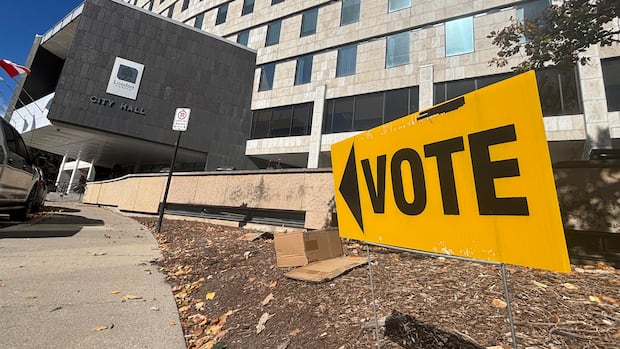
Over 100,000 residents of London voted in Monday’s local election, but around 230,000 chose not to participate.
According to city officials, just over 103,000 eligible voters took part in the municipal vote this week, resulting in a turnout rate of only 31 per cent – an increase from the 25 per cent seen four years ago, but still far below the average of 40 per cent recorded between 1994 and 2018.
Across Ontario, about 36 per cent of eligible voters cast their ballots on Monday, up from 32.9 per cent in 2022, as reported by the Association of Municipalities of Ontario (AMO).
Experts believe boosting these numbers will be quite challenging.
“In general, municipal elections are low-information elections, so it’s hard for voters to find information about candidates, and it’s becoming increasingly hard as the media landscape changes and there’s less local coverage,” said Joe Lyons, an assistant professor of political science at Western University.
This is one reason why municipal elections often see lower turnout compared to federal and provincial ones.
“People don’t always see local decisions as being political; they sometimes view them as more technical. But in reality, these are political decisions,” Lyons stated.
“Road extensions and planning choices all have significant effects on our built environment. However, they might not seem as exciting as topics like trade negotiations or social services.”
Some municipalities did better on Monday; Toronto’s turnout reached nearly 46 per cent-showing how a competitive race can motivate voter engagement.
Lyons noted that homeowners and residents of smaller towns tend to vote more frequently than renters or those living in larger cities; however, he pointed out that more research is needed.
“I guess in a smaller municipality your vote feels more impactful. That could encourage people to show up at the polls.”
He also mentioned that since local elections aren’t tied to parties directly, it’s harder for voters to understand where candidates stand politically. Still, he noted some studies suggest that having a party system might not significantly influence turnout rates.
WATCH | Matt Brown and Martin Horak dig into the election results:
Breaking down London’s election results and the new council
London Morning examined the municipal election figures along with political scientist Martin Horak and former mayor Matt Brown.
“It’s what happens between elections that really matters,” said Martin Horak during a Wednesday discussion on London Morning alongside former Mayor Matt Brown.
“The city needs to focus on showing why their services and programs matter to Londoners,” he explained.
Other places like Tillsonburg allow phone voting options too,” Brown mentioned.
“London can do better,” he added.