





London city councillors voted unanimously Tuesday to urge the province to take a closer look at how private pharmacies are handling safe-supply medications for treating opioid addiction.
In a 12-0 vote, council – convening as the Strategic Priorities and Policy Committee – supported a motion introduced by Coun. David Ferreira.
This motion asks Mayor Josh Morgan to send a letter to Ontario’s health ministry and the organizations that oversee doctors and pharmacists in Ontario, requesting an immediate review of “for-profit addiction treatment and dispensing models in Ontario.”
The motion also emphasizes the need for stricter oversight from the province regarding how safe supply medications are given out. It advocates for moving away from private models of medication dispensing for addiction treatment and switching to a “publicly funded fully integrated health model that provides comprehensive addiction treatment.”
LISTEN | Coun. Ferreira on London Morning:
London Morning6:59Does safe supply need to change?
London City Councillor David Ferreira has expressed concerns about how addiction treatment drugs are being distributed in the downtown area. Ferreira joined London Morning to talk about it.
In an interview earlier Tuesday on CBC’s London Morning, Ferreira mentioned that using private pharmacies for safe supply medication contradicts effective care for individuals dealing with opioid addiction.
“The for-profit model is about customer retention,” said Ferreira. “The model that we should be looking for is for people to get stabilized. The two are at odds with each other.”
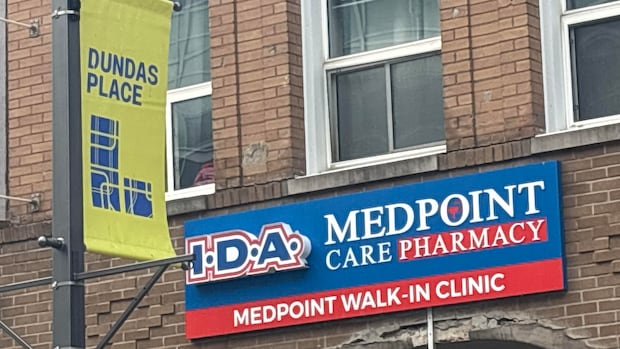
Ferreira first brought up this issue back in February, highlighting five private pharmacies located on Dundas Street that work with New Dawn Medical. This company runs addiction treatment clinics within their partner pharmacies across the province. Clients can consult with doctors, often via virtual appointments, and have their prescriptions filled on-site during one visit.
I reached out to New Dawn on Tuesday for an interview but was informed that no one from the company was available.
The safe supply treatment model aims to help patients gradually reduce reliance on dangerous opiates like street-supplied fentanyl by providing them with prescribed pharmaceutical-grade medications.
Clients line up outside the Medpoint Pharmacy location at 248 Dundas St. Diversion, where dispensed medications are re-sold, has been flagged as an issue by local businesses. (Travis Dolynny/)
Ferreira pointed out that a lot of medication handed out at these private clinics gets re-sold, which leads to open drug use and trading in nearby neighborhoods.
Health ministry responds with statement
In response, Ontario’s health ministry issued a statement saying they expect both pharmacies and doctors to adhere strictly to existing rules when prescribing medications for opioid addiction.
“It is unacceptable for pharmacists and physicians not to follow guidelines,” the statement said. “The ministry expects regulatory colleges, including the College of Physicians and Surgeons (CPSO) and the Ontario College of Pharmacists (OCP), respectively, to investigate complaints related to unprofessional conduct, failure to meet standards of practice, inadequate care, billing issues, among others.”
“The CPSO and OCP have existing policies that outline expectations regarding opioids-this includes guidelines around safe prescribing and dispensing,” stated the release.
Morgan expressed his support for the motion as well as its key message: current resources aren’t sufficient enough to tackle an addiction crisis that’s both complex and widespread.
“Some people just can’t manage without medical supervision which creates significant challenges in various parts of our city,” Morgan added.>
Stevenson: Safe supply is the problem
Not all council members were entirely on board with Ferreira’s motion.>
Coun. Susan Stevenson backed it but mentioned that she believes the core issue lies within the safe-supply model itself-something she noted isn’t endorsed by Doug Ford’s provincial government.>
“This tries addressing issues seen on Dundas Place while still supporting safer supply,” Stevenson explained. “If this council wants align with what’s happening at provincial level-to say ‘We don’t want safer supply anymore’-I’m all in favor.”>
Ferreira emphasized it’s essential that we let provincial authorities know it’s time reconsider their approach towards profit-driven models.>
“It’s clearly not helping those who seek ways out from substance abuse,” he stated.>
The motion will move forward for final approval during next full council meeting.پ>
Source link