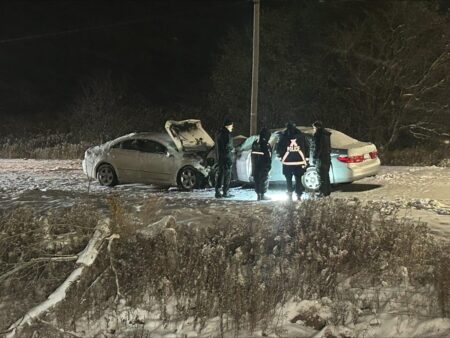





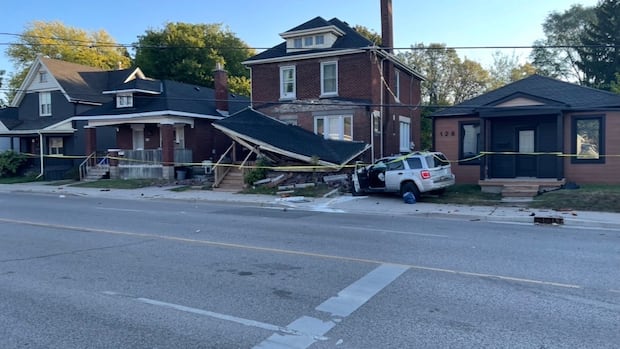
Bill Van Beers finds himself being more cautious as he watches cars zoom past his home on Adelaide Street in central London, Ont.
His residence is among at least 50 buildings struck by vehicles in 2025, a figure so alarming that safety advocates describe it as shocking.
“Shocking. Shocking that the number is actually 50,” said Angelo Di Cicco, who leads the Ontario Safety League. “I would have expected at least five, but 50 is a huge amount.”
Data obtained via a freedom-of-information request from London police revealed that 47 vehicles crashed into buildings in both years 2023 and 2024.
In just the first ten months of 2025, that count reached 50. On average, that’s five cars colliding with buildings every month in London.
“In my experience, it turns out to be simple errors that result in those types of crashes, which many people shake their heads at,” Di Cicco mentioned. His non-profit organization offers safety training to communities and professional drivers aiming to lower preventable deaths and injuries across the province.
The crash outside Van Beers’s house on October 5 destroyed his front porch.
“I heard a loud bang,” said Van Beers, “I saw one of the hydro wires swinging and I thought they had just hit a hydro pole. I didn’t realize they had hit the house and did as much damage as they did.”
A driver faced charges for impaired driving, impaired driving exceeding blood drug concentration and taking a motor vehicle without consent, police stated.
Months after the incident, Van Beers remains watchful of drivers passing by his home while he arranges for repairs.
“Everybody is always speeding by,” he noted. “I see a lot of distracted drivers. You can see there’s quite a few people on their phones, texting, doing whatever. It’s definitely a problem.”
Crews get to work on repairs on Van Beers’s porch. (Submitted)
There isn’t one specific reason why London drivers crash into buildings according to Acting Sgt. Greg Pearson from the road safety section at London police. He mentioned impaired driving, navigation errors and pedal confusion as frequent factors behind these incidents.
“Ultimately, we would like to see zero [crashes into buildings],” Pearson added. “I think that’s the goal for all police services in the country. But getting there is going to be difficult.”
Cases of pedal or gearing confusion are less likely to cause severe injuries for drivers because many occur at lower speeds with less momentum involved. However, there’s always an increased risk posed to unsuspecting pedestrians and individuals inside affected buildings.
A significant case regarding pedal confusion that London residents might remember occurred back in 2014 when a woman accidentally pressed the gas instead of brakes outside a Costco store in London; she struck a family resulting in the death of a six-year-old child while seriously injuring her pregnant mother who also lost her unborn child.
Pedal confusion often arises from distractions according to Di Cicco. He also pointed out that newer drivers may not have had sufficient practice before taking their tests due to disruptions caused by the COVID-19 pandemic; some may have skipped professional driver training altogether without developing necessary low-speed maneuvering skills prior to receiving their licenses.
Professional drivers should undergo retesting every three to five years according to him while others ought to self-test and assess their cognitive abilities along with mechanical skills required for safely operating an automobile at least once every ten years.
“The reality is that distraction is the No. 1 leading cause of incidents that we see here at the Ontario Safety League,” Di Cicco emphasized. “Multi-tasking is a lie.”
In Waterloo Region ,63 vehicles crashed into buildings during year **2024**. In **2025**, that number rose slightly , with **67** such accidents reported , according Waterloo Regional Police Service.
Source link