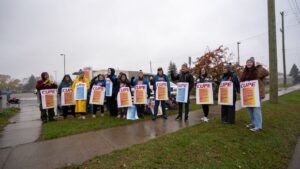






On Friday, attorneys for residents of the Kitchener encampment argued in court that the region needs a better approach for those it plans to evict – particularly for those in vulnerable situations.
This was the second of three planned court days with Kitchener Justice Michael Gibson.
The region is seeking guidance on a site-specific bylaw for 100 Victoria St. N., which would permit the region to clear the lot. The bylaw makes it illegal for anyone to reside on the property after December 1, 2025.
Earlier this year, regional council approved amendments to the bylaw aimed at having individuals leave the site by April 1.
The region states it requires the property, which it owns, for construction crews who will begin preparing to build a new transit hub at the corner of King and Victoria streets.
A Kitchener judge ruled in January 2023 that the region couldn’t evict individuals from this location without providing them with alternative housing.
The return to court follows failed mediation discussions between regional representatives and lawyers for encampment residents last December.
While this case remains active in court, no one has been asked to vacate the site yet.
The region’s attorneys contended on Thursday that residents need to vacate so Metrolinx can access the property by June.
The region asserts there are no anticipated delays regarding its transit hub project.
Region Claims Eviction Bylaw Isn’t Discriminatory
On Friday, an attorney representing encampment residents stated that the bylaw unfairly affects vulnerable populations like Indigenous people, individuals with disabilities, and women.
However, regional lawyer Andrew Lokan disagreed with this view.
“The bylaw treats everyone in the encampment the same,” he remarked, emphasizing that all residents face identical eviction orders regardless of their individual backgrounds or challenges.
“They [Indigenous residents] are not disadvantaged any more than those who are not Indigenous,” Lokan stated.
Lokan mentioned that “the region does not want involuntary removals if possible” and urged the judge to consider preventing new individuals from settling on-site, allowing a “responsible wind down of the encampment” before June’s deadline.
“The region genuinely needs and wants a roadmap for what it must do to close down the encampment,” he added.
Attorney Andrea Bolieiro represented Ontario’s Attorney General in support of closing down the encampment.
“It’s not about excluding specific members of community. It’s about excluding all members of community for a specific public purpose,” she noted while asserting that what is happening isn’t outside societal norms.
She requested that courts weigh rights of those living at encampments against broader public interests within Waterloo Region, stressing that using land as an encampment conflicts with plans for constructing a transit hub.
‘Where Will People Go?’ Asks Lawyer
Lawyer Shannon Down from Waterloo Region Community Legal Services represents most residents living at these sites.
She questioned why there’s no long-term plan available concerning where people should go once they’re evicted from 100 Victoria street.
“Where does the region want homeless people to go when 100 Victoria closes?” she posed as a pressing question.
Down highlighted how these camps offer options unavailable through existing shelters-such as keeping couples together since many shelters often segregate based on gender roles.
During Thursday’s arguments presented by officials claiming original camp inhabitants have relocated since early 2022; Down disputed this point directly stating “Encampments are fluid.. seasonally variable.”
Additonally pointing out current transitional housing waitlists show couples would need to wait behind over eleven thousand others just hoping find safe homes together!.
.
.
.
.
.
Women Face Unique Risks Outside Encampments
Ashley Schuitema also represented some members residing within said camps alongside her colleague Down saying women identifying persons encounter heightened dangers without community supports found here..A significant part discussed involved consequences stemming primarily upon dismantling said camps likely leading many losing vital belongings including medications identification papers survival gear – forcing them back into homelessness starting completely over again potentially worsening mental health conditions already present too!.
SHE referenced an affidavit written BY A FEMALE former resident detailing circumstances after being temporarily housed elsewhere (Super Eight) until ultimately faced eviction back outside only returning later discovering belongings destroyed!.“These harms aren’t just hypothetical-they’re supported through expert evidence & testimony.” Schuitema asserted firmly!
TALKING NUMBERS SHE HIGHLIGHTED THERE IS AN INSUFFICIENT NUMBER OF SAFE INDOOR SPACES AVAILABLE SPECIFICALLY FOR WOMEN DEALING WITH HOMELESSNESS THROUGHOUT WATERLOO REGION WHILE THOSE WITHOUT ACCESS TO SAFE PLACES LIKE YWCA FACE DIFFERENT RISKS SUCH AS ASSAULT/SEXUAL SOLICITATIONS WHEN LIVING STREETS SHE REPORTED!!
SCHUITEMA CONTINUED SHARING MORE AFFIDAVITS FROM OTHER WOMEN WHO ALSO LIVED WITHIN THE ENCAMPMENT INDICATING VIOLENCE INCLUDING PHYSICAL ASSAULT URINATION/SEXUAL HARASSMENT EXPERIENCING SAFER FEELINGS ONLY AFTER MOVING INTO THE CAMPSITE!!
THE HEARING’S SCHEDULED RESUMPTION WILL TAKE PLACE ON MONDAY!
Source link


