





August 2, 2026
Just three days prior to this survey starting, U. S. President Donald Trump put into effect proclamations that imposed an extra 50% tariffs on various Canadian goods, such as wine, hockey sticks, and cement. These tariffs will also impact goods that qualify under the United States-Mexico-Canada Agreement and are set to begin on August 19.
On the first day of data collection, Prime Minister Mark Carney gathered with Canada’s premiers and territorial leaders in Charlottetown. He stated that Canada was stepping up talks with the United States but was ready to react if the tariffs came into play, mentioning that “everything’s on the table” should an agreement not be reached.
Simultaneously, extensive wildfires were raging across the nation. By July 20, Ontario had reported 190 active fires, with 56 deemed out of control. Thirteen communities had either been evacuated or were in evacuation processes, displacing over 1,800 individuals.
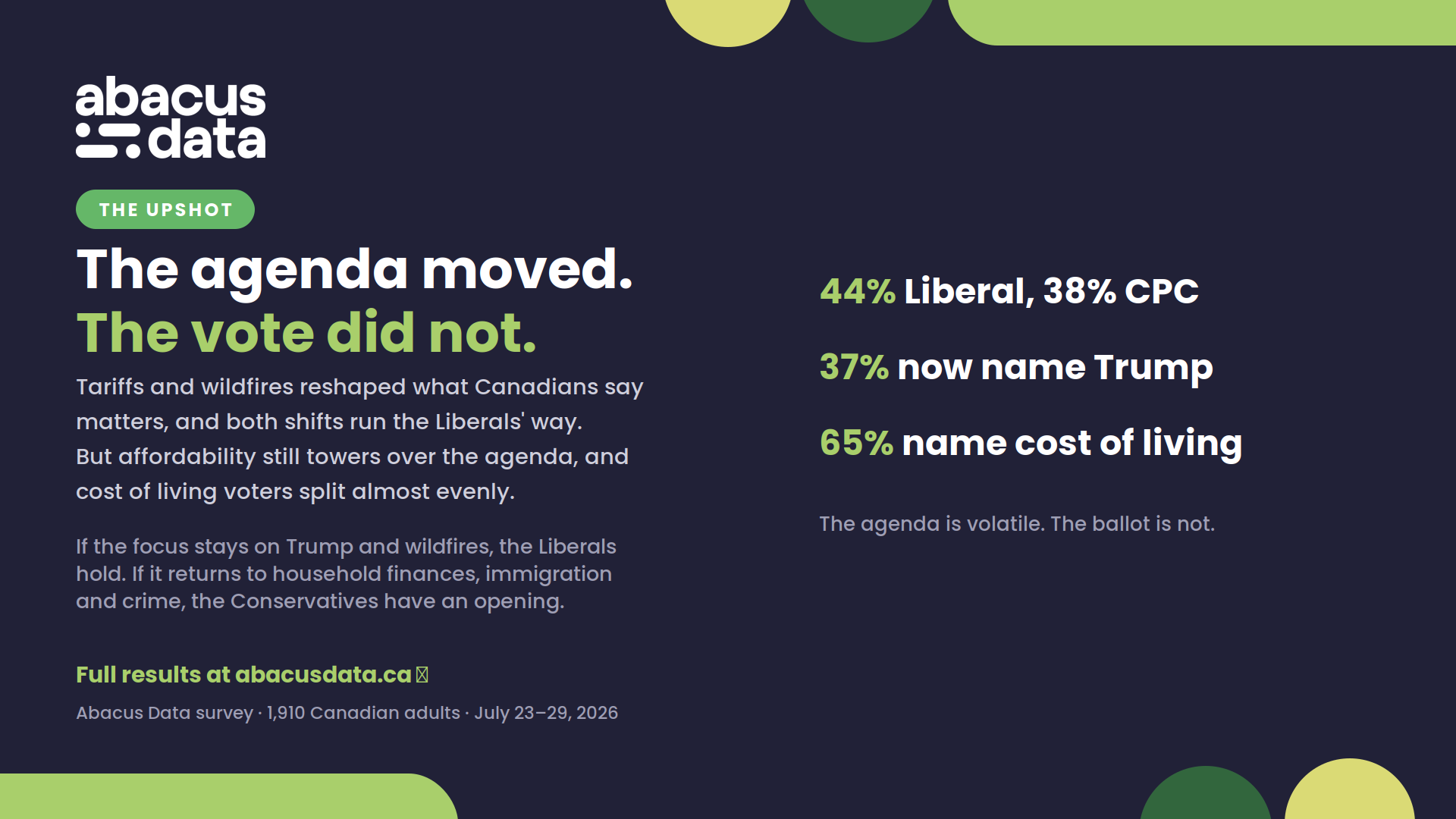
Our most recent national tracking survey involving 1,910 Canadians conducted from July 23 to July 29 shows that these events have not significantly altered voting intentions or evaluations of the government.
The Liberals still hold a six-point lead over the Conservatives. Government approval ratings stay above 50%. Mark Carney enjoys a significant personal edge over Pierre Poilievre.
However, what is capturing Canadians’ attention has shifted.
Worries regarding Donald Trump and his administration have risen by six points, making it now the second most commonly identified issue facing the country. Concerns surrounding climate change and environmental issues increased by three points (7 over one month), as wildfires led to evacuations and smoke affecting air quality became more visible.
Liberals Continue to Lead by Six Points
If an election were held today, 44% of committed voters would choose Liberal candidates; meanwhile, 38% would support Conservative candidates; 9% would opt for NDP candidates; while Bloc Québécois would get around 6%, and Green Party would receive about 3%.
In comparison to our previous survey completed on July 16th, both Liberal and Conservative support are up by one point each. Support for NDP and Green parties remains unchanged while Bloc Québécois fell by one point.
Consequently, there remains an unchanged six-point advantage for Liberals.
Among those who declare certainty about their vote choice, the Liberal lead stretches out to eight points. The Liberals earn about 45%, compared to Conservatives at roughly 37%, with NDP receiving around nine percent. This indicates a slight increase in turnout for Liberals alongside a minor decrease for Conservatives.