



Penn Political Union welcomed former ambassador David Cohen for a fireside chat focused on the relationship between the United States and Canada this past Tuesday.
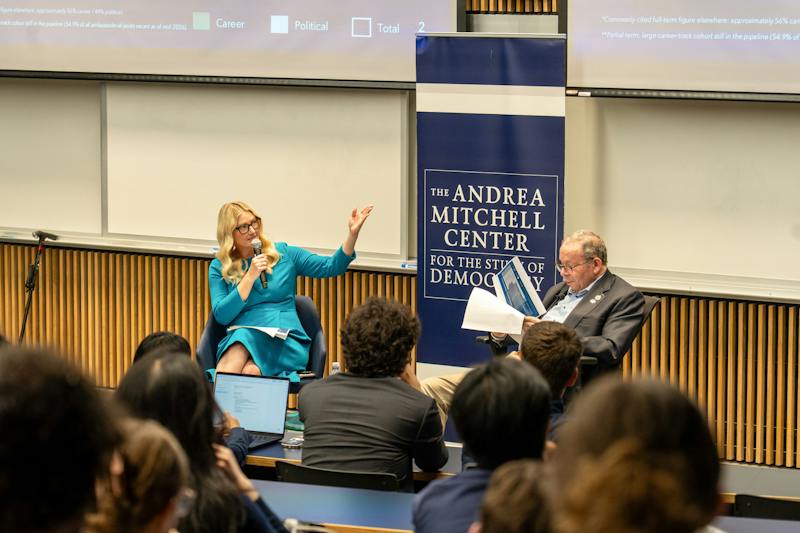
The discussion, held on September 15 and titled “The Future of Alliances,” took place in the auditorium of the Perelman Center for Political Science and Economics. It was moderated by Marie Harf, Executive Director of Perry World House. The conversation explored Cohen’s time as U. S. ambassador to Canada under President Joe Biden and his views on the Trump administration’s interactions with Canada.
“I really viewed my role as representing the United States, the story of the United States, representing it to Canadians, the Canadian government, and to the other countries who had ambassadors in Canada,” Cohen shared during the event.
He also discussed how politically appointed ambassadors differ from career diplomats-categorizing their tasks into three areas: entertainment, administration, and substantive policy work.
“One of the most important things that he talked about was how vital it is if an ambassador has a relationship with the president,” Harf remarked in an interview following the event. “When you are an ambassador representing the United States in a foreign country, if you can call the president and talk to him or her about any issue, that gives you so much more clout in the country where you’re working.”
Get the DP delivered straight to your inbox.
Sign Up
During his talk, Cohen pointed out his connection with Biden as an example. He noted that Biden would often seek his thoughts on foreign policy matters beyond just Canada-especially regarding issues in the Middle East.
While he does not “believe in criticizing President Trump” due to his “respect for the office of the president,” Cohen stressed how crucial it is to preserve strong U. S.-Canada ties.
“The United States has had no better friend, partner, or ally than Canada,” he added.
Cohen expressed that he is “opposed” to tariffs overall, describing them as “governmental interference in the way in which free-market economy works.”
He labeled Trump’s tariff approach toward Canada as “herky-jerky,” but clarified that he doesn’t see Canada’s relationship with America as permanently harmed.
“I’m the eternal optimist,” Cohen said in an interview. “I think this relationship can be put back together again, in part because it must be put back together again. And I’m optimistic that that will happen under different leadership.”
He mentioned that this relationship benefits from what he called “institutional inertia,” noting that Canada serves as a major export market for 37 states including Pennsylvania. He also hoped attendees understood “just how important a close relationship is between Canada and the United States from a trade, defense, intelligence, and security perspective.”
At event’s end, attendees had opportunities to ask Cohen questions directly and engage with him afterward.
Sophomore Shayna Strauss from PPU’s internal affairs expressed her aspiration to become a politically appointed ambassador.
“It’s very inspiring to meet someone in my own career field and take his expertise and advice,” Strauss stated in an interview. “I think my favorite part of Penn Political Union is being able to grow my network within political circles.”
College senior Neil Pereira, PPU’s external vice president who organized this event said they invited Cohen because “the U. S.-Canada alliance has been one of those hot topics appearing across nearly every news outlet over recent months-especially regarding trade issues.”
“I hope students got insight into current debates surrounding U. S.-Canada relations today,” he continued.
“I love coming back to Penn,” said Cohen-who formerly chaired Penn’s Board of Trustees-in an interview. “I enjoy any chance I have to connect with Penn students and faculty; it’s always intellectually stimulating.”
Source link