

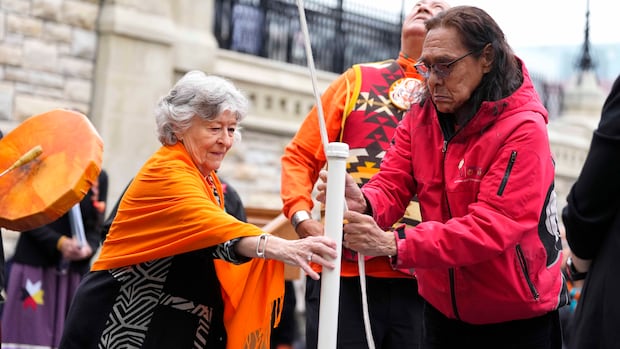
As people came together Wednesday across Canada to observe the sixth National Day for Truth and Reconciliation, Prime Minister Mark Carney reminded everyone that the journey towards understanding the past might never truly end.
“We are making some progress, but we know the work of reconciliation is far, far from finished. The wounds are still too deep. The gaps are still too wide. Reconciliation is a journey, not a destination. It’s an attitude, not an achievement,” Carney shared with an audience in Edmonton.
“Our job is to move together as far and as fast down the path as we can … Our responsibility, certainly the responsibility of government, is to reflect, and our task will be to act together.”
<p dedicating his remarks to the Indigenous children and their families present, Carney said he visited Edmonton to listen to their stories, reflect on a painful part of Canada's history, and find ways to move forward as a community.
“This is not a distant chapter in Canada’s past, but a truth that endures, and truth is the foundation of justice,” he emphasized. “We shouldn’t choose which parts of our history to remember … and we should not hear the truth of residential schools and fail to act on it.”
WATCH | Work of reconciliation ‘far from finished,’ Carney says: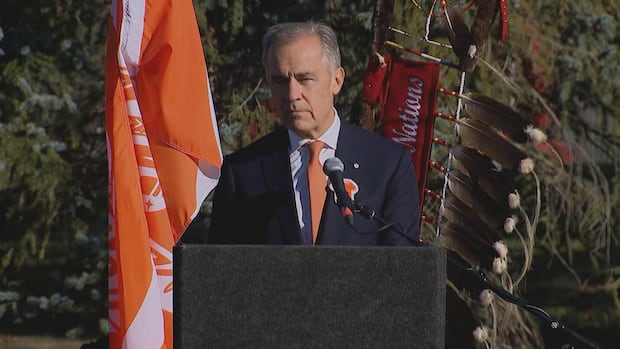
Work of reconciliation ‘far from finished,’ Carney says
Prime Minister Mark Carney marked the sixth National Day for Truth and Reconciliation from Edmonton with a call for deeper understanding and action, stating ‘our job is to move together as far and as fast down the path as we can.’
Earlier in the day, Gov. Gen. Louise Arbour shared her thoughts while observing her first National Day for Truth and Reconciliation. She noted that confronting an uncomfortable past is essential if Canadians want to create a better future.
Speaking right before raising the Survivors’ Flag at Parliament Hill in Ottawa, she recognized that “the truth does not change the past, [but] it is a reminder that memory carries responsibility – responsibility to recognize these injustices, learn from them and ensure they are never repeated.”
Arbour pointed out that the Survivors’ Flag serves “both as a symbol of warning and hope.”
She described how it “represents what was lost but also what endured and continues thriving.. including spirits, cultures, traditions, and languages of communities that have carried these legacies through immense hardship across generations in this country.”
Arbour encouraged Canadians on this sixth National Day for Truth and Reconciliation to “listen with open hearts” while reflecting on survivors’ experiences shared by them or their families.”
Children forced away from families
In a statement released ahead of his speech in Edmonton, Carney mentioned that the residential school system “was built on assimilation policies designed to sever children from their languages, cultures, identities and ways of life.”
“The federal government established this system; thus Canada bears responsibility for its profound impact causing lasting harm.”
The residential schools in Canada operated between 1857 until 1996. Around 150 thousand Indigenous children were separated from their families during this time.
WATCH | Nearly 60 years later, residential school student buried on First Nation: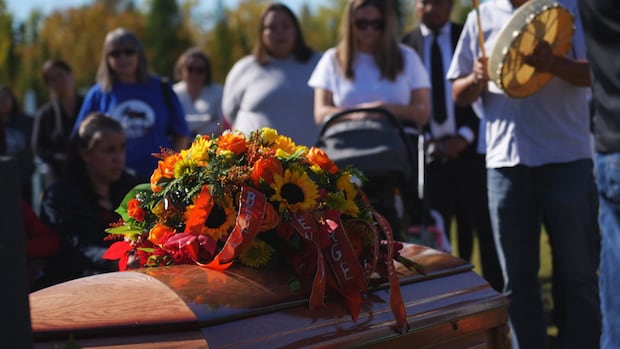
Decades after death; residential school student buried on First Nation
Around 60 years posthumously , Percy Onabigon’s remains were transferred back home from Woodstock Ont., where he was laid finally at Long Lake #58 First Nation cemetery after family efforts advocating repatriation.
The Truth and Reconciliation Commission’s (TRC) comprehensive study revealed how deeply these schools affected Indigenous communities.
The institutions aimed at assimilating Indigenous kids into mainstream Euro-Canadian culture inflicted long-lasting trauma among generations according TRC findings. They had severe neglect issues leading up approximately around six thousand deaths largely due malnutrition diseases.
A decade after publishing TRC report only fifteen out ninety-four calls actions been implemented so far.
An reporter spoke with survivor Eugene Arcand who was seen earlier today Parliament Hill event. Arcand indicated National Days offers opportunity highlight complacency which has grown since reports release :
“When it comes addressing any cooperation or even basic understanding regarding those ninety-four calls actions there remains unfinished business linked historical events.”
Citing his statement Prime Minister also stressed owes more than remembrance towards survivors: P>
“Action must follow through accordingly given they remain roadmap guiding such effort needed.” P>