





The federal government hasn’t finalized its complete fleet of next-generation jets yet, but there’s increasing talk that it might include two types of aircraft.
According to industry insiders, the Canadian government is looking at a mixed fleet of fighter jets that could exceed its initial goal of 88 aircraft.
This larger fleet would consist of both the F-35 made by Lockheed Martin in the U. S. and the Gripen from Swedish aerospace and defense company Saab.
Several industry sources familiar with the discussions shared these details with on the condition that their identities remain confidential.
was the first to report that this mixed fleet might include over 100 aircraft.
Ottawa has been silent for months regarding its highly awaited decision about acquiring a full fleet of next-generation fighter jets.
In 2023, the federal government committed to purchasing 88 F-35s to replace its aging CF-18 Hornets. However, in 2025, due to trade tensions with the U. S., Carney’s administration initiated a review of this purchase.
Canada already has a contract for 16 F-35s, but there’s been ongoing speculation about whether the government will alter its course to finalize its fleet.
New defense agreement with Sweden tells the U. S. ‘keep your stuff, we’ve been through enough’: Mulcair Political Commentator Tom Mulcair explains why he thinks negotiating for SAAB aircraft is a ‘win-win’ for Canada.
Last week, Prime Minister Mark Carney announced that Canada has started negotiations to acquire Global Eye, an advanced aerial surveillance system developed by Saab which utilizes Canadian-made jets.
In an interview with at the end of March, Saab’s CEO mentioned that there were still “intensive” discussions happening with the Canadian government regarding potential purchases of Gripen fighter jets but noted he had no timeline for when Canada would conclude its review of American-made F-35s.
3 aircraft?
News about Canada potentially acquiring a mixed fleet left at least one analyst confused.
“It complicates things for reasons that have not yet been explained by the government,” said David Perry, president of the Canadian Global Affairs Institute.
“The planes are entirely different in terms of functionality. You wouldn’t find a situation where pilots could switch between cockits day-to-day,” he clarified while adding that Canada is expected to continue using its current CF-188 Hornets-commonly known as CF-18s-for nearly another decade.
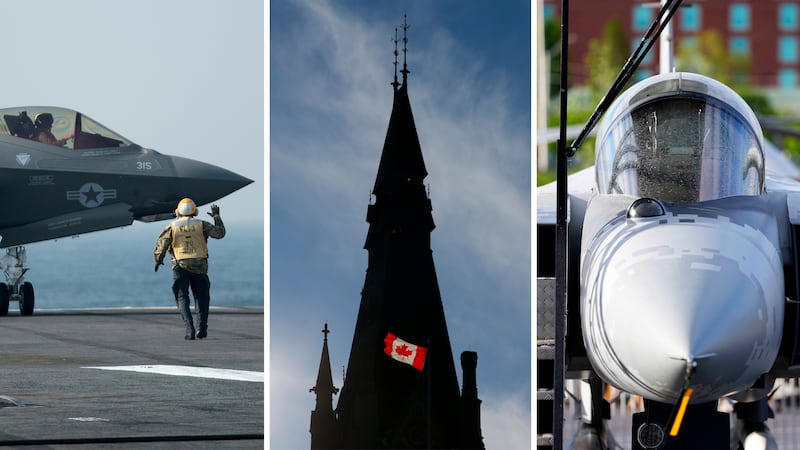
Canada fighter jet fleet Left: U. S. Navy sailors walk beside an F-35 fighter jet. Centre: A Canadian flag waves on Parliament Hill. Right: A replica of a Saab Gripen multirole fighter aircraft. (The Associated Press / The Canadian Press)
If Canada chooses to procure two new models, then the Canadian Air Force would need to maintain and service three different types of planes simultaneously.
He accused Carney’s administration of reopening procurement plans for political reasons tied to tensions with the United States after years spent finalizing agreements with them and Lockheed Martin.
“If they genuinely want to expand our overall fighter fleet size,” Perry suggested, “the most sensible approach would just be adding more F-35s-the more capable option chosen in a competitive selection led by Prime Minister Justin Trudeau.”CTV National News: Canada turning to Sweden for new Arctic surveillance jetsreports that Canada will buy Saab’s Global Eye system for Bombardier jets aimed at enhancing Arctic surveillance and defense.
While having two separate aircraft models may bring additional personnel challenges,navigating multiple platforms within one fleet isn’t unheard-of, noted Ret’d Maj.-Gen.David Fraser,>> s military analyst.</span>He pointed out how the U. S. military operates various generations of airframes within their airdefense arsenal. Fraser referred(to>> F->35: “the best jet available today,” yet also added it’s pricier than gripen— which could meet other operational needs. “F–(J—-)5 ties into NORAD (Canada’s bilateral defense pact w/the USA),& it’ll be capable defending North America.” Fraser stated, “The Saab jet will be excellent NATO assets So you can run operations jointly in Canada & abroad.”/.. When. Canadia announced it was moving forward<<>2023—–towards procuring >=88 F–(J—5jets,: ). said it was the most significant investment in RC Armed Forces >in. over three decades an expanded ; fleet even if featuring multiple =models= is welcomed addition according Fraser; “We’re talking about getting more airplanes than before, and two very capable platforms.”/..