





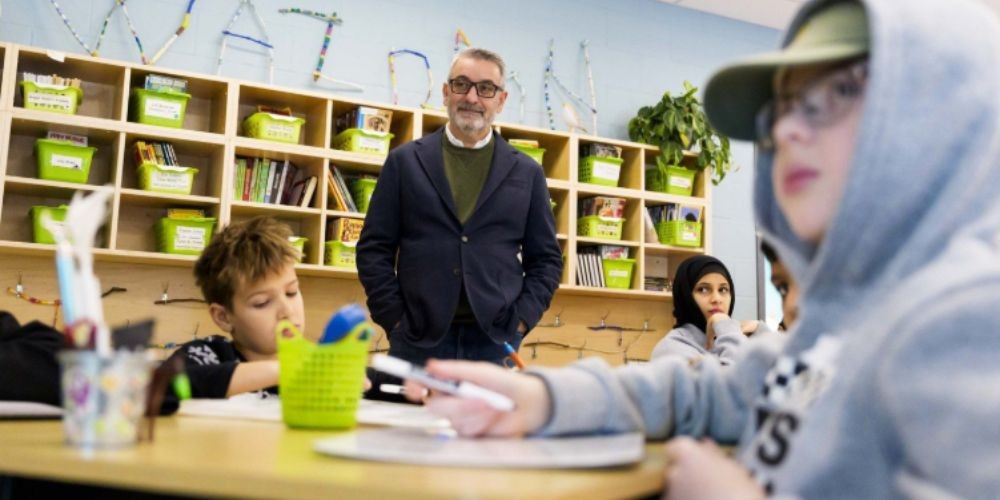
Ontario Education Minister Paul Calandra observes a Grade 6 math class during his visit to Wazoson Public School after announcing funding in Ottawa, on Friday, Dec. 5, 2025. THE CANADIAN PRESS/Justin Tang
The education bargaining season is kicking off in Ontario, with unions emphasizing their goals of smaller class sizes, better funding for special education, and increased wages.
Contracts for teachers and education workers across Ontario’s public elementary, secondary, Catholic, and French schools are set to expire in August. Their unions announced on Wednesday that they have filed notice to begin negotiations.
“Ontario students deserve classrooms that are fully resourced, safe, and supported,” said David Mastin, president of the Elementary Teachers’ Federation of Ontario. “Bargaining is one of the most powerful tools we have to make this happen.”
Education Minister Paul Calandra mentioned earlier this week that he anticipates challenging negotiations but hopes for a collaborative relationship with the unions.
“I remain quite optimistic,” he stated, highlighting that there have been relatively few disruptions affecting classrooms under Premier Doug Ford.
Barrie’s News Delivered To Your Inbox
Stay informed about what’s happening in Barrie. Get the latest local news sent directly to your inbox every day. Don’t miss out on what’s going on..
Consent Info
By submitting this form, you are consenting to receive marketing emails from: Central Ontario Broadcasting, 431 Huronia Rd, Barrie, Ontario, CA, https://www. cobroadcasting. com. You can withdraw your consent at any time by using the Safe Unsubscribe® link found at the bottom of each email. Emails are managed by Constant Contact
During the last round of bargaining, teachers agreed to take unresolved issues to binding arbitration instead of striking.
However, there was a strike by education workers represented by the Canadian Union of Public Employees that closed schools for two days. It ended after the government committed to repealing a law that imposed contracts on CUPE members and restricted their right to strike while utilizing the notwithstanding clause to override certain Charter rights.
This issue and others like a now-repealed wage restraint law have created tensions between the Ford government and unions. However, Mastin expressed hope that they can work together effectively with Calandra’s team.
“Mr. Calandra made it sound very warm and gentle and collaborative yesterday,” Mastin said. “So we’re looking forward to that collaboration. We’re looking forward to that desire to work together. Haven’t seen it yet but we’ll view it as a positive statement.”
The unions have long indicated that reducing class sizes will be critical in these negotiations; Mastin noted they will propose lowering class sizes in kindergarten as well as Grades 4 through 8. Current size limits for Grades 1 through 3 have helped create stability and improved learning opportunities for students in those grades; therefore teachers want similar standards applied elsewhere in elementary classes.
🎧 Listen to daily headlines about what matters most
Subscribe on Spotify, Apple Podcasts or wherever you get your podcasts so you can be notified about new episodes every day.
Martha Hradowy, president of the Ontario Secondary School Teachers’ Federation, pointed out ongoing staffing shortages along with rising violence issues and increasing mental health needs within complex classroom environments.
“The challenges bringing us here today have been building over many years; ignoring them has become impossible,” she stated.
“This round of bargaining focuses on enhancing learning conditions for students as well as working conditions for those who assist them daily.”
Hradowy also emphasized that high school class sizes need reduction too-especially with destreaming-indicating it did not come with adequate support or resources from the government.
The unions plan to bring up special education discussions at the bargaining table since some students can’t attend school due to inadequate supports available for their safety during attendance.
“We want real investment into special education throughout this province,” stated Joe Tigani from CUPE representing education workers.
“We know many kids are falling behind or being told they can’t even come into school because there aren’t enough resources available-so yes-we’re asking specifically about increasing staff levels.”
Wage increases will also feature among union proposals although specific percentage targets were not provided yet.
This report from The Canadian Press was first June 3rd , 2026.
What do you think about this article?
Source link
Source link