





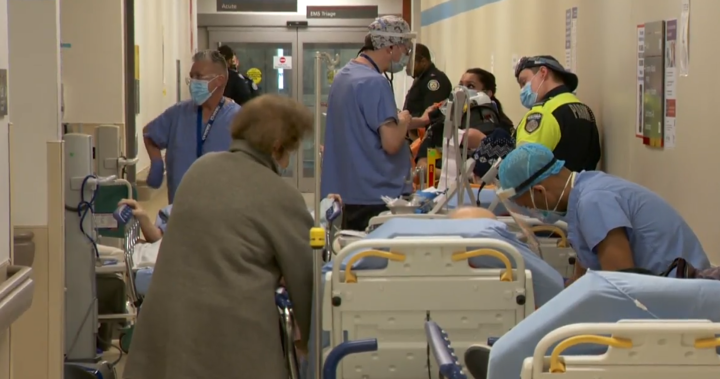
A recent report from the Canadian Centre for Policy Alternatives reveals that hospitals in Ontario are under increasing strain as emergency room wait times rise and funding shortages grow.
The author of the study, Andrew Longhurst, indicates that provincial funding has not kept up with the growing demand for services.
“We need the government to step up and recognize the severity of the situation,” Longhurst said.
“The funding coming down from the provincial government has not been adequate to address increases in hospital admissions and emergency room wait times.”
The report found that by 2024-25, nearly 90 percent of patients were spending an average of 44 hours in emergency departments waiting for care.
Longhurst noted that Kingston Health Sciences Centre has experienced notable increases in wait times.
Story continues below
“For Kingston Health Sciences specifically, we’ve seen a 66-per cent increase from 27.7 hours to 37.7 hours waiting in the emergency department,” he said.

Source link
Get weekly health news
Receive the latest medical news and health information delivered to you every Sunday. The report also indicated that most hospitals in Ontario have been running deficits since 2022, including around 70 percent this year. Kingston Health Sciences Centre was not one of them. Longhurst pointed out that the province’s latest budget left a significant gap in healthcare funding. “The last provincial budget left a gaping hole of $3 billion in funding that is required to just maintain services in the public health care system,” he said. “At the same time, we’re seeing the provincial government somehow finding the money for private for-profit health care facilities.” More on Health More videos The report comes nearly a year after KHSC revealed plans for a new west-end healthcare campus to replace aging downtown hospitals. The province has yet to announce any funding for this project. Ted Hsu remarked that this report highlights ongoing concerns within the healthcare system and emphasizes a need for long-term planning. “We really need that space,” Hsu said. “The population has grown. It’s not possible to keep upgrading the current site. If we make healthcare work, it leads to a stronger economy because it’s a big expense, and if we can do it efficiently and provide care in an equitable way that doesn’t depend on your income, then our economy will be stronger for it.” Story continues below The report concludes by stating that rising hospital costs – which are increasing by about six percent each year – combined with insufficient government funding are creating what it describes as a “toxic” situation undermining timely access to care. © 2026 , a division of Corus Entertainment Inc.Source link