



A recent report from an online insurance comparison site has placed Burlington as the second most dangerous city for driving in Ontario. However, local officials argue that this conclusion might not accurately represent the city’s actual accident statistics.
On Feb. 26, 2026, My Choice, an insurance comparison platform, released a report titled Top 10 Safest and Most Dangerous Cities for Driving in Ontario in 2026, naming Toronto as the safest city while ranking Burlington as the second most dangerous.
When contacted by Burlington Local-News. ca, My Choice clarified that their research does not utilize official collision data. Rather, it is based on over 200,000 insurance quote requests made between 2020 and 2025, which include drivers’ self-reported histories of accidents and infractions.
“Our analysis instead looks at the percentage of drivers who have accidents or infractions on their record,” the company stated, adding that this data reflects an insurance risk viewpoint rather than a tally of all collisions occurring within a municipality.
This ranking has been shared by several news outlets; therefore, readers looking into Burlington’s traffic safety may come across headlines labeling the city as one of Ontario’s riskiest places to drive. Still, this description might not be entirely accurate.
Collision figures from the Ontario Ministry of Transportation paint a more nuanced picture. The Ontario Road Safety Annual Report indicates that Burlington experienced 1,505 collisions in 2022. In contrast, Brampton had around 9,060 collisions while Toronto saw over 32,000 during the same year.
While it’s important to consider population differences among cities, even when analyzing collisions per capita, Burlington does not rank among those with the highest collision rates in the province. Based on population estimates for 2022 and data from the Ontario Road Safety report for that year, Brampton had about 1,208 collisions per 100,000 residents; Toronto had approximately 1,081 per 100,000; and Brantford recorded around 1,258 per 100,000 residents.
And what about Burlington? It stood at roughly 805 collisions per 100,000 residents.
Burlington Ward 5 Councillor Paul Sharman points out that this methodology makes it hard to determine if the ranking truly reflects driving conditions in Burlington.
“Well, what we understand is that this is a report produced from insurance data,” Sharman explained. “We don’t even know who My Choice is; if it’s coming from insurance data raises questions about whether that recording is based on where people live versus where they actually had an accident.”
He also mentioned that city staff have faced challenges trying to interpret these findings.
“So we just don’t know what that data represents truthfully,” Sharman continued. “I had a conversation with city staff about it and they said ‘We don’t know what it is.’ We don’t have any way to demonstrate or prove whether it’s right or wrong.”
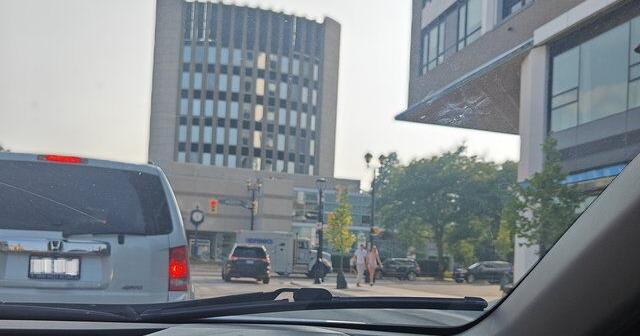
Even with doubts surrounding the report’s findings, traffic congestion remains one of the biggest issues voiced by residents in Burlington.
Sharman notes that recent years have been particularly tough due to major highway maintenance impacting traffic flow.
“We’ve had the Skyway bridge being closed especially during summer for maintenance,” he said. “That has turned what was already a busy downtown area into something resembling a nightmare during peak hours.”
The situation worsens when drivers exit highways due to congestion issues and redirect additional traffic onto local neighborhood streets.
“The highway gets blocked up every night,” Sharman elaborated. “People get off at Third Line and Burloak heading west then jam our streets for about three hours.”
The ongoing growth and development also raise concerns regarding future traffic issues.
“To make matters worse,” he added,” there are new buildings always being proposed which adds more pressure on local traffic.”
Burlington’s current transit system structure also discourages many locals-especially older adults-from using public transport effectively.
“Our transit system relies heavily on large buses with fixed routes,” he said.” A lot of people wouldn’t need to drive if we had a more convenient on-demand transit system available.”
“We’ve got about12 ,000 residents aged over75 , yet daily transit ridership averages only around several thousand,” he pointed out.
“Older adults aren’t likely going to walk to bus stops-particularly not when weather conditions are harsh,” he added.
Burlington has been exploring options like smaller electric vehicles operating within neighborhoods aimed at providing better transport solutions tailored towards seniors plus others currently relying heavily upon cars.
An effort continues meanwhile amongst city officials seeking community feedback concerning ways they can tackle congestion alongside transportation hurdles.
Councillor Sharman together with Ward2 Councilor Lisa Kearns plans hosting a Community Traffic Forum scheduled April1st from630 PM until9 PM located at Art Gallery Of Burlington. The event will bring together representatives hailing from Halton Regional Police Service, Burlington Transit, the City Transportation Department along other stakeholders aiming discussions towards potential solutions
“While debates persist surrounding how BURLINGTON compares against other municipalities regarding road safety”, Said Sharman “one thing stands certain: residents are demanding action relatedto Trafficissues”.
Source link
Source link