





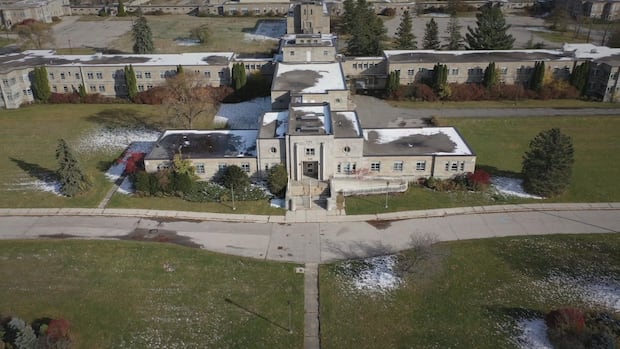
The Municipality of Central Elgin is moving forward with plans to redevelop the old St. Thomas Psychiatric Hospital site in response to the expected housing demand linked to a new Volkswagen battery plant set to open in 2027.
However, one heritage advocate warns that this proposal may erase a vital part of the area’s architectural and cultural history.
Last spring, Central Elgin councillors approved a vision for the nearly 170 hectares of hospital land at the southern end of St. Thomas. The plan envisions a new multi-use community that could accommodate up to 9,000 residents in about 3,500 homes.
“This is the only time in the history of Central Elgin we’ve been able to do this,” said Mayor Andrew Sloan in an emailed statement.
![]() A land use plan for the St. Thomas Psychiatric Hospital grounds includes several residential areas, a downtown main street and parks. (Municipality of Central Elgin)
According to updated planning documents, the area will feature a mix of affordable and accessible housing, a commercial main street, parks, schools, community centers and city facilities.
This project aims to support around 3,000 direct jobs and an estimated 30,000 indirect jobs when the Volkswagen battery gigafactory opens its doors in 2027.
Nevertheless, historian and architectural preservationist Jennifer Grainger expressed concerns that this new development might lead to demolishing significant parts of St. Thomas’ heritage: namely, the old hospital buildings.
“It is a large lot, and surely some of the designated buildings could actually be preserved; there would still be plenty of extra room for housing development,” she said.
A land use plan for the St. Thomas Psychiatric Hospital grounds includes several residential areas, a downtown main street and parks. (Municipality of Central Elgin)
According to updated planning documents, the area will feature a mix of affordable and accessible housing, a commercial main street, parks, schools, community centers and city facilities.
This project aims to support around 3,000 direct jobs and an estimated 30,000 indirect jobs when the Volkswagen battery gigafactory opens its doors in 2027.
Nevertheless, historian and architectural preservationist Jennifer Grainger expressed concerns that this new development might lead to demolishing significant parts of St. Thomas’ heritage: namely, the old hospital buildings.
“It is a large lot, and surely some of the designated buildings could actually be preserved; there would still be plenty of extra room for housing development,” she said.
![]() Jennifer Grainger is a historian and architectural preservationist in London, Ont. She says she would like to see the old hospital buildings repurposed. (Submitted by Jennifer Grainger)
The municipality stated that all buildings are currently owned by the province and any decision about demolition lies with them.
Infrastructure Ontario mentioned it began searching for a demolition contractor back in March and plans for site-clearing are set to start later this year. They expect work will take about two years total.
“The buildings are beyond their useful life and pose a health and safety risk in their current state,” said Infrastructure Ontario spokesperson Ian Mc Conachie.
Jennifer Grainger is a historian and architectural preservationist in London, Ont. She says she would like to see the old hospital buildings repurposed. (Submitted by Jennifer Grainger)
The municipality stated that all buildings are currently owned by the province and any decision about demolition lies with them.
Infrastructure Ontario mentioned it began searching for a demolition contractor back in March and plans for site-clearing are set to start later this year. They expect work will take about two years total.
“The buildings are beyond their useful life and pose a health and safety risk in their current state,” said Infrastructure Ontario spokesperson Ian Mc Conachie.
![]() The total former hospital grounds cover roughly 416 acres of land. Nearly 80 acres is occupied by the former hospital buildings, Southwest Centre for Forensic Mental Health Care and an OPP detachment. (Google Maps)
Since closing down operations at the hospital, an Ontario Provincial Police detachment has opened as well as Southwest Centre for Forensic Mental Health Care; however, most old structures have remained empty.
“They seem to have let it sit empty for quite some time without trying anything toward repurposing it,” Grainger said.
If given another chance they could turn those buildings into offices or perhaps create a museum focused on psychiatric treatment history or even offer affordable housing options instead.”
This past October saw both federal funding alongside contributions from City of London amounting up $10 million allocated towards developing supportive housing within London’s So Ho neighborhood-transforming what used-to-be War Memorial Children’s Hospital into forty-two affordable units!..........
Sloan added however that there were studies done already through Infrastructure Ontario examining whether these structures can actually be reused-but findings indicated they’re no longer suitable conditions wise.”, thus leading him remark “reports show these specific types build material have exceeded life expectancy rendering them unsafe/dangerous while also exorbitantly costly if repairs needed were ever initiated rather than demolished altogether!”
The total former hospital grounds cover roughly 416 acres of land. Nearly 80 acres is occupied by the former hospital buildings, Southwest Centre for Forensic Mental Health Care and an OPP detachment. (Google Maps)
Since closing down operations at the hospital, an Ontario Provincial Police detachment has opened as well as Southwest Centre for Forensic Mental Health Care; however, most old structures have remained empty.
“They seem to have let it sit empty for quite some time without trying anything toward repurposing it,” Grainger said.
If given another chance they could turn those buildings into offices or perhaps create a museum focused on psychiatric treatment history or even offer affordable housing options instead.”
This past October saw both federal funding alongside contributions from City of London amounting up $10 million allocated towards developing supportive housing within London’s So Ho neighborhood-transforming what used-to-be War Memorial Children’s Hospital into forty-two affordable units!..........
Sloan added however that there were studies done already through Infrastructure Ontario examining whether these structures can actually be reused-but findings indicated they’re no longer suitable conditions wise.”, thus leading him remark “reports show these specific types build material have exceeded life expectancy rendering them unsafe/dangerous while also exorbitantly costly if repairs needed were ever initiated rather than demolished altogether!”
Source link
Can these buildings be saved?
The psychiatric hospital opened its doors back in 1939 and was operated by the province until it transferred management to St. Joseph’s Health Care London in 2001. The facility closed down completely in 2013. Grainger believes that preserving these historic buildings is essential due to their unique architecture. “These were very interesting, unusual buildings made out of Queenston limestone by a well-known architect named William Somerville,” she explained. “It’s Art Deco style; even the sculpture on its exterior was created by female sculptor Jacobine Jones.”Source link