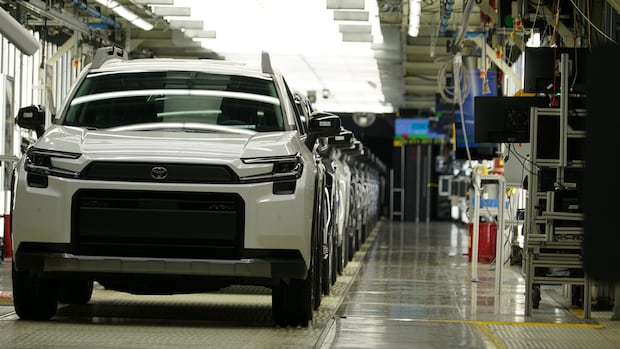
The largest car manufacturer in southwestern Ontario reinforced its dedication to its Canadian employees on Friday, even amidst challenges facing other sectors of the auto industry.
Toyota Canada reaffirmed that commitment during a factory tour at its Woodstock, Ont. plant, where production of the sixth generation of RAV4 SUVs has begun.
“This is a significant demonstration of Toyota’s confidence in our people, our plants, and our manufacturing ecosystem,“ Tim Hollander, the president of Toyota Motor Manufacturing Canada (TMMC), said.
“It also reflects our long-term commitment to Canada and the communities where we operate.”
![]() The first sixth-generation RAV4 to roll off the line in Toyota’s Woodstock plant. (Alessio Donnini/)
With nearly 40 years in Canada, Toyota operates plants in Woodstock and Cambridge that employ about 8,500 workers. The company claims that its southwestern Ontario facility produces more vehicles than any other location on the continent.
This investment continues despite 2025 being a tough year for many in Ontario’s auto sector. Hundreds lost their jobs after General Motors closed its CAMI assembly plant in Ingersoll, while another 3,000 were laid off at Stellantis’ Brampton plant, which hasn’t produced a vehicle in two years.
In June, Toyota revamped operations at both the Woodstock and Cambridge plants so battery packs for the new RAV4s could be manufactured on-site instead of being shipped from Japan.
The new model will only be offered as an electric hybrid and features a complete redesign from top to bottom. Hollander mentioned that Toyota invested $1.1 billion for its production in Canada.
According to company representatives, total investments by Toyota in Canadian operations exceed $12 billion with no plans for cutbacks.
However, for auto workers seeking employment opportunities, it was stated that there are currently no expansions planned.
The first sixth-generation RAV4 to roll off the line in Toyota’s Woodstock plant. (Alessio Donnini/)
With nearly 40 years in Canada, Toyota operates plants in Woodstock and Cambridge that employ about 8,500 workers. The company claims that its southwestern Ontario facility produces more vehicles than any other location on the continent.
This investment continues despite 2025 being a tough year for many in Ontario’s auto sector. Hundreds lost their jobs after General Motors closed its CAMI assembly plant in Ingersoll, while another 3,000 were laid off at Stellantis’ Brampton plant, which hasn’t produced a vehicle in two years.
In June, Toyota revamped operations at both the Woodstock and Cambridge plants so battery packs for the new RAV4s could be manufactured on-site instead of being shipped from Japan.
The new model will only be offered as an electric hybrid and features a complete redesign from top to bottom. Hollander mentioned that Toyota invested $1.1 billion for its production in Canada.
According to company representatives, total investments by Toyota in Canadian operations exceed $12 billion with no plans for cutbacks.
However, for auto workers seeking employment opportunities, it was stated that there are currently no expansions planned.
![]() A partially assembled Toyota RAV4 at the company’s Woodstock Plant. (Alessio Donnini/)
A partially assembled Toyota RAV4 at the company’s Woodstock Plant. (Alessio Donnini/)
![]() Scott Mac Kenzie photographed on Friday at Toyota’s Woodstock plant. (Alessio Donnini/)
Scott Mac Kenzie photographed on Friday at Toyota’s Woodstock plant. (Alessio Donnini/)
Source link
The issues of Canada-U. S. trade talks, Chinese EVs
Liberal MP Kareem Bardeesy attended Friday’s event as parliamentary secretary to Industry Minister Melanie Joly. Minister Joly has expressed her intention to develop a strategy for the CAMI plant while supporting autoworkers. Bardeesy noted that while Canada needs to adjust to new circumstances, it’s essential to maintain existing partnerships-a sentiment echoed by the Prime Minister during his speech at Davos earlier that week. “This plant and the ecosystem along with consumers and team members who are part of that integration between Canada, the United States, Japan and beyond exemplifies how these connections work,” Bardeesy stated. Concerns about upcoming CUSMA trade negotiations were shared by Scott Mac Kenzie, director of corporate and external affairs at Toyota Canada. When asked if ongoing production of RAV4 SUVs in Ontario depends on favorable agreements being reached he declined to speculate further saying: “I don’t think we know where that’s going to end up but we’ll make those decisions once details become clearer.” He added: “We believe that integrated operation among all three countries is most effective for North America’s industry. Ideally we would have no tariffs.”The Prime Minister’s choice allowing 49 thousand vehicles into circulation annually has faced criticism from Ontario Premier Doug Ford and several leaders within the auto industry as potentially harmful for Canada’s market.
“I think the federal government found itself between two major economies trying hard to navigate through effectively,” Mac Kenzie remarked. “I don’t see this as highly significant here nor do I believe it will impact our operations within Canada.” “[This is] a continued vote of confidence in our Canadian workforce and operations,” he added.Source link