





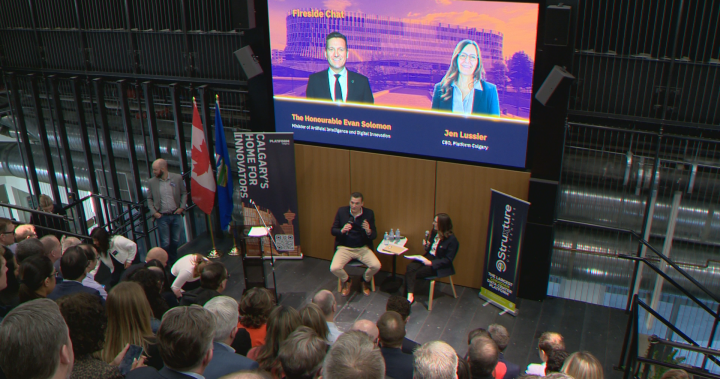
On Wednesday, Platform Calgary was buzzing as Canada’s minister for AI and digital innovation, Evan Solomon, shared insights on how the government aims to back the expanding AI industry.
“We are on a mission for ‘team yes’ to find answers,” explained Solomon. “My job is to facilitate ‘team yes.’ To get out of the way when we need to, and to give a boost when we have to.”
Solomon stated that Canada is at a pivotal moment as we navigate through rapid political and technological changes.
Minister Evan Solomon says his government is here to support Canada’s AI industry.
“This political and this technological realignment poses real challenges to our sovereignty, our values, and our communities… but it also presents opportunities,” Solomon noted.
Story continues below
Minister Solomon pointed out that there are two clear perspectives on AI. Some are optimistic and think AI will solve many global issues, while others fear it will lead to job losses and environmental harm.
“We’ve got to be open to the opportunities here and not stifle the innovation, and make sure that we’re candid about their concerns,” said Solomon. “Privacy, data, jobs, and we will protect those things as well.”
Those attending Wednesdays event listening intently to potential regulations for AI.
AI companies in Alberta are responding positively to the idea that the federal government wants to help keep Canadian firms in Canada.

Dwyer added,” So we’re witnessing these models starting not quite working.” Story continues below However, Dwyer feels hopeful about Canada’s ability compared with other regions regarding regulation development. “The European Union does an excellent job with regulation much better than what’s happening here in North America,”she remarked. “That doesn’t mean they have everything figured out nor is EU’s approach without issues. Canada rightly seeks its own unique path toward balancing interests.” & copy 2026 , a divisionof Corus Entertainment Inc.
Source link
Get breaking National news
Get breaking Canada news delivered to your inbox as it happens so you won’t miss a trending story. “That spirit of collaboration and ecosystem growth, built on an actual federal level? I think that’s absolutely key,” affirmed Ferdinand Hingerl, chief technology officer with Ambyint. Story continues below “With such a strong neighbour in the south that we always have to deal with (brain drain), the question is how can we address that challenge so that all the money we invest in our people here stays in Canada.” The federal government has three main goals: ensuring access to capital, computing resources, and customers. “Most companies would rather have a contract than a grant, and the federal government can play a big role in that,” said Shannon Vander Meulen, co-founder of Wait Well. “There’s a bit of a double-edged sword with that because obviously a lot of companies like mine sell extensively into the U. S.” Pursuing advanced generative AI systems in Canada currently only follows voluntary guidelines. Solomon told that he and other ministers aim to introduce new laws providing clearer protections for Canadians and their data. “The justice minister has tabled legislation on non-consensual sharing of sexual content involving synthetic deep-fake imagery,” Solomon shared. “I will be tabling legislation aimed at updating privacy laws, protecting consumers-including children-and ensuring their information is secure… And then Marc Miller will handle online safety aspects.” Mount Royal University information design associate professor Lauren Dwyer says regulating AI in Canada is critical for protecting Canadians. Learners at Mount Royal University believe creating mandatory frameworks for protecting Canadians is very important according to associate professor Lauren Dwyer. Story continues below “We are driving next to a cliff with potential huge consequences if we aren’t managing this properly,” noted Dwyer. “And we’ve seen some of the most deadly versions of this when we look at what happened in Tumbler Ridge.” Dwyer studies various aspects of artificial intelligence-how its design influences communication and behavior-and what actions people take regarding it. If we’re aiming for less human involvement, she believes there needs more focus on accuracy. “When using this tool for efficiency purposes alone means removing human oversight at every step,” Dwyer said. “We love talking about artificial intelligence including having someone supervising decisions being made; that’s great if efficiency isn’t prioritized. If someone supervises these decisions while being pushed for speed chances are they’re just glancing quickly.” Dwyer explains historically new tech adoption requires foundational work first. A study from Toronto Metropolitan University’s social media lab found many Canadians use generative artificial intelligence tools like Chat GPT but most don’t trust information produced by them.Dwyer added,” So we’re witnessing these models starting not quite working.” Story continues below However, Dwyer feels hopeful about Canada’s ability compared with other regions regarding regulation development. “The European Union does an excellent job with regulation much better than what’s happening here in North America,”she remarked. “That doesn’t mean they have everything figured out nor is EU’s approach without issues. Canada rightly seeks its own unique path toward balancing interests.” & copy 2026 , a divisionof Corus Entertainment Inc.
Source link