





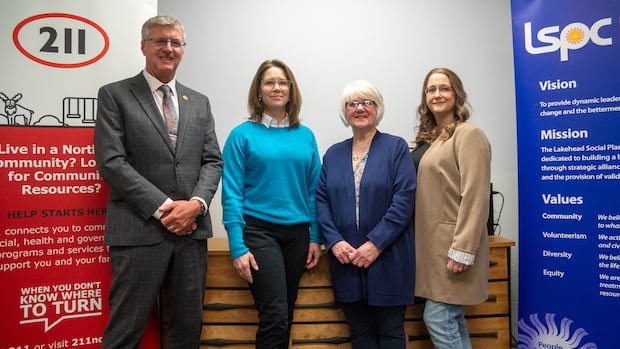
In Thunder Bay, Ont., many individuals dealing with food insecurity also face various other challenges that hinder their ability to meet basic needs.
This insight emerged from the Lakehead Social Planning Council’s (LSPC) recent pilot initiative, titled “Removing Access Barriers to Food and Essential Services.”
The year-long program, which runs through 2025, focused on supporting those who feel isolated, live on limited incomes, or experience health or mobility issues that complicate access to necessary support.
The LSPC received a nearly $100,000 seed grant from the provincial government’s Ontario Trillium Foundation to implement the pilot, which reached over 300 people in the community.
“What this project has made clear to me is that when someone calls [for] emergency food, it usually reflects challenges far beyond hunger,” said LSPC’s executive director, Marie Klassen.
“Behind that call is often someone who can’t leave their home easily, someone choosing between paying a utility bill and buying groceries, someone who doesn’t know … that they qualify for benefits through the income tax program, someone who was trying to navigate complicated systems entirely alone.”
![]() Marie Klassen is executive director of the Lakehead Social Planning Council in Thunder Bay, Ont. She says the pilot program allowed staff to provide wraparound support to some of the community’s most vulnerable. (Sarah Law/CBC)
The LSPC celebrated the success of its pilot at its office Friday morning and shared how staff members were able to:
Assist individuals in applying for income and benefit programs. Help address urgent utility and housing stability concerns. Connect residents to community supports that improved their ability to remain safely housed. Provide enhanced system navigation and one-on-one support.
The program helped staff create an improved assessment and referral process aimed at identifying people’s needs-including aspects they hadn’t sought help for before.
<p“Out of I think 361 assessments, we were able to help connect a lot of individuals to the essential services in our community,” Klassen said.
For her, a key takeaway was realizing how little information people had about available services.
“We were able to uncover all sorts of essential needs that they didn’t have – simple things that we take for granted,” she said.
Marie Klassen is executive director of the Lakehead Social Planning Council in Thunder Bay, Ont. She says the pilot program allowed staff to provide wraparound support to some of the community’s most vulnerable. (Sarah Law/CBC)
The LSPC celebrated the success of its pilot at its office Friday morning and shared how staff members were able to:
Assist individuals in applying for income and benefit programs. Help address urgent utility and housing stability concerns. Connect residents to community supports that improved their ability to remain safely housed. Provide enhanced system navigation and one-on-one support.
The program helped staff create an improved assessment and referral process aimed at identifying people’s needs-including aspects they hadn’t sought help for before.
<p“Out of I think 361 assessments, we were able to help connect a lot of individuals to the essential services in our community,” Klassen said.
For her, a key takeaway was realizing how little information people had about available services.
“We were able to uncover all sorts of essential needs that they didn’t have – simple things that we take for granted,” she said.
![]() Kristen Tomcko is director of operations and client services at the Lakehead Social Planning Council in Thunder Bay, Ont. She says it’s important for staff members to take the time to build connections with clients through meaningful conversations. (Sarah Law/CBC)
“The more we can do to better understand someone’s full story, the better we’re able to help support them,” Tomcko said.
“It is time consuming work; working one-on-one with individuals takes extra effort and follow-up ensure they’re connecting with services – that’s where this grant has been really helpful.”
Even though the pilot has officially wrapped up, LSPC continues assisting some individuals as they work towards meeting their needs.
“We are going continue seeking out other funding options so we can keep supporting this program as much as possible,” Tomcko stated.
Thunder Bay-Atikokan MPP Kevin Holland praised Friday’s event highlighting its success while stating he would back efforts aimed at renewing funding for future iterations – although approval lies with Ontario Trillium Foundation board.
“It appears that it has been very successful in achieving its objectives,” Holland noted about LSPC’s efforts. “It’s a really important service for local residents.”
Kristen Tomcko is director of operations and client services at the Lakehead Social Planning Council in Thunder Bay, Ont. She says it’s important for staff members to take the time to build connections with clients through meaningful conversations. (Sarah Law/CBC)
“The more we can do to better understand someone’s full story, the better we’re able to help support them,” Tomcko said.
“It is time consuming work; working one-on-one with individuals takes extra effort and follow-up ensure they’re connecting with services – that’s where this grant has been really helpful.”
Even though the pilot has officially wrapped up, LSPC continues assisting some individuals as they work towards meeting their needs.
“We are going continue seeking out other funding options so we can keep supporting this program as much as possible,” Tomcko stated.
Thunder Bay-Atikokan MPP Kevin Holland praised Friday’s event highlighting its success while stating he would back efforts aimed at renewing funding for future iterations – although approval lies with Ontario Trillium Foundation board.
“It appears that it has been very successful in achieving its objectives,” Holland noted about LSPC’s efforts. “It’s a really important service for local residents.”
Source link
Understand people’s stories
Approximately 22 percent of households in the Thunder Bay district experienced food insecurity between 2022 and 2024 according to the Thunder Bay District Health Unit. Kristen Tomcko is LSPC’s director of operations and client services. She mentioned that the pilot program enabled staff members to engage in meaningful conversations with clients regarding their challenges.Source link