


A tremor that startled residents in the Esterhazy, Sask., region on Tuesday morning was likely due to mining operations, as stated by Natural Resources Canada (NRCan).
The quake – recorded at a magnitude of 3.4 – occurred at 7:04 a. m. CST, with its epicentre located about nine kilometres east-northeast of Esterhazy, according to NRCan’s Earthquake Canada website.
The federal agency described the earthquake as “a suspected mining-induced event,” which is classified as anthropogenic – or human-caused – seismic activity.
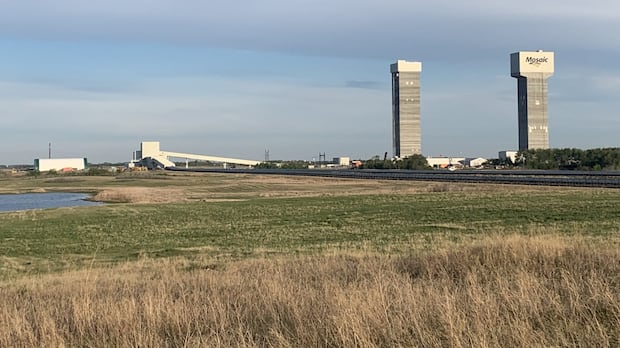
The Mosaic Company runs a potash mine approximately 15 kilometres northeast of Esterhazy.
Last year, the area experienced three earthquakes, including two within a three-month span. Earthquake Canada indicated that those were also likely linked to mining activities.
Jason Whitby and his wife were just beginning their day when they felt Tuesday’s quake. They heard a loud boom and their house shook, causing cups on the shelf to topple and artwork on the walls to shift.
Initially, he thought someone had crashed into their home.
“It was a crazy bang. It lasted a couple seconds then it was over,” Whitby said in an interview with CBC. “I’ve never felt anything like that.”
Whitby mentioned he didn’t notice last year’s earthquakes but worries about potential damage to his home if such events happen more often.
“It happens here and there, but nothing like this before,” Whitby said. “To shake a house is pretty wild. It might get worse; who knows?”
All Mosaic employees are safe and post-earthquake safety checks have been completed, the company reported in a statement. Approximately 1,200 individuals work both underground and above ground at the site, according to Mosaic’s website.
Potash production wasn’t disrupted and the earthquake took place “in a mined-out area of the older workings of the K3 Mine,” per their statement.
“Mining induced seismic activity in this area is common, and our facilities are designed with seismic loading considerations,” Mosaic noted in its statement.
“While this recent event happened far from active mining areas and poses no immediate safety risks, we continue working to enhance our understanding of the geological characteristics of the K3 ore body and will collaborate with external experts to assess seismic activity.”
The Mosaic Company operates the K3 Esterhazy mine. (CBC)
NRCan has tracked anthropogenic seismic activity around Esterhazy for decades, according to seismologist Claire Perry from NRCan.
“The number of natural earthquakes in this area is very low. It’s not an active tectonic zone; it’s far from active plate boundaries and subduction zones,” Perry explained.
“So this region is stable where we don’t see many earthquakes. Therefore, these shallow events near Esterhazy are related to industrial activities that have persisted for years.”
As of now, NRCan hasn’t received any reports of damage to homes or other structures.
E ste rh azy M ayor Ra ndy Bot sa id t he town “i s n o st ranger t o s eismic e vents” d ue t o th e m ine’ s proxim ity. p >
“W ith one o f th e ri ch est po tash d eposits b eneath ou r feet , oc casional g round m ovement i s so mething ou r co mmun ity ha s ex perienced ov er th e ye ars , ” B ot sa id i n a sta teme nt t o C BC. p >
“O ur pr imary co ncern i s al ways th e sa fety o f ou r re si dents an d ev eryo ne w orking i n th e ar ea. We ha ve co nfidence i n Mo saic an d th e mo nit or ing , sa fety pr otocols , an d re gulatory ov ersight tha t are pa rt o f ou r mi ning ind ustry.” p >
Th e mo st sig nificant sei smic ev ent i n th e ar ea – w ith a ma gnitude o f 4.1 – hap pened in 2019 , bu t mo st me asure i n a ra nge o f 2.0 t o 3.0 ma gnitude an d on ly tho se ab ove 2.8 ar e ty pic ally fe lt b y pe ople. p >
Bu t Pe rry sa id it’ s sti ll im portant t o ta ke pre cautions. p >
“N oth ing i s im possible an d ev eryone shou ld re member t o be pre pared an d ha ve an em ergency ki t re ady ,” she said. p >
“E ven if we do n’t li ve in an ear thqua ke-pr one re gion … it’ s go od t o be pre pared an d kn ow wh at t o do should you fe el sha king. Th e re flex shou ld be t o ge t un der a de sk or ta ble or so mething clo se by , ta ke co ver , pro tect yo ur head an d wa it fo r tha t sha king t o su bside.” p >
Po tash mi nes exc ava te ma ssive amoun ts of ma terial fr om deep bel ow th e sur face an d cr ea te la rge ca vities tha t ca n ev entu ally shif tor al ter th e rock stra ta ab ove it , wh ich in tu rn ca n cre ate “cra cking” or “fracturing” tha tm ay pr od uce sei smic acti vity , sai d An drew Fr ed erik sen , ap rof essor inthe earth scie nces dep art ment atth euniversityof Ma nitoba.
“E ven if you sto pp ed all mi ning no w, manyareasalreadyexcava tedthatthisactivitywouldlikelycontinue,”said Frederiksen.”Onceyou’vegottheseopencavitiesfromthemining, thiskindof[seismic]activityisprobablyprettyinevitable.”
The se ism ic ac ti vi tyis rel ati ve ly saf eco mparedtoare asneart ectoni cfaultsand isn’ ti ndicativeoffuture, largerearthquakes,”hesaid.
“Som ethinginthemagnitude threeorfourrange happeningacoupleoftimesayearisquitesmallpotatoesontheglobalscale,”Frederiksen said.
“Themechanismthatproducestheseearthquakes[aroundthepotashmine]has sortofamaximumsizetoit…whereasearthquakescausedbytectonicplatemotionscouldscaleuptobeverylarge.”
Source link