


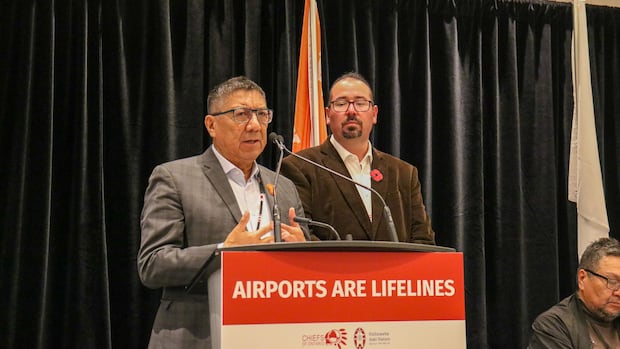
Indigenous leaders in Ontario are urging both the provincial and federal governments to tackle what they describe as an infrastructure crisis affecting remote airports in northern regions.
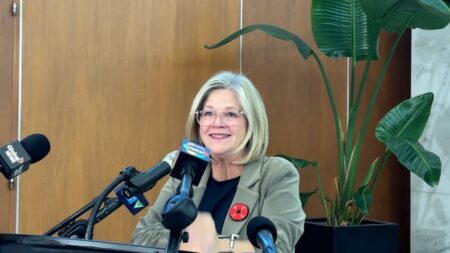
Nishnawbe Aski Nation (NAN) and Chiefs of Ontario (COO) held a joint press conference in Toronto on Wednesday afternoon, coinciding with the launch of a documentary and advocacy initiative regarding this issue.
“We need improved lighting, we need better navigational aids, we need our airstrips lengthened to accommodate larger aircraft,” stated NAN Grand Chief Alvin Fiddler.
“Our runways should be paved so that when a larger plane arrives for community evacuations, it won’t damage the runway, and we require staff to keep these airports running 24/7.”
Ontario’s Ministry of Transportation is responsible for owning and operating the 29 northern airports, with 27 located in remote First Nations.
Based on a comprehensive needs assessment done by NAN last year, fixing infrastructure issues at these airports could cost up to $1.5 billion.
NAN and COO are asking both government levels to:
Commit to providing immediate and long-term funding for infrastructure. Develop a phased plan for improving infrastructure. Conduct an immediate safety audit. Form an ongoing multilateral committee that includes First Nations, related organizations, provincial and federal governments, as well as regional air carriers. Invest in local First Nations employment and capacity building related to aviation.
An aerial shot taken from a plane en route to Eabametoong First Nation, a remote Ojibway community in northwestern Ontario. (Sarah Law/CBC)
Additionally, NAN and COO seek changes to the National Airports Policy that would create an essential service airport standard “that adequately funds the investments required to improve safety and access for remote First Nations,” according to NAN’s news release on Wednesday.
“Our message again to Ontario: we can’t keep meeting with you or sending letters. You need to take action. The same goes for Canada,” Fiddler said. “The legislation you pass regarding transportation doesn’t match what’s needed on the ground in our communities.”
reached out to Ontario’s Ministry of Transportation (MTO), Indigenous Services Canada, and Transport Canada for their thoughts on these calls for action.
Dakota Brasier, director of media relations with MTO, mentioned that the province allocates $27.2 million each year “for airport operations, maintenance, and rehabilitation” at its remote airports.
“Ontario has also set up a forum with Nishnawbe Aski Nation to exchange information about transportation issues affecting NAN member First Nations including MTO-owned remote airports,” Brasier stated. “We look forward to continuing discussions around transportation priorities raised within that forum.”
Representatives from federal departments indicated they are working on responses regarding concerns expressed by First Nation leaders.
Gravel runways require ‘constant repair’
Remote airports play a crucial role in medevac flights, transport services for residents heading toward medical appointments in urban areas as well as emergency evacuations and delivering food along with other necessities stated Ontario Regional Chief Abram Benedict.
NAN and COO argue that years of chronic underfunding have rendered remote airports unable to meet basic safety standards which puts lives at risk.
Bruce Achneepineskum , chief of Marten Falls First Nation , shared about a recent incident where a large plane struck the side of his community’s Ministry of Transportation building. p > br>
His community is currently upgrading its gravel runway but Achneepineskum noted this isn’t sustainable. p > br>
“In our current situation , our airport is 3 ,500 feet when most others across Canada” measure 5 ,000 feet or are paved ,” he said , adding their gravel runway “needs constant repair every year.” p >
An image showcasing Wapekeka First Nation’s airport captured back in September 2023. (Sarah Law/CBC)
Flights can be delayed or even canceled at remote First Nations due factors like bad weather , lack of pilots or planes available. P >
Russell Wesley , chief from Cat Lake First Nation shared how his members missed out on 88 appointments over just one week due cancellations. Many were necessary visits specialists. P >
Ornge air ambulance provides emergency medevacs but faces challenges landing safely on short gravel runways during emergencies. P >
From January 2020 through September 2026 Ornge received around 33 ,000 emergency calls originating from Ontario ‘s remote airports averaging roughly about 13 calls daily. P >
However aircraft couldn’t land safely over 2 ,300 times causing delays for urgent medical care reports Fiddler saying. P />
[a href=https://ontariochronicle. ca/wp-content/uploads/2026/10/1793231580_135_default. jpg]Source link[/a]